7-Day Low-Fat Diet Plan for Fat Loss (With Macros)
If you want to lose fat without starving, overthinking, or following a complicated diet, this 7-day meal plan is a practical starting point. It is built around ordinary food, simple portions, and meals you can repeat for weeks without getting bored.
On this page19 sections
The plan works for one reason: it makes a moderate calorie deficit easy to hold. Nothing here is exotic, and nothing is banned. You will find the full week below, plus the portion guide, the food lists, and the answers to the questions beginners ask most.
Key Takeaways
- Fat loss comes from a calorie deficit, not from a specific food list. This plan simply makes that deficit easier to repeat.
- Protein is the priority nutrient. It protects lean mass and keeps you full, which is what makes a deficit bearable.
- You do not need to count every calorie to start. Hand portions plus a protein anchor at each meal work well for most beginners — but the macro numbers are here if you want them: a typical day lands near 1,770 kcal with about 130 g of protein and 50 g of fat, which is roughly 25–30% of energy from fat.
- Planning beats willpower. Research on behavioural weight-loss programs links more frequent meal planning with greater weight loss.
- Repeat and swap freely. The plan is a template, not a prescription: adjust portions up or down based on results over two to three weeks, not on a single hungry evening.
How This Meal Plan Is Structured
The plan is deliberately plain: three meals and one optional snack a day, built from food sold in any supermarket. Nothing is banned, nothing needs a supplement, and the same plate shape repeats every day so you do not have to make decisions in the evening.
- Breakfast — protein plus fibre (eggs, yogurt or oats), because a breakfast of toast and juice only will not hold you until lunch.
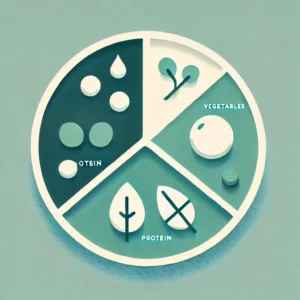
- Lunch — a balanced plate: a palm-sized protein, one cupped hand of carbohydrate, two handfuls of vegetables.
- Dinner — lighter than lunch but still protein-led, with vegetables filling most of the plate.
- Snack (optional) — fruit, nuts or yogurt, useful when the gap between lunch and dinner runs longer than five hours.
Three meals a day is not a rule. Four smaller meals work the same way, and so does moving the snack to mid-afternoon; keep a protein portion at every meal and move the timing to fit your day.
Each day lands in a moderate calorie deficit for most adults, keeps protein high, and includes vegetables and fruit for fibre and micronutrients. If you want the numbers behind it, the next two sections explain them. If you would rather just start, skip ahead to the 7-day plan.
The Numbers: Calories and Macros Behind the Plan
The title promises macros, so here they are. The plan is built for two intake tiers, because a 60 kg woman and a 95 kg man do not need the same plate. Pick the tier that suits your size and activity, then use the portion guide and swap list to fine-tune from there.
- Tier A — around 1,600–1,800 kcal a day: protein 120–140 g, fat 45–55 g, carbohydrate 170–200 g. Suitable for smaller adults, women, and anyone with a lower activity level.
- Tier B — around 2,000–2,200 kcal a day: protein 135–155 g, fat 55–70 g, carbohydrate 220–260 g. Suitable for larger adults, men, and people who train regularly.
- Protein target: 1.6–2.0 g per kg of body weight. In a meta-regression of 87 studies, protein intakes above 1.05 g/kg were associated with 0.60 kg greater retention of fat-free mass during energy restriction, and with 1.21 kg in studies lasting more than 12 weeks (Krieger et al., American Journal of Clinical Nutrition, 2006). More protein helps; it does not need to be extreme.
- Fat target: 25–30% of energy, which is what makes this a low-fat plan in the technical sense rather than just a vague one.
- Carbohydrate: whatever is left after protein and fat. It is not the enemy — it is the part of the plan that fuels training and makes meals satisfying.
Two cautions about these numbers. First, they are targets for a moderate deficit, not a prescription: the right intake is the one that produces roughly 0.5–1% of body weight lost per week while you still feel functional. Second, if you are significantly heavier, older, pregnant, breastfeeding, or managing diabetes, get an individual figure from a clinician or dietitian rather than scaling these.
A Worked Day, With the Numbers
Here is Day 1 with realistic portions, so the macros are not an abstraction. Gram amounts are cooked weight unless stated.
- Breakfast — 529 kcal, 23 g protein, 74 g carbs, 16 g fat: oats 70 g dry (266 kcal), one banana 120 g (107 kcal), two boiled eggs (156 kcal).
- Lunch — 618 kcal, 55 g protein, 66 g carbs, 12 g fat: grilled chicken breast 150 g (248 kcal), cooked rice 200 g (260 kcal), mixed vegetables 200 g (66 kcal), olive oil 5 g for cooking (44 kcal).
- Dinner — 461 kcal, 39 g protein, 29 g carbs, 24 g fat: tuna in water 120 g (139 kcal), olive oil 10 g (88 kcal), salad vegetables 200 g (40 kcal), one slice wholegrain bread 40 g (98 kcal), avocado 60 g (96 kcal).
- Snack — 165 kcal, 15 g protein, 26 g carbs, 1 g fat: low-fat Greek yogurt 150 g (87 kcal) and an apple 150 g (78 kcal).
- Day total — about 1,773 kcal, 133 g protein, 195 g carbs, 51 g fat. That is 30% of energy from protein, 44% from carbohydrate and 26% from fat: a low-fat day, with protein high enough to protect lean mass at roughly 1.9 g/kg for a 70 kg person.
Days 2–7 use the same template with different foods, so they land within roughly 150 kcal of this figure. If you want Tier B, add the four items in the next section.
Moving a Day Up or Down by About 150 kcal
This is the part most plans leave out, and it is the part that decides whether you can actually hold the intake for weeks. Change one item at a time, then wait two weeks before changing anything again.
- To add about 130 kcal: another 100 g of cooked rice, or 15 g of olive oil (one tablespoon).
- To add about 100 kcal: one more slice of wholegrain bread.
- To add about 80 kcal: one more piece of fruit, or 150 g of low-fat yogurt.
- To remove about 130 kcal: halve the rice portion, or drop the cooking oil and use a non-stick pan.
- To remove about 90 kcal: skip the bread at dinner, or halve the avocado.
Adding the larger options all at once turns Day 1 into roughly 2,210 kcal with about 140 g of protein — that is the cheap way to build Tier B without redesigning the week.
What “Low-Fat” Actually Means Here
“Low-fat” is used loosely in diet books, so it is worth being precise. WHO guidance is to limit total fat to 30% of energy intake, shift saturated fat below 10% and industrial trans fat below 1%, and replace saturated fats with unsaturated ones. A day at 1,773 kcal with 51 g of fat sits at 26% of energy — inside that definition — and most of the fat here comes from olive oil, avocado, eggs and fish rather than from fried food.
Three things follow from that:
- Low-fat is not no-fat. Fat carries flavour and fat-soluble vitamins and slows gastric emptying; going far below about 20% of energy tends to make meals less satisfying, which is where most low-fat diets collapse.
- Low-fat does not beat low-carbohydrate. In a network meta-analysis of 121 trials and 21,942 participants, low-fat and low-carbohydrate diets produced similar weight loss at six months (4.37 versus 4.63 kg, both moderate certainty), and both effects shrank by 12 months (Ge et al., BMJ, 2020). A separate meta-analysis of 38 studies in 6,499 adults found low-carbohydrate diets ahead by 1.30 kg at 6–12 months (Chawla et al., Nutrients, 2020) — a small, contested difference that mostly reflects adherence.
- What decides the result is the deficit and whether you can repeat it. That is why the plan is built around ordinary food, fixed structure, and portions you can eyeball.
What actually drives fat loss
Body fat is lost when energy intake stays below energy expenditure for long enough. That is the whole mechanism, and it is why no single food or meal timing trick replaces the deficit. The World Health Organization makes the same point from the public-health side: weight gain follows an energy imbalance between calories consumed and calories expended, and the practical fix is a healthy diet plus regular activity.
What does change with diet quality is how easy or hard the deficit feels. In an inpatient randomised controlled trial published in Cell Metabolism (2019), people ate either an ultra-processed or an unprocessed diet matched for presented calories, sugar, fat, fibre and sodium. Eating the ultra-processed version led to significantly more calories consumed and weight gain, while the unprocessed version led to weight loss. Same macronutrients, different food, different outcome.
That is the logic of this plan: mostly minimally processed food, structured simply enough to repeat.
Protein: the one number worth protecting
A 2015 review in the American Journal of Clinical Nutrition examined the role of protein in weight loss and maintenance. Across shorter controlled feeding studies and longer trials, higher-protein diets were associated with greater weight loss, greater fat-mass loss, better preservation of lean mass, and improved appetite control.
Protein also has the biggest effect on satiety of the three macronutrients, which is exactly what you need when calories are reduced. The International Society of Sports Nutrition position stand on protein and exercise likewise treats adequate protein as central to maintaining muscle when energy intake is restricted.
Practically: put a protein source in every meal. Eggs, yoghurt, chicken, fish, lean beef, tofu, tempeh, beans or lentils all count. If a meal has no obvious protein, it will not keep you full for three hours.
7-Day Meal Plan
Grams are cooked weight unless stated, and the amounts match the worked day above, so Day 1 here and Day 1 there are the same plate. Portion sizes repeat all week: only the food changes.
Day 1
- Breakfast: Oats 70 g dry, 1 banana (about 120 g), 2 boiled eggs
- Lunch: Grilled chicken breast 150 g, cooked rice 200 g, mixed vegetables 200 g, 1 tsp olive oil for cooking
- Dinner: Tuna in water 120 g, salad vegetables 200 g, olive oil 10 g, 1 slice wholegrain bread (40 g), avocado 60 g
- Snack: Greek yogurt 150 g and 1 apple (about 150 g)
Day 2
- Breakfast: Greek yogurt 200 g, mixed berries 100 g, oats 40 g dry
- Lunch: Lean beef strips 150 g stir-fried with mixed vegetables 250 g, cooked rice 150 g, 1 tsp oil
- Dinner: Vegetable soup 400 g with firm tofu 200 g, 1 slice wholegrain bread (40 g)
- Snack: Almonds 25 g
Day 3
- Breakfast: Wholegrain toast 2 slices (80 g), peanut butter 20 g, 1 orange (about 150 g)
- Lunch: Salmon fillet 150 g, potatoes 250 g, broccoli 200 g, 1 tsp olive oil
- Dinner: Chicken and vegetable soup: chicken 150 g, vegetables 250 g
- Snack: Greek yogurt 200 g
Day 4
- Breakfast: Smoothie: 1 banana (120 g), spinach 50 g, protein powder 30 g, milk 200 ml
- Lunch: Grilled firm tofu 200 g, cooked rice 200 g, stir-fried vegetables 200 g, 1 tsp oil
- Dinner: Lean beef salad: beef 120 g, salad vegetables 250 g, olive oil 10 g
- Snack: Mixed nuts 25 g
Day 5
- Breakfast: 3 boiled eggs, fruit bowl 200 g
- Lunch: Chicken teriyaki 150 g, cooked rice 200 g, steamed vegetables 200 g
- Dinner: Shrimp 150 g stir-fried with vegetables 250 g, 1 tsp oil
- Snack: 2 oranges (about 250 g)
Day 6
- Breakfast: High-protein yogurt 200 g, granola 40 g
- Lunch: Beef stew: beef 150 g, vegetables 250 g, potatoes 150 g
- Dinner: Grilled white fish 150 g, green salad 200 g, olive oil 10 g, 1 slice wholegrain bread (40 g)
- Snack: 1 banana (120 g)
Day 7
- Breakfast: Scrambled eggs (3 eggs), wholegrain toast 2 slices (80 g)
- Lunch: Chicken quinoa bowl: chicken 150 g, cooked quinoa 150 g, vegetables 200 g
- Dinner: Vegetable and tofu stir-fry: tofu 200 g, vegetables 250 g, 1 tsp oil
- Snack: Berries 150 g
That is the whole method: protein stays at 150 g of cooked meat or fish (or 200 g tofu, or 3 eggs plus dairy), and everything else moves around it. If one meal leaves you hungry, add protein and vegetables first — not bread, oil or rice — and give it two weeks before changing anything else. Built this way, each day lands near the Day 1 total of about 1,773 kcal; the swap list further down moves a day up or down by roughly 150 kcal without recalculating anything.
Shopping List for the Week
Quantities below cover one person following the plan exactly for seven days. If you cook for two, double everything except the oil and the nuts. Nothing here spoils inside a week, and the fish can come from the freezer.
Protein
- Chicken breast — 600 g (four portions)
- Lean beef — 450 g (stir-fry, salad and stew)
- Salmon fillet — 150 g
- White fish fillet — 150 g
- Shrimp — 150 g
- Canned tuna in water — 1 can (about 120 g drained)
- Firm tofu — 600 g
- Eggs — 12
- Plain low-fat Greek yogurt — 1 kg tub
- Milk — 250 ml
- Protein powder — 1 scoop (30 g), optional
Grains, potatoes and pantry
- Rolled oats — 250 g
- Rice — 300 g dry (about 900 g cooked)
- Quinoa — 60 g dry
- Wholegrain bread — 1 loaf (the plan uses 7 slices)
- Potatoes — 500 g
- Granola — 50 g
- Peanut butter — 1 small jar (20 g used)
- Almonds and mixed nuts — 100 g
- Olive oil — about 100 ml, dressings included
- Vegetable stock or canned tomatoes — for the two soups
Produce
- Bananas — 3 · apples — 1 · oranges — 3
- Mixed berries, fresh or frozen — 250 g
- Spinach — 100 g · salad leaves — 400 g
- Mixed vegetables, fresh or frozen — about 2.5 kg over the week: broccoli 1 head, carrots, peppers, green beans, onions
- Avocado — 1
If the total looks expensive, two changes cut it most: buy frozen fish and frozen mixed vegetables (cheaper per portion and no waste), and use eggs or canned tuna in place of two meat portions. The food choices here are ordinary on purpose; if you want the reasoning behind them, see best foods for fat loss and nutrition for fat loss.
A scale is useful for the first week only — after that, the palm and hand portions in the next section are accurate enough for most people.
Simple Portion Guide
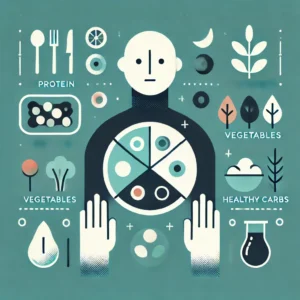
- Protein: Palm-sized portion
- Carbohydrates: One cupped hand
- Vegetables: Two handfuls
- Fats: Thumb-sized amount
How to use it: build each plate with one protein portion first, then add the carbohydrate, then fill the rest with vegetables, then finish with the fat. If you are still hungry two hours after a meal, the usual cause is too little protein or too few vegetables, not too few calories.
If you want a more precise method, a kitchen scale for one week teaches you what these portions look like. After that, most people can eyeball them well enough. For a count-free approach in more detail, see how to control portions without counting calories.
Foods to Focus On

- Lean meats (chicken, beef, fish)
- Eggs
- Tofu, tempeh, beans
- Vegetables of all kinds
- Whole grains (rice, oats, potatoes)
- Fruits (banana, berries, apples)
- Healthy fats (olive oil, nuts, avocado)
These foods are not magic. They are simply filling, nutrient-dense, and hard to overeat, which makes the deficit easier to hold. The WHO healthy diet guidance points in the same direction: plenty of vegetables and fruit, whole grains, limited free sugars and saturated fat.
Foods to Limit
- Sugary drinks
- Deep-fried foods
- Processed snacks
- High-sugar desserts
- High-fat fast food
"Limit" means less often and smaller portions, not never. The ultra-processed diet trial above is the reason these foods sit on this list: they are easy to eat in large amounts without noticing, so they quietly undo the deficit.
Why meal planning works better than willpower
Planning is the part of this plan that does the heavy lifting. In a 40-week worksite behavioural weight-loss program (139 participants, published in Annals of Behavioral Medicine, 2021), people who planned their meals more often on average lost more weight, and meal planning frequency kept increasing as the program went on. Exercise planning, notably, did not show the same relationship.
That matches everyday experience. Decisions made when you are hungry, tired, or in a hurry usually go badly. Decisions made on Sunday evening with a shopping list go well. Cook two or three portions at a time, keep a protein ready in the fridge, and the plan survives a busy Wednesday.
How to adapt the plan to your life
- Swap within the same category. Any lean protein can replace any other protein; any whole grain can replace rice; any vegetable can replace any other vegetable.
- Vegetarian. Replace meat and fish with tofu, tempeh, beans, lentils, eggs and dairy, and keep the protein portion at every meal.
- Budget. Eggs, canned tuna, beans, lentils, oats, frozen vegetables and seasonal fruit give the same structure for less money.
- Eating out. Choose a grilled or roasted protein, ask for the sauce on the side, and skip the sugary drink. One meal out does not break a week.
- Training days. Put the larger carbohydrate portion on the days you train, and keep protein steady every day.
If eating out is your weak point, the article on eating out while losing fat covers that scenario in detail.
Tips to Stay on Track

- Prep ingredients ahead of time
- Drink a glass of water before meals
- Get enough sleep to reduce cravings
- Don't skip meals — it leads to overeating
- Keep snacks healthy and simple
Sleep deserves its own mention here, because short sleep makes appetite regulation measurably worse: in a controlled study of healthy young men, restricting sleep for two nights lowered leptin, raised ghrelin and increased hunger and appetite, especially for calorie-dense, high-carbohydrate foods. If you are following the plan perfectly and still ravenous, check your sleep before cutting anything else.
What a 7-Day Plan Can and Cannot Do
A week is a useful unit for shopping, cooking and building a habit. It is not a duration that changes body composition on its own, and the trials are fairly blunt about that.
- The diet you choose matters less than whether you hold it. Across 121 trials and 21,942 participants, low-fat and low-carbohydrate diets both produced about 4.4–4.6 kg of loss at six months and both lost ground by 12 months (Ge et al., BMJ, 2020). Nothing in that dataset suggests a specific seven-day menu is superior to another.
- Planning is associated with better diets, in observational data. Among 40,554 French adults, people who planned meals ahead had higher adherence to national nutrition guidelines (OR 1.13, 95% CI 1.07–1.20) and greater food variety (OR 1.25, 95% CI 1.18–1.32); women who planned had lower odds of being overweight (OR 0.92) or obese (OR 0.79) (Ducrot et al., International Journal of Behavioral Nutrition and Physical Activity, 2017). Cross-sectional, so it cannot prove that planning caused the difference.
- Taking planned breaks does not ruin the effort. In a meta-analysis of 9 intervention arms (796 participants), pausing an energy-restricted programme for defined periods gave the same weight loss as continuous restriction at a median 26 weeks (−7.09 vs −7.00 kg) and at 52 weeks (−6.91 vs −6.19 kg), with no difference in dropout (Wren et al., Obesity, 2024). If a birthday or holiday interrupts your week, restart rather than abandon.
- Structure-only tools fade. Portion-control plates produced −3.68 kg at three months across 14 RCTs (1,762 participants) but the effect shrank to −1.77 kg at six months, with a confidence interval that crossed zero (Zhang et al., BMC Primary Care, 2026). Tools help early; what keeps the weight off is the routine behind them.
Read together, they support one honest claim: this plan works because it hands you a repeatable structure inside a moderate deficit with enough protein — not because seven days is a magic length, and not because low-fat is uniquely effective.
Frequently asked questions
How many calories should I eat on this plan?
Use the two tiers above rather than guessing: about 1,600–1,800 kcal for smaller or less active adults, and 2,000–2,200 kcal for larger adults or regular trainees. Day 1 in this plan works out at about 1,773 kcal with 133 g of protein. If you want a personal figure, work from your maintenance intake and subtract a modest amount rather than a large one — see calorie deficit for beginners.
Is this plan actually low-fat?
Yes, in the technical sense. WHO guidance caps total fat at 30% of energy, with saturated fat under 10% and industrial trans fat under 1%; Day 1 here provides 51 g of fat at 1,773 kcal, which is about 26% of energy, mostly from olive oil, avocado, eggs and fish. It is not a very-low-fat plan — going far below 20% of energy usually makes meals less satisfying and harder to sustain.
Can I lose weight in 7 days on this plan?
You can lose weight on the scale, but much of the first week's change is water and glycogen rather than fat, especially if you cut carbohydrate and salt at the same time. Expect roughly 0.5–1% of body weight per week if the deficit is right; anyone promising 5 kg of fat in seven days is describing dehydration. Treat the first week as a setup week and judge results over four to six weeks.
Can I repeat this 7-day plan every week?
Yes. It is designed to be flexible, repeatable and easy to maintain. You can swap ingredients, repeat favourite meals, or change portion sizes as your needs change. Familiarity is usually an advantage: no decisions, no surprises.
Do I have to eat exactly at these times?
No. Meal timing is a personal preference. What matters is the total intake across the day and the protein anchor at each meal. Three meals, four meals, or a later dinner all work if the deficit holds.
What if I don't like some of these foods?
Replace them. The plan is a template built from categories: protein, whole carbohydrates, vegetables, fruit, healthy fats. As long as you keep one from each category, you can rebuild any day with foods you actually enjoy.
How fast will I lose fat on this plan?
Rate depends on your starting weight, your deficit and how consistently you follow it. A slow, steady rate is easier to maintain than a fast one, which is why this plan favours a moderate deficit over an aggressive one.
Can I use this plan if I train at the gym?
Yes, though you may want a larger carbohydrate portion around training sessions and a protein source afterwards. Strength training helps preserve muscle while you lose fat, so keep it in the week. See strength training for fat loss.
Start Eating Smarter Today
Fat loss becomes much easier when your meals are simple, balanced, and satisfying. Use this 7-day plan as your foundation — and build healthier habits day by day.
Keep reading
- The complete beginner's fat loss guide
- Healthy snacks for fat loss
- Drinking water for fat loss
- Smart eating habits that make fat loss easier
- Beginner home workout (no equipment)
- The 10-minute fat-burning workout
Sources
- World Health Organization. Healthy diet — fact sheet (vegetables, fruit, whole grains; limited free sugars and saturated fat).
- World Health Organization. Obesity and overweight — fact sheet (energy imbalance between calories consumed and expended).
- NHS. The Eatwell Guide (UK food-based guidance for a balanced diet).
- NHS. How to eat a balanced diet.
- Leidy HJ et al. The role of protein in weight loss and maintenance. American Journal of Clinical Nutrition, 2015.
- Jäger R et al. International Society of Sports Nutrition Position Stand: protein and exercise. Journal of the International Society of Sports Nutrition, 2017.
- Hall KD et al. Ultra-Processed Diets Cause Excess Calorie Intake and Weight Gain: An Inpatient Randomized Controlled Trial of Ad Libitum Food Intake. Cell Metabolism, 2019.
- Hayes JF et al. Greater Average Meal Planning Frequency Predicts Greater Weight Loss Outcomes in a Worksite-Based Behavioral Weight Loss Program. Annals of Behavioral Medicine, 2021.
- Spiegel K et al. Sleep curtailment in healthy young men is associated with decreased leptin levels, elevated ghrelin levels, and increased hunger and appetite. Annals of Internal Medicine, 2004.
- NHS. Healthy weight — Live Well.
- Ge L et al. Comparison of dietary macronutrient patterns of 14 popular named dietary programmes for weight and cardiovascular risk factor reduction in adults: systematic review and network meta-analysis of randomised trials. BMJ, 2020. (121 trials, 21,942 participants: low-fat 4.37 kg and low-carbohydrate 4.63 kg at six months, both moderate certainty; effects attenuated by 12 months.)
- Krieger JW et al. Effects of variation in protein and carbohydrate intake on body mass and composition during energy restriction: a meta-regression. American Journal of Clinical Nutrition, 2006. (Protein above 1.05 g/kg associated with 0.60 kg greater fat-free mass retention, 1.21 kg in studies longer than 12 weeks.)
- Ducrot P et al. Meal planning is associated with food variety, diet quality and body weight status in a large sample of French adults. International Journal of Behavioral Nutrition and Physical Activity, 2017. (n = 40,554; meal planners OR 1.13 for higher diet quality, OR 1.25 for food variety; women OR 0.92 overweight, OR 0.79 obesity — cross-sectional.)
- Wren GM et al. Effect of planned pauses versus continuous energy restriction on weight loss and attrition: a systematic review. Obesity, 2024. (9 intervention arms, 796 participants: −7.09 vs −7.00 kg at median 26 weeks; −6.91 vs −6.19 kg at 52 weeks; no difference in attrition.)
- Zhang X et al. Time-dependent metabolic effects of portion-control plate interventions in adults with chronic diseases: a systematic review and meta-analysis. BMC Primary Care, 2026. (14 RCTs, 1,762 participants: −3.68 kg at 3 months; −1.77 kg at 6 months, 95% CI −4.46 to 0.92.)
- Chawla S et al. The Effect of Low-Fat and Low-Carbohydrate Diets on Weight Loss and Lipid Levels: A Systematic Review and Meta-Analysis. Nutrients, 2020. (38 studies, 6,499 adults: low-carbohydrate ahead by 1.30 kg at 6–12 months, 95% CI −2.02 to −0.57.)
This article is general information for healthy adults, not medical advice, and it is not a personalised meal plan. If you are pregnant, breastfeeding, managing diabetes or another medical condition, have a history of an eating disorder, or you are taking medication that affects appetite or blood sugar, speak to a qualified clinician or dietitian before changing how you eat.