Meal Prep for Fat Loss: A Weekly System That Sticks
Most fat loss plans fail on a Tuesday evening, not on a spreadsheet. The plan says chicken and vegetables; the reality is that you get home at 19:40, the fridge contains half a cucumber and a jar of olives, and the fastest option is whatever can be ordered from a phone. Nothing about that evening is a character flaw. It is a design problem: the decision was made at the worst possible moment, by a hungry person with no time.
Meal prep is an attempt to move that decision earlier. Cook once, portion it out, and let the version of you who is tired and hungry simply open the fridge. It sounds like a small logistical trick, and in a sense it is — but the research on meal planning, home cooking and food preparation keeps pointing at the same quiet pattern: people who plan and cook ahead tend to eat better, and in large cohort studies they gain less weight over the years. This guide looks at what that evidence actually shows (including where it is weaker than the internet suggests), then walks through a prep system that fits a real working week: what to cook, how much to put in each container, how long it keeps, and how to avoid the two failure modes — an empty fridge on Wednesday and a fridge full of food you cannot face eating by Friday.
Updated 23 October 2026: written against the current peer-reviewed evidence, with NHS and WHO guidance checked in October 2026 and listed at the end.
Key Takeaways
- In a French cohort of 40,554 adults, people who planned meals ahead were more likely to have a higher diet-quality score (OR 1.13, 95% CI 1.07–1.20) and greater food variety (OR 1.25), and women who planned had lower odds of being overweight (OR 0.92) or obese (OR 0.79). This is association, not proof of cause.
- US national data (n = 9,569) found that adults who cooked dinner at home 6–7 nights a week ate about 573 kJ (137 kcal) less per day than those who cooked 0–1 nights, plus less fat and less sugar — regardless of whether they were trying to lose weight.
- In two Harvard cohorts (99,727 adults, 2.1 million person-years), eating 11–14 home-prepared meals a week was associated with 14% lower type 2 diabetes risk, and with 0.34 kg (women) to 1.23 kg (men) less weight gain over the first 8 years. The effect on diabetes was largely explained by body weight.
- The strongest causal evidence is indirect: a 2026 randomised trial of a 12-session cooking programme produced a net 4.30% body weight loss at 12 months versus control (p = 0.021), but with only 50 participants.
- A systematic review of 34 cooking-intervention studies found mostly positive changes in diet and cooking confidence, but less than half had a control group and few followed people up — so treat cooking-programme results as promising, not settled.
- Portion size is the lever that reliably changes how much you eat: in a pooled analysis of three randomised trials, reducing portion size lowered meal energy intake for most participants, with no subgroup that was consistently immune.
- Container and plate size is not the magic trick it is sold as: a 2024 randomised crossover trial found smaller versus larger breakfast dishware made no significant difference to how much people ate (394.8 vs 394.4 kcal, p = 0.98).
- The realistic target is not a photogenic grid of 21 identical boxes. It is one 60–90 minute session that removes three or four decisions from your week and keeps food safe to eat.
What the evidence on meal planning and home cooking actually shows
Meal prep sits at the intersection of three behaviours that researchers measure separately: planning what you will eat, cooking at home, and preparing food in advance. Each has its own literature, and each has the same weakness — most of it is observational. That does not make it useless. It means the honest conclusion is "people who do this tend to be healthier, and there is some trial evidence that teaching people to cook helps", not "prepping containers burns fat".
Planning ahead is linked to better diet quality — and lower body weight
The largest study on the subject used 40,554 participants of the French NutriNet-Santé cohort. About 57% said they planned meals at least occasionally. Compared with people who never planned, planners were more likely to sit in the top quartile of diet quality (odds ratio 1.13, 95% CI 1.07–1.20) and of overall food variety (OR 1.25, 95% CI 1.18–1.32). In women, planning was associated with lower odds of being overweight (OR 0.92, 95% CI 0.87–0.98) and obese (OR 0.79, 95% CI 0.73–0.86); in men the association was significant for obesity only (OR 0.81, 95% CI 0.69–0.94). The authors were explicit that causality cannot be inferred — people who plan may simply be people who already cook, sleep, and shop differently. The effect sizes are also modest. A 13% shift in the odds of a high diet-quality score is real but not transformative on its own.
What makes the finding useful is the mechanism it implies. Planning ahead is a proxy for removing spontaneous food decisions. If most of your eating is decided in advance, the number of moments where you can accidentally eat 700 extra calories drops sharply. That is a structural change, and structural changes survive bad days better than willpower does.
People who cook dinner most nights eat less, not more
Using 2007–2010 US national survey data (n = 9,569 adults), Wolfson and Bleich compared households that cooked dinner 0–1 times a week with those that cooked 6–7 times. The low-cooking group averaged 9,627 kJ (about 2,301 kcal) a day, 86 g of fat and 135 g of sugar. The high-cooking group averaged 9,054 kJ (about 2,164 kcal), 81 g of fat and 119 g of sugar. The differences were statistically significant and consistent across subgroups, and — this is the part worth remembering — they held whether or not the person was trying to lose weight. Home cooking was not a diet; it was simply a different default.
The gap is about 137 kcal a day. On its own that is not dramatic. Over a year, if it were fully realised and maintained, it is the kind of difference that separates slow drift from slow loss. It is also a gap you could close or widen entirely with what goes into the pan — a home-cooked meal of pasta, cream and cheese is still pasta, cream and cheese.
The long-term cohort data: less weight gain, lower diabetes risk
The most striking numbers come from two Harvard cohorts following 58,051 women and 41,676 men for decades — 2.1 million person-years and 9,356 cases of type 2 diabetes. Eating 11–14 home-prepared meals a week, compared with 0–6, was associated with a hazard ratio of 0.86 (95% CI 0.81–0.91) for type 2 diabetes. Participants eating 11–14 home-prepared meals a week also gained less weight in the first 8 years of follow-up: 0.34 kg less in women and 1.23 kg less in men. Among people who were not obese at baseline, the most frequent home cooks had 14% lower risk of becoming obese (HR 0.86, 95% CI 0.82–0.91).
The authors then did the test that matters: adjusting for body mass index during follow-up weakened the diabetes association to a hazard ratio of 0.95 (95% CI 0.89–1.01, p = 0.13). In other words, most of the apparent protection ran through weight. Home cooking was not doing something magical to blood glucose; it was helping people weigh less, and weighing less reduced risk. The study also had two clear limitations the authors stated themselves: it could not see which individual foods made up those meals, and the participants were health professionals of relatively homogeneous socioeconomic status. A nurse who cooks at home and a shift worker who cannot are not interchangeable, and no cohort fully solves that.
The randomised evidence is thinner — and smaller
Randomised trials of meal prep as a standalone behaviour barely exist. The closest thing is culinary medicine: teaching people to cook and eat in a structured programme, then measuring weight. A 2026 bi-centre randomised controlled trial enrolled 50 adults with a BMI of 27.5–35 kg/m² and compared dietary counselling plus twelve 30-minute cooking sessions against counselling plus written resources only. At 3 months the intervention group had lost 3.23% of body weight; at 6 months, 4.2%; at 12 months, 4.02%, a net difference of 4.30 percentage points versus control (95% CI −0.69 to −7.92, p = 0.021). Reported calorie intake fell by 452 kcal at 6 months, a net difference of −390 kcal. That is a genuinely encouraging result — and it comes from fifty people, in a programme with twelve sessions and professional instructors. It is proof of principle, not proof that a Sunday afternoon of batch cooking will do the same.
A systematic review of 34 cooking and home-food-preparation interventions in adults reached a similar place from the other direction. Most studies reported improvements in dietary behaviour and in cooking confidence and knowledge. But fewer than half included a control group, few followed participants after the intervention ended, instruments were often unvalidated, and samples were small and convenient. The review's own conclusion was that intervention design and assessment need to be strengthened. When you see a headline claiming cooking classes cause weight loss, this is the evidence base behind it: promising, mostly uncontrolled, and rarely followed up.
Why prepping works for fat loss, mechanically
Strip away the branding and meal prep helps for four unglamorous reasons.
1. It removes decisions, not food. Fat loss rarely fails because someone did not know that vegetables are healthy. It fails because at 21:00 the only available options are delivery, cereal, or effort. Prepped food changes the default from "order something" to "reheat something", and defaults win far more often than intentions.
2. It makes the portion decision once instead of seven times. If you portion into containers when you are full and calm, the amount is fixed before hunger negotiates. This is where the portion-size evidence becomes practical: in a pooled analysis of three randomised trials (111 adults), reducing meal portion size decreased energy intake for the majority of participants, and the authors found no participant characteristic that reliably protected people from eating less when portions shrank. There was also little evidence of a subgroup whose intake resisted portion reduction — the often-repeated idea that "some people just don't respond" did not hold up.
3. It shifts the balance toward less processed food. A secondary analysis of the POUNDS Lost trial (356 participants) found that replacing 10% of daily calories from ultra-processed foods with minimally processed foods and culinary ingredients was associated with slightly greater 6-month weight loss, body-fat and trunk-fat reduction. The effect was modest, and the confidence intervals were wide, but the direction is consistent with the cooking literature. When you cook a batch of food from raw ingredients, the ultra-processed share of your week tends to fall as a side effect rather than as a rule you have to police.
4. It makes the week's food visible. A fridge with five labelled containers is a form of feedback. You can see whether you have eaten the protein, whether the vegetables are still there, and whether you need to shop. That visibility is the same reason food diaries work, without the daily effort of writing everything down.
The 75-minute weekly session
The version of meal prep that survives contact with real life is not a grid of 21 identical meals. It is a single session that produces components, not finished dishes — because components can be recombined, and recombinations are what stop you from hating the food by Thursday.
Step 1 — Decide three dinners, not seven. Pick three dinners you genuinely like and can cook in under 30 minutes each. You will eat each one twice, and the seventh night stays flexible for leftovers, eating out, or something someone else cooks. Writing down three meals takes two minutes and eliminates the entire "what's for dinner" conversation for the week.
Step 2 — Shop once, from a list built backwards. Write the list from the three dinners, not from the supermarket's layout. If two dinners use spinach, buy one bag and plan to use it early in the week. This is where most food waste is created and prevented: buying for recipes rather than for optimism.
Step 3 — Cook the protein in one batch, plainly. Two kilos of chicken thighs, a tray of salmon, a pot of lentils, or a block of tofu — seasoned but not sauced. Plain protein is the most reusable thing in the fridge: it can become a stir-fry, a salad, a wrap, or a bowl depending on what you add later. Sauced protein can only be one meal.
Step 4 — Roast vegetables on two trays while the protein cooks. One tray of sturdy vegetables (carrots, peppers, onions, courgette) and one of quick-cooking vegetables (broccoli, green beans). Roasting is hands-off, and oven time is free time. Keep the seasoning neutral — oil, salt, pepper, maybe cumin or paprika — so the vegetables can go with anything.
Step 5 — Cook one grain and one starchy base. Rice, potatoes, couscous, or pasta. Cook more than you think you need; cooled rice and roasted potatoes reheat well and form the base of most bowls.
Step 6 — Prepare one "flavour" element and one "fresh" element. A yoghurt-and-herb sauce, a chilli-and-lime dressing, a jar of pickled onions, or a tray of roasted garlic. Then something raw and crunchy: shredded cabbage, cucumber, cherry tomatoes, herbs. These two elements are the difference between "sad container" and food you look forward to, and they take ten minutes.
Step 7 — Portion what you will eat in three days, freeze or leave the rest. This is the step people skip, and it is the one that matters most for both calories and food safety. Portioning on Sunday while you are full is easier and more accurate than portioning on Wednesday while you are hungry.
How much goes in each container
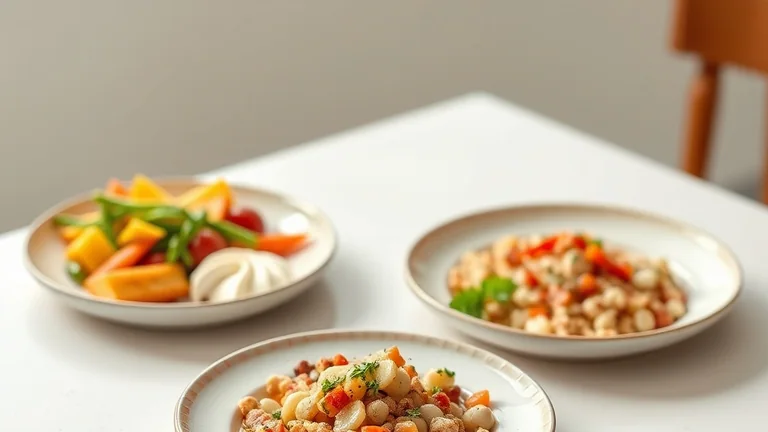
The honest answer is that the container does not control anything; the amount you put in it does. A 2024 randomised crossover trial tested the popular claim that smaller dishware reduces intake: 50 women ate breakfast from smaller or larger dishware on two separate days, with total daily intake measured. Breakfast intake was essentially identical (394.8 kcal smaller vs 394.4 kcal larger, p = 0.98), post-breakfast intake was somewhat higher after the larger dishware but not significantly so (1,974.6 vs 2,077.5 kcal, p = 0.06), and total daily intake, hunger and fullness did not differ. The authors concluded that earlier studies may have overestimated the promise of dishware size, and that other parts of the food environment should be prioritised.
So do not buy smaller plates and expect chemistry. What does appear to work is reducing the amount served. In the pooled trial analysis, meals reduced to about 75% and about 50% of a normal portion produced lower energy intake in most participants, without a compensatory increase later in the day that fully cancelled the difference.
A workable container rule for most adults, without weighing anything:
- Protein first: a palm-sized portion per meal — roughly 25–35 g of protein, which is in the range that keeps hunger down and protects muscle during a deficit. If you are training hard or are larger, take two palms.
- Vegetables to fill the volume: half the container. This is the cheapest way to make a meal look and feel substantial without adding many calories.
- Starch by appetite and training load: a cupped handful on rest days, closer to two on heavy training days. Rice, potatoes, bread and pasta are not the enemy; the amount is the variable.
- Fat as a measured addition, not a base: a thumb of oil, a small handful of nuts, a quarter avocado. Fats are calorie-dense and easy to pour past the point of usefulness.
If you want the arithmetic instead of the hand measurements, the practical route is to estimate your maintenance calories once, subtract a moderate deficit, and divide by the number of meals you actually eat. For a fuller explanation of the deficit itself, see calorie deficit for beginners; for why protein deserves its own line item, see protein intake for body recomposition.
Food safety: the part of meal prep that goes wrong quietly
Cooking five days of food on Sunday is a small food-safety experiment, and the failure mode is not dramatic — it is a mediocre week with an upset stomach, or worse if you are pregnant, older, or immunocompromised. The NHS lists the main routes to food poisoning as food that is not cooked or reheated thoroughly, food that is not stored correctly, food left out for too long, and food handled by someone who is ill or has not washed their hands. All four are controllable in a home prep session.
A nationally representative Canadian survey published in 2026 shows how common the gaps are: 8.4% of men and 5.6% of women said they refrigerated leftovers more than six hours after cooking, about 30% said they always rinse raw meat or poultry before cooking, and 73.6% judged whether meat was done by looking at it rather than using a thermometer. None of those behaviours is rare, and all of them are avoidable.
The practical version, in five rules:
- Cool fast, refrigerate promptly. Do not leave a large pot on the hob overnight. Split it into shallow containers so it cools quickly, and get it into the fridge rather than leaving it on the counter through the evening.
- Reheat until steaming hot all the way through, not until it is warm at the edges. Stir mid-way if the container is deep.
- Reheat once. If you are not going to finish a portion, take out what you need rather than reheating the whole container again.
- Keep raw and cooked separate — separate boards, separate containers, raw meat at the bottom of the fridge.
- Do not stretch fish, rice or shellfish as far as chicken. Rice in particular is a well-known culprit when it is cooled slowly and kept too long; freeze what you will not eat within a couple of days.
A simple schedule that avoids both waste and risk: cook on Sunday, eat fresh portions Sunday to Tuesday, freeze Wednesday to Friday on Sunday night, and defrost in the fridge the night before. Nothing sits in the fridge for five days, and nothing is thrown away because it turned.
The five mistakes that make people quit
1. Prepping 21 identical meals
It looks efficient and it is the fastest route to ordering takeaway by Thursday. Monotony is not a moral test. Prep components, not finished meals, and keep two or three sauces or dressings in the fridge to change the same ingredients into different dinners.
2. Spending four hours on Sunday
A four-hour session is a one-week experiment. A 60–90 minute session with the oven doing most of the work is a habit. If the first attempt takes longer, simplify the menu rather than clearing more of your Sunday.
3. Cooking only "diet food"
If none of the containers contains something you actually want to eat, the plan has already failed. Fat loss does not require plain chicken and steamed broccoli; it requires a calorie deficit you can sustain. Food you dread is a deficit you will abandon.
4. Forgetting the weekend
Many people prep Monday to Friday perfectly and then undo the week in two days of unstructured eating. The fix is not to prep the weekend like a workday; it is to keep one anchor — a planned breakfast, or a batch of something in the freezer — so Saturday does not start from zero. For more on that specific pattern, see weekend fat loss.
5. Treating a missed week as a failure
Some weeks will not have a prep session. The useful response is to lower the bar rather than abandon the system: cook one protein and one tray of vegetables, or buy pre-cut vegetables and a rotisserie chicken and portion those. Prep is a tool for making the default better, not a standard you have to meet.
Does meal prep save money and time? A cautious answer
The claim that meal prep saves money is intuitive and mostly untested in the literature reviewed here. What the data does support is a shift in where calories come from: home-prepared meals are associated with lower daily energy, fat and sugar intake, and cooking at home is associated with less ultra-processed food in the diet. Whether your weekly shop is cheaper than your weekly delivery orders depends entirely on what you buy — a batch of lentils and a batch of salmon are both "meal prep".
On time, the honest accounting is that prep moves time rather than removing it. You spend 75 minutes on Sunday to save roughly 20–30 minutes on three or four weeknights. The gain is not the total minutes; it is that the minutes happen when you have energy, and the weeknights happen when you do not.
A realistic week, assembled from components
With one batch of protein, two trays of vegetables, one grain, one sauce and one crunchy element, a week can look like this without any of it being a separate recipe:
- Monday: protein + grain + roasted vegetables + yoghurt-herb sauce.
- Tuesday: the same components in a bowl with shredded cabbage, lime and chilli.
- Wednesday: protein and vegetables folded into a wrap or an omelette with a little cheese.
- Thursday: grain-based salad with the raw crunchy element, olive oil and vinegar.
- Friday: whatever is left, stir-fried with garlic and soy, or eaten out with the week's calories in mind.
- Saturday and Sunday: one planned meal, one flexible meal, and no guilt about either.
This is not a meal plan in the sense of a prescribed menu with exact calories. It is a structure that makes a decent choice the easy one, which is what the planning literature is really describing. If you want a fully specified menu instead, the 7-day fat loss meal plan works as a starting template — but the structure above is what makes a template survivable.
Frequently asked questions
How many days of food can I prep at once?
Three days in the fridge is a sensible ceiling for cooked food you intend to reheat; freeze the rest on the day you cook it. The limit is not a calorie issue but a food-safety one, and it is far easier to freeze half on Sunday than to gamble on Friday.
Do I need to count calories to make meal prep work?
No. Counting is one way to guarantee a deficit; portion structure is another. If you portion protein, vegetables, starch and fat consistently, you have effectively set the calories without logging them. Counting becomes useful mainly when progress stalls and you need to find where the extra energy is coming from.
Is meal prep cheaper than cooking fresh every night?
It can be, mainly because it reduces waste and delivery orders, but the evidence here is thin and it depends on ingredients. Batch cooking lentils, beans, eggs and seasonal vegetables is cheap; batch cooking salmon and steak is not. The measurable benefit in the research is dietary quality, not spending.
What if I hate eating the same food twice?
Prep components rather than meals, and cook two proteins instead of one. The same roast chicken can be a bowl on Monday, a salad on Tuesday and a soup on Wednesday if the sauce and the vegetables change. Variety in the research is measured across the whole diet, and it is compatible with a small number of base ingredients.
Does meal prep work if I have a family?
The evidence on home food preparation and diet quality includes households, and the practical adjustment is to prep shared components and let people assemble their own plates. That also solves the portion problem: everyone serves themselves from the same base, and the person managing their weight simply takes more vegetables and less starch.
Sources
Peer-reviewed evidence
- Ducrot P, Méjean C, Aroumougame V, et al. Meal planning is associated with food variety, diet quality and body weight status in a large sample of French adults. International Journal of Behavioral Nutrition and Physical Activity, 2017 (40,554 adults; 57% planned at least occasionally; diet quality OR 1.13, food variety OR 1.25; overweight OR 0.92 and obesity OR 0.79 in women; cross-sectional, no causality).
- Wolfson JA, Bleich SN. Is cooking at home associated with better diet quality or weight-loss intention? Public Health Nutrition, 2015 (NHANES 2007–2010, n = 9,569; cooking dinner 6–7 vs 0–1 times a week: 9,054 vs 9,627 kJ/day, 81 vs 86 g fat, 119 vs 135 g sugar; associations held regardless of weight-loss intention).
- Zong G, Eisenberg DM, Hu FB, Sun Q. Consumption of meals prepared at home and risk of type 2 diabetes: an analysis of two prospective cohort studies. PLoS Medicine, 2016 (99,727 adults, 2.1 million person-years, 9,356 diabetes cases; 11–14 vs 0–6 home-prepared meals/week HR 0.86, 95% CI 0.81–0.91; less weight gain by 0.34 kg in women and 1.23 kg in men over 8 years; association attenuated to HR 0.95 after adjusting for BMI; limited to health professionals).
- Polak R, Budd MA, Finkelstein A, et al. One-year weight loss following a remote culinary medicine program: a bi-center randomized controlled trial. Obesity, 2026 (n = 50, BMI 27.5–35; 12 cooking sessions; 12-month weight change −4.02% in the intervention group, net difference −4.30 percentage points, 95% CI −0.69 to −7.92, p = 0.021; calorie intake −452 kcal at 6 months; small sample).
- Reicks M, Kocher M, Reeder J. Impact of cooking and home food preparation interventions among adults: a systematic review (2011–2016). Journal of Nutrition Education and Behavior, 2018 (34 studies; mostly positive dietary and cooking-confidence outcomes; fewer than half controlled, limited follow-up, often unvalidated measures).
- Robinson E, Haynes A. Individual differences and moderating participant characteristics in the effect of reducing portion size on meal energy intake: pooled analysis of three randomized controlled trials. Appetite, 2021 (111 adults; reducing portion size lowered meal energy intake for most participants; no characteristic reliably moderated the effect).
- Langfield T, Clarke K, Sadab AA, Jones A, Robinson E. Impact of dishware size on energy intake in adult females: a randomized control trial examining effects on within-meal and post-meal energy intake. Appetite, 2024 (n = 50; smaller vs larger dishware: 394.8 vs 394.4 kcal at breakfast, p = 0.98; no significant effect on daily intake; earlier claims for dishware size may be overstated).
- Yao Q, de Araujo CD, Juul F, et al. Isocaloric replacement of ultraprocessed foods was associated with greater weight loss in the POUNDS Lost trial. Obesity, 2024 (356 participants; replacing 10% of energy from ultra-processed with minimally processed foods associated with greater 6-month weight and fat loss; modest effect, wide intervals).
- Yáñez-Sepúlveda R, López-Moreno M, Miño C, et al. Home food preparation involvement and ultra-processed food consumption in adolescents: the EHDLA study. International Journal of Food Sciences and Nutrition, 2026 (847 adolescents; helping prepare meals ≥3 times/week associated with 3.52 fewer servings of ultra-processed food per week; cross-sectional, adolescent sample).
- Sy M, Thomas MK, Nesbitt A, Thaivalappil A, Young I. Food safety knowledge and behaviors of Canadians: Foodbook 2.0. Journal of Food Protection, 2026 (8.4% of men and 5.6% of women refrigerated leftovers more than six hours after cooking; 30.0% always rinsed raw meat or poultry; 73.6% judged doneness visually).
Authority guidance (links checked October 2026)
- NHS. Food poisoning (main routes: food not cooked or reheated thoroughly, not stored correctly, left out too long, or handled by someone who is ill; symptoms usually resolve within a week).
- NHS. How to eat a balanced diet (proportions of the main food groups, fibre and fluid guidance for adults).
- NHS. The Eatwell Guide (what a balanced plate looks like across a week, including starchy carbohydrates, beans, pulses, fish, eggs, meat and alternatives).
- WHO. Healthy diet fact sheet (at least 400 g of fruit and vegetables a day, at least 25 g of naturally occurring dietary fibre a day, and limiting free sugars and salt).
Keep reading
- 7-day fat loss meal plan
- Control portions without counting calories
- Best foods for fat loss
- Protein intake for body recomposition
- Fibre for fat loss
- Calorie deficit for beginners
- Healthy snacks for fat loss
- Eating out while losing fat
- Weekend fat loss
- Smart eating habits
- Habit stacking for fat loss
- Nutrition for fat loss
This article is general information for healthy adults and is not medical advice. Energy needs, protein requirements and portion sizes differ between people, and the guidance changes for anyone who is pregnant, takes regular medication, or manages a condition such as diabetes, kidney disease or a history of disordered eating. If any of that applies to you, speak to a qualified dietitian or clinician before restructuring how you eat. Food-safety guidance also varies by country; follow your local authority if it differs from the NHS advice summarised here. This site does not sell meal plans, containers or supplements.