Weekend Fat Loss: How to Stay on Track Without Obsession
Many people hold their diet together from Monday to Friday, then watch it come apart on Saturday. Social meals, eating out, a slower schedule, and the feeling that the week has been earned all push in the same direction.
On this page15 sections
The good news is that weekends do not need to be perfect, and one or two relaxed meals will not erase a good week. The bad news is that the weekend effect is real and measurable — and in most diet plans it is the reason progress is slower than the maths predicted.
This guide covers what actually happens to weight and eating over a weekend, how big the effect is, and a practical system that survives Saturday without turning into a second job.
Key Takeaways
- The weekend pattern is measurable. In a 12-month Australian cohort of 368 adults, weight swung about 0.3% (252 g) each week, with Monday and Tuesday the heaviest days.
- Weekend eating stalls weight loss, even in structured programmes. In a controlled trial, participants in a calorie-restricted group stopped losing weight on weekends, and the exercise group gained weight on weekends.
- Lapses cluster at home, in the evening, and at the weekend. That pattern came from ecological momentary assessment in 189 adults during a 12-month programme.
- Weekend "catching up" on sleep does not undo the damage. A sleep-lab study found weekend recovery sleep failed to prevent metabolic dysregulation from repeated short sleep.
- Holidays are bigger than weekends. Christmas added 1.35% of body weight in a European cohort, and it was not fully compensated afterwards.
- The fix is structure, not restriction — one planned meal, a protein anchor, and movement you actually enjoy.
Why Weekends Feel Harder for Fat Loss
Weekends are not a moral test. They are a change in environment, and environment drives behaviour more reliably than intention.
- More social meals. Restaurant food, alcohol, and shared plates remove control over portions and ingredients.
- Less routine. The structure that made weekday eating easy simply disappears for 48 hours.
- Higher exposure to snacks and treats. More time at home, more grazing, more visible food.
- Reward and emotion. After a demanding week, food is the fastest available reward.
- Later nights and less sleep. Both increase appetite and reduce impulse control the next day.
Each factor is small. Together they reliably shift energy balance. If you want the nutrition foundation first, start with nutrition for fat loss.
How Big Is the Weekend Effect, Really?
Two long-term tracking studies give the clearest numbers, and both point the same way.
The first followed 368 Australian adults for 12 months using a fitness tracker and a connected scale. Participants gained a median of 0.26% of body weight (218 g) over the year, but the interesting part was the weekly rhythm: weight fluctuated about 0.3% (252 g) each week, with Mondays and Tuesdays the heaviest days. Weight fell gradually from Tuesday to Friday, then rose across the weekend back to Monday. Christmas added 0.65% and Easter 0.29%, and participants were heaviest in summer and lightest in autumn.
The second study analysed weekly and holiday patterns in 1,421 participants of a European weight-loss maintenance trial. Within-week fluctuations reached 0.35%, again characterised by weekend gain and weekday reduction. Over Christmas, weight rose by a mean of 1.35% and was not fully compensated for in the following months.
The numbers explain a familiar frustration. A 250 g weekend gain followed by a 250 g weekday loss produces no net progress at all — and a slightly heavier weekend produces slow gain that is invisible day to day.
One important caveat: scale weight includes glycogen and water, especially after a salty or carbohydrate-heavy meal. A 250 g Monday increase is not 250 g of fat. The pattern matters because it repeats, not because any single reading is meaningful.
The Evidence From a Controlled Trial
The strongest evidence that weekends genuinely interfere with fat loss comes from a randomised trial rather than observation.
Forty-eight healthy adults aged 50–60 with BMI 23.5–29.9 were assigned to a year of calorie restriction or a year of daily exercise. Weight was measured on seven consecutive mornings — 165 weeks at baseline and 437 weeks during the interventions — while energy intake came from food diaries and activity from accelerometers, both validated against doubly labelled water.
At baseline, participants gained weight on weekend days (+0.06 kg/day) and not on weekdays (−0.02 kg/day). The cause was identifiable: higher dietary intake on Saturdays and lower physical activity on Sundays.
During the interventions both groups were in negative energy balance on weekdays. On weekends, the calorie-restriction group stopped losing weight, and the exercise group gained 0.08 kg per day because of higher weekend intake. The authors concluded that weekend behaviour explains the slower-than-expected weight loss seen in many studies.
That is the honest version of the weekend problem: it is not that Saturday ruins your diet, it is that Saturday and Sunday together cancel a meaningful part of the weekday deficit.
Where Lapses Actually Happen
A 12-month behavioural weight-loss programme tracked 189 adults with ecological momentary assessment at baseline, mid-treatment, and end of treatment. Participants reported lapses in real time along with the situation, environment, and mood.
Lapses most often occurred at home, in the evening, at the weekend, and involved eating a forbidden food. Momentary hunger, feelings of deprivation, and the presence of palatable food prospectively predicted lapses. Baseline lapse frequency was negatively associated with early and overall weight loss.
Two things follow. First, the weekend is not a vague risk — it is a specific, recurring window, which means it can be planned for. Second, the strongest triggers are hunger and deprivation, not weakness. If Friday arrives after a week of aggressive restriction, Saturday is almost guaranteed to be large. Emotional eating covers the coping side in more depth.
Don't Aim for "Perfect" Weekends
Trying to eat perfectly on weekends usually backfires: perfection raises stress, stress raises cravings, and cravings produce the episode you were trying to prevent.
A better target is reasonable consistency. Concretely, that means the weekday deficit absorbs the weekend, rather than the weekend needing to be flawless.
Simple arithmetic. If your weekday deficit is 400 kcal per day, five days produces 2,000 kcal. A 2,000 kcal weekend surplus wipes it out completely; a 1,000 kcal surplus leaves half the deficit intact and still produces steady loss. This is why the size of the weekday deficit matters — a very aggressive Monday-to-Friday plan leaves no room for a normal social life.
Use Simple Weekend Guidelines
Guidelines work better than rules because they survive ambiguity.
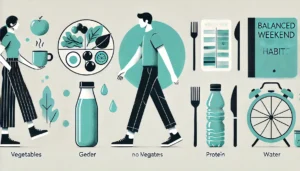
- Protein at every meal. It is the most satiating macronutrient and the one most often missing from restaurant food.
- Vegetables when possible. Volume buys fullness for very few calories.
- Watch the drinks. Alcohol and sugary drinks add energy without reducing appetite. See liquid calories.
- Drink water before meals. Hydration is a small lever, but it is free.
- Keep portions visible. Serve onto a plate rather than eating from a packet or a shared bowl.
These habits keep intake in range without tracking anything. If portion size is your main problem, portion control without counting calories is the detailed guide.
Plan One Meal, Not the Whole Weekend
Planning an entire weekend is unrealistic and fragile. Planning one anchor meal is not.
- Saturday breakfast is usually the easiest meal to control, and it sets the tone for the day.
- Sunday dinner at home can be planned in advance, including the portion of the starchy component.
- One social meal can be enjoyed without negotiation if the other meals are ordinary.
This is the same logic as habit stacking: attach one reliable behaviour to a fixed point, instead of trying to control everything.
Handle Social Eating Without Guilt
Restaurant meals are not a failure state. They are a normal part of a life that includes other people.
- Look at the menu before you arrive. Decisions made hungry and socially pressured are worse decisions.
- Choose a protein-led main and add vegetables or salad.
- Decide on drinks before the first one, not after the third.
- Eat normally during the day. Skipping meals to "save" calories usually produces a larger evening intake.
- Do not compensate the next morning with a punishing workout or a fast. Return to your normal pattern.
Practical restaurant strategies are covered in eating out while losing fat.
Is Weekend Eating Really the Problem, or Is It Something Else?
Not every weekend pattern is driven by food choices, and one large cross-sectional study is a useful corrective to overconfident advice.
Researchers in Italy surveyed 2,596 adults attending an obesity centre, classifying weekend eating into four patterns: maintaining weekday habits, cooking at home, eating out, and eating prepared meals. They then compared body fat percentage between groups.
The result was counter-intuitive. Women who cooked at home on weekends had higher body fat percentage than those who ate out or maintained weekday habits, and the same pattern appeared in men aged 31–45. Eating out, being hosted, or maintaining weekday habits were associated with lower fat mass percentage than cooking at home.
The authors were careful about the limits: diet quality was not assessed, so "cooking at home" may have meant large, rich, home-cooked meals rather than lean ones. The study is cross-sectional and cannot establish causation, and the sample came from a clinical population seeking obesity treatment.
The takeaway is not "eat out more often". It is that the content of the weekend meal matters more than the location, and that "I cooked at home so it was healthy" is not a safe assumption.
Sleep: Weekend Recovery Does Not Work
A common weekend strategy is to sleep in and "catch up". A sleep-laboratory study tested whether that actually protects metabolism.
Healthy young adults were assigned to a control group (9-hour sleep opportunities, n=8), sleep restriction without weekend recovery (5-hour opportunities, n=14), or sleep restriction with two weekend recovery nights (n=14). Insufficient sleep increased after-dinner energy intake and body weight in both restriction groups.
During the weekend recovery nights, participants slept about 1.1 hours more than baseline and after-dinner intake fell. But when insufficient sleep resumed, circadian phase was delayed and after-dinner energy intake and body weight rose again. Whole-body, hepatic, and muscle insulin sensitivity fell by roughly 9–27%.
The conclusion was direct: weekend recovery sleep is not an effective strategy to prevent metabolic dysregulation caused by recurrent insufficient sleep. If your weekday sleep is chronically short, fixing the week is the intervention — not sleeping until noon on Sunday. See sleep for fat loss.
Related but separate: a 2026 case-control study of 444 adults found that social jetlag and eating jetlag were not independent predictors of overweight or obesity, while poor sleep quality, emotional eating, and the timing of the last meal were. Weekly variability in timing appears less important than how late and how poorly you sleep.
Use Movement to Support Weekend Balance
Sunday inactivity was one of the two mechanisms identified in the controlled trial, which makes weekend movement a legitimate target rather than a punishment.
- Walk after the largest meal. Twenty to thirty minutes blunts the post-meal glucose rise and adds activity without a training session.
- Keep one active weekend ritual. A long walk, a bike ride, a swim, a family outing — something you would do anyway, made slightly longer.
- Do not "earn" food with exercise. Using movement as debt repayment turns it into a chore and makes it the first thing abandoned.
Walking is the most sustainable option for most people; see walking for fat loss for realistic volume. If you prefer structure, a short home workout works on a weekend schedule.
Reset on Monday — Without Punishment
Monday is not a debt collection day. It is simply the next normal day.
- Eat normally. No compensatory fast, no 800-calorie penance day.
- Weigh yourself and expect it to be high. Weekend sodium and carbohydrate can add 1–2 kg of water that disappears by Wednesday.
- Walk. Twenty minutes, no intensity target.
- Prepare one meal for the next two days.
- Note one thing you would do differently next weekend — one, not ten.
If the weekend went badly and you feel like you have failed, that is the moment the whole plan is most at risk. Restarting fat loss after falling off track covers how to resume without the compensatory spiral, and consistency over perfection explains why the 80% approach wins.
A Weekend Template
- Friday evening: normal dinner, one drink maximum if you drink, early night.
- Saturday morning: protein-led breakfast, 30-minute walk.
- Saturday lunch or dinner: the social meal. Choose a protein main, add vegetables, decide on drinks in advance.
- Sunday morning: normal breakfast, no compensation for Saturday.
- Sunday afternoon: some movement — a walk, a swim, a bike ride.
- Sunday evening: home-cooked, portioned dinner; plan Monday's lunch.
- Monday: normal day, weigh in, ignore the number.
The template is deliberately loose. It assumes you will eat more on Saturday than on Tuesday, and it builds the week around that instead of pretending it will not happen. For a weekday structure to pair with it, see the 7-day fat loss meal plan and weekend lifestyle habits.
Frequently Asked Questions
Can I still lose fat if I eat more on weekends?
Yes, if the weekly total is still a deficit. The controlled trial showed weekends can stall loss when intake rises enough to cancel the weekday deficit — so the answer depends on magnitude, not on whether Saturday was relaxed.
Why is my weight always higher on Monday?
Weekend food is usually saltier and higher in carbohydrate, both of which retain water. The 12-month cohort found Monday and Tuesday were consistently the heaviest days. Compare weekly averages instead of individual readings.
Should I cut calories during the week to "save" for the weekend?
Only mildly. Banking calories by starving Monday to Thursday increases hunger, worsens weekend decisions, and reduces lean mass retention. A moderate weekday deficit plus one planned social meal works better than a feast-famine cycle.
Does sleeping in on Sunday help?
Not metabolically. In a controlled sleep study, weekend recovery sleep did not prevent the metabolic effects of recurrent short sleep, and after-dinner intake rose again once restriction resumed. Fix weekday sleep instead.
How many "free" meals can I have per week?
There is no universal number. The practical test is arithmetic: one large meal of about 1,000 kcal above normal fits inside a 400 kcal/day weekday deficit. Two such meals plus drinks and dessert usually do not.
What if every weekend includes a social event?
Then build the plan around that reality rather than fighting it: keep weekday meals simple and high in protein, choose protein-led restaurant dishes, limit alcohol, and add walking. Consistency across the week matters more than any single meal.
Weekends are part of the plan, not a break from it. Build them in deliberately and the rest of the week stops feeling like a recovery operation.
Sources
- Maher C, Ferguson T, Curtis R, et al. Weekly, Seasonal, and Festive Period Weight Gain Among Australian Adults. JAMA Netw Open. 2023;6(7):e2326038. PMID 37498598.
- Turicchi J, O'Driscoll R, Horgan G, et al. Weekly, seasonal and holiday body weight fluctuation patterns among individuals engaged in a European multi-centre behavioural weight loss maintenance intervention. PLoS One. 2020;15(4):e0232152. PMID 32353079.
- Forman EM, Schumacher LM, Crosby R, et al. Ecological Momentary Assessment of Dietary Lapses Across Behavioral Weight Loss Treatment: Characteristics, Predictors, and Relationships with Weight Change. Ann Behav Med. 2017;51(5):741–753. PMID 28281136.
- Racette SB, Weiss EP, Schechtman KB, et al. Influence of weekend lifestyle patterns on body weight. Obesity (Silver Spring). 2008;16(8):1826–1830. PMID 18551108.
- Gorini S, Camajani E, Feraco A, et al. Gender and age differences in weekend eating habits: associations with fat mass percentage in a cross-sectional study. Front Nutr. 2025;12:1578574. PMID 40406155.
- Ulusoy Gezer HG, İşler AO, Oguz SH, Karabulut E, Rakıcıoğlu N. Late-night eating, poor sleep quality, and emotional eating: stronger predictors of overweight and obesity than social jetlag and eating jetlag. Chronobiol Int. 2026;43(9):1451–1462. PMID 42153247.
- Depner CM, Melanson EL, Eckel RH, et al. Ad libitum Weekend Recovery Sleep Fails to Prevent Metabolic Dysregulation during a Repeating Pattern of Insufficient Sleep and Weekend Recovery Sleep. Curr Biol. 2019;29(6):957–967.e4. PMID 30827911.
- NHS. Managing your weight.
- World Health Organization. Obesity and overweight fact sheet.
This article is general education, not medical advice. It does not diagnose or treat any condition. If you have a medical condition, take medication, are pregnant, or have a history of an eating disorder, speak to a qualified clinician before changing your diet or exercise routine.