Slow Eating for Fat Loss: Does Eating Slower Help?
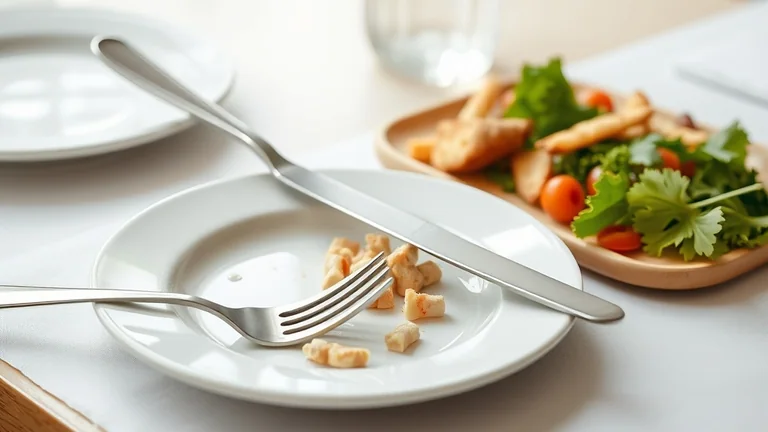
"Chew your food properly and put your fork down between bites." It is one of the oldest pieces of diet advice there is, usually handed down by a parent rather than a study. Behind the cliché, though, sits a question researchers have genuinely tried to answer: does how fast you eat change how much you eat — and does that difference turn into fat loss?
The honest short answer is that eating rate is a real but modest lever. Eating more slowly tends to reduce how much food you eat in a sitting, especially when the food itself is textured and chewy. But the effect is smaller and more conditional than the popular version of the advice suggests, and the strongest evidence is about the form of your food, not about willpower or a target number of chews.
This guide looks at what the randomised trials and meta-analyses actually show about eating speed and weight, including the results that cut against the neat narrative. It ends with a practical way to use the idea without turning every meal into a slow, joyless ritual — and without pretending that chewing more is a substitute for managing total calories.
Key Takeaways
- Eating rate is a real but modest lever: a 2014 meta-analysis of 22 studies found slower eating was linked to lower energy intake (standardised mean difference 0.45, 95% CI 0.25 to 0.65), but it had no significant effect on hunger.
- Population studies link fast eating with higher body weight — 23 studies found fast eaters averaged a BMI 1.78 kg/m² higher and roughly double the odds of obesity — but almost all were cross-sectional and relied on self-reported eating speed, so they cannot prove cause and effect.
- The effect is not universal. In a randomised crossover trial, eating slowly lowered meal energy intake in normal-weight adults (804 vs 893 kcal) but not in overweight or obese adults (667 vs 725 kcal, not significant) — the very group most likely to be trying to lose fat.
- Manipulating food texture is the most reliable way to change eating rate. Controlled feeding studies found slow-textured meals cut energy intake by roughly 13% to 20% in the short term.
- Less food eaten in the lab does not automatically become weight lost. An 11-day crossover trial found 121 g/day less food but no significant difference in energy intake, and a 2-week trial found no difference in body weight despite people eating about 369 kcal/day less.
- A device that retrained eating speed helped obese adolescents lose more weight than standard care over 12 months — evidence that eating behaviour can be changed and matter, but in a specific group using a specific tool.
- The practical takeaway is unglamorous: eat meals with more texture and fewer liquid or ultra-processed calories, avoid inhaling your food, and keep the calorie deficit as the main engine of fat loss.
What "eating rate" actually means
The research uses several overlapping terms, and they are worth separating because they are measured in different ways:
- Eating rate — usually grams or calories consumed per minute during a meal. This is the most objective measure and is often derived from video or from the weight of the plate over time.
- Eating speed — the everyday label of "fast" or "slow", almost always self-reported in large population studies.
- Oral processing time — how long food spends in the mouth before being swallowed, which combines chewing and the pauses between bites.
- Oro-sensory exposure — how much taste, texture and mouth-feel you experience per bite. This is a separate signal from speed and turns out to matter a great deal in the trials.
The distinction matters because "eat slower" is not one behaviour. You can eat slowly by taking smaller bites, by pausing between bites, by chewing more, or simply by choosing food that takes longer to break down. As the evidence below shows, those routes are not equally effective. They also interact with appetite signals: the act of eating may feed back into how full you feel, which is why nutrition fundamentals and what you eat when eating out stay central.
What the research shows: a real but conditional effect
The clearest summary of the laboratory evidence is a 2014 systematic review and meta-analysis in the American Journal of Clinical Nutrition by Robinson and colleagues. It pooled 22 studies that deliberately manipulated eating rate and measured how much people ate. Across them, slower eating was associated with lower energy intake, with a standardised mean difference of 0.45 (95% CI 0.25 to 0.65, p<0.0001). The direction of the effect held regardless of how eating rate was manipulated — smaller bites, pauses, or food form.
Two details in that same paper are easy to miss. First, the authors reported a large amount of heterogeneity, meaning studies disagreed substantially about how big the effect was. Second, and more importantly, there was no significant relationship between eating rate and hunger at the end of the meal or up to 3.5 hours later. Eating slowly changed how much people ate in the test meal; it did not reliably change how hungry they felt afterwards. That undercuts the idea that slow eating works mainly by leaving you more satisfied for hours.
The large population studies tell a similar, slightly louder story. A 2015 systematic review and meta-analysis in the International Journal of Obesity by Ohkuma and colleagues combined 23 epidemiological studies. Compared with slow eaters, fast eaters had a mean BMI that was 1.78 kg/m² higher (95% CI 1.53 to 2.04), and the pooled odds ratio of eating quickly being associated with obesity was 2.15 (95% CI 1.84 to 2.51). Again there was significant heterogeneity (I² of about 78% for BMI and 72% for obesity), and the association was weaker in people with diabetes.
The catch is the study design. Ohkuma's analysis pooled observational studies, most of them cross-sectional, and relied on people describing themselves as fast or slow eaters. That design can show a link but not the direction of cause. It is entirely possible that people who already carry more body fat eat more quickly, rather than that fast eating made them gain weight. The authors themselves concluded that "further studies are warranted to determine whether interventions to slow the speed of eating are effective for weight control."
Controlled feeding trials tighten the picture. A 2024 crossover study in the British Journal of Nutrition had healthy adults eat 24 different ad libitum meals, twelve breakfasts and twelve lunches, each engineered to be eaten at a fast or slow rate. The slow meals were consumed about 39% (breakfast) and 45% (lunch) more slowly, and participants ate on average 22% less food and 13% less energy — about 71 kcal — from the slow meals. A related 2016 study using everyday, unmodified supermarket meals found that foods eaten more slowly delivered more fullness and, when the same food was offered again, people ate less of the slow version without compensating at a snack an hour later.
The findings that do not fit the story
If the effect were simple and universal, this would be an easy article. It is not. Several well-designed studies found the benefit shrinking or vanishing in exactly the conditions people care about.
- It did not work for overweight and obese adults. A randomised crossover study published in the Journal of the Academy of Nutrition and Dietetics in 2014 studied 35 normal-weight and 35 overweight/obese adults eating the same meal slowly or quickly. Slow eating significantly lowered meal energy intake in the normal-weight group (804.5 vs 892.6 kcal, p=0.04) but not in the overweight/obese group (667.3 vs 724.8 kcal, p=0.18). Both groups did eat more slowly and chose less energy-dense food, and both reported less hunger — but the calorie reduction that is the whole point did not show up in the heavier group.
- Speed alone was not enough. A 2020 randomised trial in the American Journal of Clinical Nutrition separately manipulated eating rate and oro-sensory exposure (how much taste and mouth-feel per bite). In one experiment, slower eating reduced intake by 42 g only when oro-sensory exposure was high; with low exposure, slowing down made no difference. In the second experiment, high oro-sensory exposure reduced intake by 66 g, while slow versus fast eating rate had no significant effect at all (p=0.35). In other words, what you eat and how much you taste it can matter more than how fast you chew.
- Less food did not mean less energy. An 11-day randomised crossover feeding trial in the British Journal of Nutrition (2026) put 20 adults on a slow-textured and a fast-textured diet. On days when texture clearly slowed eating, people ate 121 g per day less food, and the effect did not fade over the study. But cumulative energy intake was not significantly different between diets. Eating less by weight does not always mean eating fewer calories, because slow foods can be more energy-dense.
- A calorie drop did not become a weight drop. A 2-week single-blind crossover trial in the American Journal of Clinical Nutrition (2026) compared ultra-processed diets engineered to be eaten slowly or quickly. People ate about 369 kcal per day less on the slow diet, a large and sustained difference. Yet body weight did not differ between the two diets, although body fat mass fell by about 0.43 kg on the slow diet. Two weeks is far too short to judge weight change, and the effect on body fat, while statistically significant, was small.
- Portioning and spacing a fast-food meal changed nothing. A 2007 crossover study in Pediatrics gave 18 adolescents a large fast-food meal as one serving, as four smaller servings, or as four servings spaced 15 minutes apart. Energy intake was not significantly different across the three conditions. The authors concluded that the fast food's own properties — low fibre, high energy density, high palatability — drove intake more than the eating pattern.
It is also worth knowing where the most encouraging intervention evidence comes from — and its limits. A 12-month randomised controlled trial published in the BMJ in 2009 used a computerised feedback device to retrain eating speed and portion size in 106 obese adolescents alongside standard lifestyle therapy. The device group had a significantly lower BMI standard-deviation score at 12 months (baseline-adjusted difference 0.24, 95% CI 0.11 to 0.36), maintained at 18 months, and their mean meal size fell by 45 g. That is genuinely encouraging, but it involved adolescents, a purpose-built device, and a full behavioural programme — not a note to chew more. A related study in the same era found no added satiety benefit when earplugs were added to a slow-eating protocol, a reminder that adding gadgets does not always add effect.
Food texture: the lever you can actually pull
If there is a single practical lesson in this literature, it is that eating rate is mostly a property of the food, not of your self-control. Foods that take more chewing, more mouth-work and longer to get through a plate slow you down automatically. Foods that are soft, liquid, refined or ultra-processed slide down quickly — and they tend to carry more calories per bite.
That is exactly what the ultra-processed food trials suggest. A 2024 randomised crossover study in Diabetes, Obesity and Metabolism found that when overweight men ate matched ultra-processed versus unprocessed diets for a week each, the ultra-processed week produced 1.1 kg more weight gain and 813 kcal per day more intake, along with significantly fewer chews per calorie. The researchers argued that the texture and eating rate of ultra-processed food is part of why it drives overeating. Rather than counting chews, choosing meals built from whole, fibrous, textured ingredients may do the slowing for you.
This connects neatly to the rest of a sensible fat-loss diet. Fibre-rich foods such as vegetables, legumes and whole grains are chewy and bulky, which is part of why they help with fullness, as explored in the guide to fibre for fat loss. Protein foods also take longer to eat than refined carbohydrates and support satiety, covered in protein intake for body recomposition. Meals you assemble yourself — rather than a soft, drinkable, hyper-palatable alternative — are naturally eaten more slowly, which is one reason liquid calories are so easy to over-consume.
How to eat more slowly without overthinking it
Given how conditional the evidence is, the goal should be to make slow eating a side effect of better meals rather than a discipline you white-knuckle through. A few habits do most of the work:
- Choose foods that require chewing. Whole cuts of meat, beans, lentils, crunchy raw or lightly cooked vegetables, whole fruit, wholegrain bread and nuts all take time. Soft bread, pastries, crisps and sweet drinks barely register in the mouth.
- Put the fork down between bites. It is a cliché for a reason: pausing is the easiest way to add oral processing time without following a rule about chew counts.
- Eat one course at a time. Serving food in stages rather than piling everything on one plate gives your fullness signals a chance to catch up, echoing the idea behind controlling portions without counting calories.
- Do not eat while distracted. Screens and phones speed meals up. Sitting at a table with the food as the main event slows the pace on its own, which is part of the broader set of smart eating habits.
- Drink water with the meal, but do not drink your meal. Chewing is impossible with liquids, and liquid calories slide past the fullness signals that solid food triggers.
These are small changes, and on their own the evidence says they will not transform your body. They work best when stacked onto a routine that is already in place, the approach described in habit stacking for fat loss and building a fat-loss routine.
Where slow eating fits a fat-loss plan
The single most important thing to keep in perspective is that fat loss comes from a calorie deficit, not from the pace of your chewing. If you are overeating, chewing more slowly is unlikely to fix it, and the study where slow eating failed to reduce intake in overweight/obese adults is a fair warning against over-relying on it. What slow eating can do is help at the margins: it may shave some calories off a meal, it nudges you toward more filling foods, and it may reduce the odds of eating a large meal so fast that you barely notice it.
So treat eating rate as one supporting habit, alongside the bigger levers. Get your calorie deficit right, keep protein and fibre high, lift weights as covered in the strength training guide, protect your sleep, and aim for consistency rather than perfection. Build meals mostly from unprocessed foods, keep snacks structured rather than constant, and if you tend to eat emotionally, address that too, as discussed in emotional eating and fat loss. Slow eating then becomes a free bonus rather than another rule to fail at.
Frequently asked questions
Does eating slowly actually help you lose weight?
It can help a little, but it is not a weight-loss method on its own. A 2014 meta-analysis found slower eating reduced energy intake in controlled meals, and a 2024 crossover study found slow-textured meals cut intake by about 13%. But an 11-day trial found lower food intake with no significant difference in energy intake, and a 2-week trial found a 369 kcal/day reduction with no difference in body weight. Slow eating is a supporting habit, not a substitute for a calorie deficit.
How many times should I chew each bite?
There is no evidence-based magic number, and the trials that changed eating rate did so by changing food texture or using a feedback device, not by prescribing a chew count. Studies have linked faster eating and lower chewing frequency with higher intake and weight, and a 2015 study found faster eating lowered the thermic effect of food (the calories burned digesting a meal) in the first 15 minutes, but that was a small study of nine women and the difference was modest. Rather than counting, aim to put your fork down between bites and choose chewier foods.
Why does eating fast make you eat more?
Partly because fullness signals take time. Eating quickly means you can consume a large amount of food before satiety catches up, which matches the finding that slow-textured meals were eaten more slowly and led to less food intake without later compensation. But the mechanism is not just speed: a 2020 randomised trial found that oro-sensory exposure (how much taste and mouth-feel you get per bite) independently reduced intake, and that slow eating only helped when oro-sensory exposure was high. Fast eating also tends to come with soft, energy-dense, ultra-processed food, which is easy to over-eat for reasons beyond speed.
Is slow eating better than counting calories?
They address different things. Calorie balance determines whether you lose fat; eating rate may influence how many calories you take in without trying. The evidence shows slow eating produces small, inconsistent reductions in intake, so it is a helpful supporting habit rather than a replacement for awareness of how much you eat. If calorie counting is not for you, texture-based meals plus portion strategies such as those in controlling portions without counting calories are a reasonable middle path.
Which foods are naturally slow to eat?
Foods that need real chewing and hold their shape: whole meat, fish, eggs, beans, lentils, chickpeas, whole grains like oats and brown rice, crunchy vegetables, whole fruit, and nuts or seeds. Soups, smoothies, white bread, pastries, crisps and sugary drinks are at the fast, low-chew end. A practical rule is that if a meal can be finished in a few minutes without much mouth-work, it is probably easy to over-eat.
Keep reading
- How often should you eat for fat loss?
- 7-day fat loss meal plan for beginners
- Walking for fat loss: how much is enough?
- Fat loss plateau: why the scale stops
- Signs you are actually losing fat
- How long does fat loss really take?
- Stress, cortisol and fat loss
- Meal prep for fat loss
Sources
Peer-reviewed evidence
- Robinson E, Almiron-Roig E, Rutters F, de Graaf C, Forde CG, Tudur Smith C, Nolan SJ, Jebb SA. A systematic review and meta-analysis examining the effect of eating rate on energy intake and hunger. American Journal of Clinical Nutrition, 2014 (22 studies; slower eating rate associated with lower energy intake, SMD 0.45, 95% CI 0.25 to 0.65; large heterogeneity; no significant relation with hunger at the meal or up to 3.5 h later).
- Ohkuma T, Hirakawa Y, Nakamura U, Kiyohara Y, Kitazono T, Ninomiya T. Association between eating rate and obesity: a systematic review and meta-analysis. International Journal of Obesity, 2015 (23 observational studies; fast versus slow eaters BMI difference 1.78 kg/m², 95% CI 1.53 to 2.04; pooled OR for obesity 2.15, 95% CI 1.84 to 2.51; significant heterogeneity; association weaker in diabetic patients; mostly cross-sectional and self-reported).
- Shah M, Copeland J, Dart L, Adams-Huet B, James A, Rhea D. Slower eating speed lowers energy intake in normal-weight but not overweight/obese subjects. Journal of the Academy of Nutrition and Dietetics, 2014 (randomised crossover, 70 adults; slow eating lowered meal energy intake in normal-weight adults 804.5 vs 892.6 kcal, p=0.04, but not in overweight/obese adults 667.3 vs 724.8 kcal, p=0.18).
- Lasschuijt M, Mars M, de Graaf C, Smeets PAM. How oro-sensory exposure and eating rate affect satiation and associated endocrine responses — a randomized trial. American Journal of Clinical Nutrition, 2020 (slow eating reduced intake by 42 g only with high oro-sensory exposure; in a second experiment intake was 66 g lower with high oro-sensory exposure but slow versus fast eating rate had no significant effect, p=0.35).
- Heuven LAJ, van Bruinessen M, Tang CS, Stieger M, Lasschuijt MP, Forde CG. Consistent effect of eating rate on food and energy intake across twenty-four ad libitum meals. British Journal of Nutrition, 2024 (slow meals eaten 39%–45% more slowly; participants ate 22% less food, 84 g, and 13% less energy, about 71 kcal).
- van Bruinessen M, Heuven LAJ, Stieger M, Lasschuijt MP, Forde CG. The sustained effect of texture-based eating rate on food intake in an 11-d randomised controlled trial. British Journal of Nutrition, 2026 (n=20; slow diet 32% slower; food intake reduced by 121 g/day, p<0.001, without attenuating over time; cumulative food intake 6% lower but no significant difference in energy intake).
- Forde CG, Heuven LA, van Bruinessen M, Liu Z, Stieger M, de Graaf K, Lasschuijt MP. Eating rate has sustained effects on energy intake from ultraprocessed diets: a 2-week ad libitum dietary randomized controlled crossover trial. American Journal of Clinical Nutrition, 2026 (n=41; 369 kcal/day lower intake on the slow-ER ultra-processed diet, no difference in body weight, body fat mass −0.43 kg; several authors declare food-industry funding and advisory relationships, including Nestlé, Kerry and PepsiCo).
- Ford AL, Bergh C, Södersten P, Sabin MA, Hollinghurst S, Hunt LP, Shield JPH. Treatment of childhood obesity by retraining eating behaviour: randomised controlled trial. BMJ, 2009 (106 obese adolescents; feedback device plus standard care lowered BMI standard-deviation score at 12 months, baseline-adjusted difference 0.24, 95% CI 0.11 to 0.36, maintained at 18 months; mean meal size fell 45 g).
- Ferriday D, Bosworth ML, Godinot N, Martin N, Forde CG, Van Den Heuvel E, Appleton SL, Mercer Moss FJ, Rogers PJ, Brunstrom JM. Variation in the oral processing of everyday meals is associated with fullness and meal size; a potential nudge to reduce energy intake? Nutrients, 2016 (slower-eaten everyday meals gave higher expected satiation and satiety; participants ate less of the slow version of the same food and did not compensate at a snack an hour later).
- Hamano S, Sawada M, Aihara M, Sakurai Y, Sekine R, Usami S, Kubota N, Yamauchi T. Ultra-processed foods cause weight gain and increased energy intake associated with reduced chewing frequency: a randomized, open-label, crossover study. Diabetes, Obesity and Metabolism, 2024 (n=9 overweight/obese men; ultra-processed week produced 1.1 kg more weight gain and 813.5 kcal/day more intake, with fewer chews per calorie).
- Ebbeling CB, Garcia-Lago E, Leidig MM, Seger-Shippee LG, Feldman HA, Ludwig DS. Altering portion sizes and eating rate to attenuate gorging during a fast food meal: effects on energy intake. Pediatrics, 2007 (18 adolescents; portioning the meal into four servings, or spacing them 15 minutes apart, did not significantly change energy intake; authors attributed intake to the food's own properties).
- Toyama K, Zhao X, Kuranuki S, Oguri Y, Kashiwa Kato E, Yoshitake Y, Nakamura T. The effect of fast eating on the thermic effect of food in young Japanese women. International Journal of Food Sciences and Nutrition, 2015 (nine non-obese women; the thermic effect of food in the first 15 minutes was significantly lower with fast eating, and total mastication frequency correlated with it; small study).
Authority guidance (links checked November 2026)
- NHS. Tips to help you lose weight (aim to lose weight at a sustainable rate of about 0.5 to 1 kg a week; get active for 150 minutes a week; do not skip meals; plan meals and share your plan with someone you trust).
- NHS. Understanding calories (weight management depends on energy balance; the average man needs about 2,500 kcal and the average woman about 2,000 kcal a day; planning meals helps manage intake).
- WHO. Obesity and overweight fact sheet, updated 7 October 2026 (in adults, overweight is a BMI of 25 or more and obesity a BMI of 30 or more; in 2024, 45% of adults aged 18 and over — about 2.6 billion people — were overweight, including 940 million living with obesity).
Updated 6 November 2026. Every study cited here was checked against its PubMed record, and the NHS and WHO pages were re-checked on that date.
This article is general information for healthy adults and is not medical advice. Energy needs, appetite and eating behaviour differ between people, and the strategies here may not suit anyone who is pregnant, managing a condition such as diabetes, an eating disorder or a gastrointestinal condition, or taking regular medication. Trouble swallowing, or deliberately changing how slowly you eat in a way that causes distress, is a reason to speak to a qualified clinician or dietitian before continuing. This site does not sell or recommend any specific device, supplement, app or programme.