How Often Should You Eat for Fat Loss? (Meals vs Snacks)
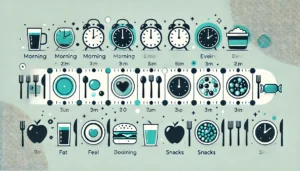
One of the most common questions beginners ask is how often they should eat to lose fat. Some people believe eating more frequently boosts metabolism, while others swear by fewer meals.
On this page13 sections
The truth is simpler than most diet myths suggest.
This article explains how meal frequency really affects fat loss—and how to choose a pattern that works for you.
Updated 14 November 2026: this article was expanded with the 2020 network meta-analysis, the 2023 systematic review and the 2025–2026 appetite and protein-distribution trials cited below.
Key Takeaways
- Fat loss is driven by your total calorie intake over weeks, not by how many times you eat per day.
- In controlled trials, three meals and six eating occasions produced nearly the same weight loss when calories were matched.
- Body composition—not the scale—is where frequency can make a small difference, and the evidence is still thin.
- Eating more often tends to mean eating more: extra eating occasions raise daily intake unless you plan them.
- Timing changes fat loss mainly by changing appetite, not by speeding up metabolism.
Does Meal Frequency Affect Fat Loss?
Fat loss depends on total calorie intake over time—not how many meals you eat per day.
Eating more often does not magically increase fat loss, and eating less often does not automatically slow metabolism.
What matters most is consistency and portion control.
For a full understanding of nutrition fundamentals, start here:
What the Randomized Trials Actually Show
Meal frequency is one of the few diet questions that has been tested directly in randomized trials, where both groups eat the same number of calories and only the number of eating occasions differs. Here is what those trials found.
Three meals plus three snacks vs three meals
A 2024 randomized controlled trial published in the Journal of the American Nutrition Association assigned 40 women with a BMI of 27 or above to either three meals plus three snacks per day or three meals per day, with the identical 500-calorie daily deficit for three months.
Weight, BMI and waist circumference fell in both groups by a similar amount. What differed was body composition: the group eating more often lost a larger share of their body fat (about 18.8% of their fat mass versus 14.9%) and gained a larger share of fat-free mass. With only 40 participants, all women, over 12 weeks, that finding is a signal—not a rule you should restructure your life around.
Six meals vs three meals in a 90-day trial
A Brazilian randomized clinical trial in Food & Function compared six meals with three meals a day in 40 women with obesity over 90 days, again with the same hypocaloric diet. There was no difference between groups in weight loss, body composition, energy expenditure, blood glucose or ghrelin levels. The three-meal group did finish with lower triglycerides and a higher resting metabolic rate than at baseline.
Together, these two trials point the same way: when calories are matched, the number of meals is not the engine of fat loss. Any body-composition difference is small and not yet consistent between studies.
The largest synthesis: 22 trials, 647 participants
A network meta-analysis in Advances in Nutrition (Schwingshackl et al., 2020) compared every meal frequency from one to eight or more eating occasions per day, using only trials that matched calories between groups. Twenty-two randomised trials with 647 participants were included.
The results ran against the popular direction. Two meals a day reduced body weight slightly more than three meals (mean difference −1.02 kg, 95% CI −1.70 to −0.35) and more than six meals (−1.29 kg, 95% CI −1.74 to −0.84), both at moderate certainty. Two meals also reduced waist circumference compared with six meals (−3.77 cm, 95% CI −4.68 to −2.86). Energy intake was not affected by meal frequency at all.
The authors still closed with a warning rather than a recommendation: there is little robust evidence that deliberately reducing meal frequency is beneficial. The honest reading is symmetrical — when calories are matched, the number of meals is not doing the work in either direction.
Sixteen trials, and 15 of them at high risk of bias
The most recent systematic review of the question (Blazey et al., 2023, International Journal of Behavioral Nutrition and Physical Activity) screened the literature again and found 16 eligible trials. Fifteen were at high risk of bias, and five had to be excluded from the meta-analysis for insufficient reporting.
The pooled difference in weight change between high-frequency and low-frequency eating was −0.62 kg (95% CI −2.76 to 1.52), which is to say no difference, at very low certainty of evidence. Their conclusion is worth quoting because it sets the realistic ceiling on this whole question: there was no discernible advantage to eating in a high- or low-frequency pattern for cardiometabolic health.
Fifteen studies, and one of them drove the result
An earlier meta-analysis by Schoenfeld, Aragon and Krieger (2015) is still the one most often cited for frequent meals, and it is instructive to read what happened inside it. Across 15 studies, feeding frequency was positively associated with reductions in fat mass and body-fat percentage and an increase in fat-free mass — a finding that would justify the “eat every three hours” advice.
Then the sensitivity analysis removed one study, and the positive findings disappeared. The authors said so explicitly in their own conclusion, noting that the effect was the product of a single study and that the results needed to be interpreted with circumspection. If you have seen this paper quoted as proof that six meals beat three, that sentence is the one that was left out.
Intermittent fasting vs everyday calorie cutting
A 2025 systematic review and network meta-analysis in The BMJ pooled 99 randomized trials with 6,582 adults and compared alternate-day fasting, time-restricted eating, whole-day fasting, continuous calorie restriction and unrestricted eating.
Every strategy that reduced calories beat unrestricted eating. Against plain continuous calorie restriction, only alternate-day fasting showed an extra benefit, and it was small—about 1.3 kg on average, with moderate certainty. In the trials lasting 24 weeks or longer, the intermittent approaches no longer clearly outperformed everyday calorie cutting. The authors concluded that intermittent fasting has broadly similar effects to continuous restriction for weight and cardiometabolic risk factors.
Meal timing: appetite, not metabolism
A 2024 systematic review in JAMA Network Open pooled 29 randomized trials with 2,485 adults. Time-restricted eating, lower meal frequency and eating more of your calories earlier in the day were all associated with modestly greater weight change than usual care—around 1.4 to 1.9 kg. The authors were explicit that these effects are small, the clinical importance is uncertain, and most included studies carried a high risk of bias.
Why would timing help at all if metabolism is unchanged? A controlled study in Obesity measured 24-hour energy expenditure in adults eating either from 8am to 2pm or from 8am to 8pm, with identical food and identical meal frequency. Energy expenditure was not different—the difference was about 10 calories per day. What changed was appetite: ghrelin fell by roughly 32 pg/mL and hunger became more even across the day, while fat oxidation increased.
In other words, meal timing works through appetite control and how easy it is to stay in a deficit—not by burning meaningfully more calories.
Why More Meals Can Blunt Appetite Control
If frequency does not change weight when calories are fixed, the only honest reason to choose a pattern is how it affects hunger, and that is measurable. The FRESH study (Zhang et al., 2025, Obesity) was a randomised crossover trial in 50 healthy adults who ate two eucaloric 21-day periods — three meals a day versus six — with identical foods and identical total energy. On day 21 of each period they sat through a seven-hour clinic visit with hourly blood draws.
Eating six times a day produced smaller postprandial changes in ghrelin and peptide YY than eating three times a day, with significant differences in the area under the curve (ghrelin p = 0.03; PYY p < 0.001), and the same pattern appeared in self-reported hunger, desire to eat and fullness. The differences in PYY were larger in participants with overweight or a high body-fat percentage.
The authors’ interpretation is the one that matches the weight data: small frequent meals may blunt the normal rise and fall of appetite signals, leaving satiety less well regulated rather than better regulated. That is a mechanism-level finding from 50 people over two three-week periods, so it does not settle the question — but it does mean “more meals keeps hunger steadier” should not be repeated as a fact.
For the behavioural half of appetite control, the more useful material is in slow eating and eating late at night.
3 Meals a Day: Simple and Effective
For many beginners, three meals per day is the easiest structure to follow.
- Clear meal boundaries
- Less grazing and mindless snacking
- Easier portion control
This approach works well for people with regular schedules.
Using balanced meals helps:
Meals Plus Snacks: Flexible for Busy Days
Some people prefer smaller meals with planned snacks in between.
- Helps manage hunger
- Useful for active lifestyles
- Prevents overeating at main meals
The key is choosing snacks wisely:
Unplanned snacking, however, can easily derail progress.
Does Regularity Matter More Than Frequency?
A related question gets far less attention: not how many times you eat, but whether the pattern is consistent from day to day. The evidence here is small but points somewhere useful.
Farshchi, Taylor and Macdonald (2005, American Journal of Clinical Nutrition) ran a 14-day randomised crossover in ten women with obesity, comparing a regular six-times-a-day pattern with an irregular one that swung between three and nine eating occasions per day. Both phases provided the same kind of food. Regular eating was associated with lower energy intake, greater postprandial thermogenesis, lower fasting total cholesterol (4.16 versus 4.30 mmol/L) and lower LDL cholesterol (2.46 versus 2.60 mmol/L).
Ten women over two weeks is not enough to build a diet around, and the cholesterol differences are small. But the direction matches a 2025 review of eating frequency and intermittent fasting (Silverii and Turrini, Current Obesity Reports), which notes that eating-schedule variability is associated with excess weight, and that adding eating occasions for people who already eat three times a day does not produce weight loss.
The practical translation: a predictable three meals a day beats a chaotic five, and the number matters less than the predictability. If your schedule genuinely shifts week to week, the honest fix is planning around the shift rather than chasing an ideal frequency — see meal prep for fat loss.
Fewer Meals: Can It Work?
Some people naturally eat fewer meals per day and still lose fat successfully.
This works only if:
- Total calories remain controlled
- Protein intake is sufficient
- Energy levels stay stable
There is no universal “best” frequency.
Does Eating More Often Mean Eating More?
This is the practical trap. A meta-analysis in Advances in Nutrition combined randomized controlled feeding trials that measured how portion size and the number of eating occasions affect daily energy intake.
Larger portions were associated with about 295 extra calories per day. More eating occasions were associated with about 203 extra calories per day. Both effects push in the same direction as the daily-life experience most people know: the more moments you create for eating, the more food tends to find its way in—unless each occasion is planned and measured.
That is why a structure with more meals and snacks can backfire for someone who eats by habit rather than by hunger. It is also why fewer meals feel easier for many people: there are simply fewer decisions to get wrong.
Protein: The Part That Does Matter
The popular claim is that spreading protein evenly across the day—around 25 to 30 grams per meal—protects muscle better than eating most of it at dinner. That advice is based on short-term muscle protein synthesis studies, so a randomized trial published in The Journal of Nutrition tested the outcome that actually matters: body composition over a full weight-loss program.
Forty-three women with overweight or obesity completed 8 weeks of a controlled 20% calorie deficit followed by 8 weeks of self-chosen eating, with identical protein totals but either an even or a dinner-heavy distribution. Over 16 weeks, weight fell about 5.6 kg, fat mass about 4.6 kg and fat-free mass about 1.0 kg. The distribution pattern made no difference to any of those changes.
What this means in practice: get enough protein in total, and do not agonise over when. If you happen to prefer protein at every meal because it keeps you full, that is a perfectly good reason to do it.
There is a newer result from the same trial that complicates the “distribution does not matter” conclusion without overturning it. The 2026 report (De Leon et al., Journal of the Academy of Nutrition and Dietetics) followed the same 16-week protocol and measured something different: how hard the women would work for energy-dense snack food, and how much of it they ate when it was offered.
The even-distribution group had a lower relative reinforcing value for snack foods than the dinner-heavy group (0.44 versus 0.55, p = 0.048), and at the end of the study they ate less of those snacks — 44.3 g versus 62.0 g (p = 0.020). An even split did not protect muscle better, but it made high-calorie snack food less attractive.
That is a useful distinction for anyone choosing a pattern: distribution appears to change eating behaviour and appetite more than it changes body composition directly. Spreading protein across meals is a reasonable default for that reason — not because muscle protein synthesis demands a stopwatch.
To set a protein target instead of guessing, use this guide:
How to Choose the Best Eating Frequency for You
- Choose a pattern you can maintain daily
- Match meals to your schedule
- Pay attention to hunger and energy
- Avoid forcing a structure you dislike
The best plan is the one you can follow long term.
- If you get very hungry and then overeat: more, smaller eating occasions with planned snacks usually wins.
- If you snack out of habit or boredom: three meals with fewer decisions usually wins.
- If you work shifts or eat late: put the largest meals earlier where your schedule allows, and keep total intake steady.
- If you train: place a protein-rich meal or snack within a few hours of training and keep the rest of the day the same.
A simple beginner structure can help:
Common Meal Frequency Myths
- “Eating every 2–3 hours boosts fat loss.” Trials that match calories find no meaningful weight-loss advantage. If it helps you control hunger, do it; if it makes you eat more, don’t.
- “Skipping snacks ruins metabolism.” A 90-day trial found the lower-frequency group actually ended with a higher resting metabolic rate than their own baseline.
- “More meals always mean better results.” More eating occasions were associated with roughly 200 extra calories a day in controlled feeding trials.
- “Breakfast is mandatory for fat loss.” What matters is the total day, not the number of timestamps on your plate.
These myths distract from what truly matters: total intake and consistency.
Choose an eating pattern that fits your life, not trends.
Frequently Asked Questions
Is it better to eat 3 meals or 6 small meals for fat loss?
When calories and protein are matched, weight loss is essentially the same. Some trials suggest small body-composition differences in favour of more frequent eating, but the evidence is not strong enough to make it a rule. Pick the pattern that keeps your hunger manageable and your intake predictable.
Does skipping breakfast slow my metabolism?
No. In measured studies, changes in meal timing did not change 24-hour energy expenditure in any meaningful way. Skipping breakfast can still affect fat loss indirectly—if it makes you ravenous by midday and you eat more than planned.
Is intermittent fasting better than eating normally?
A network meta-analysis of 99 trials found broadly similar results for intermittent fasting and continuous calorie restriction. Only alternate-day fasting showed a small extra weight-loss advantage, about 1.3 kg, and that advantage was not clearly present in the longer trials.
How many snacks should I eat per day?
As many as you have planned for, and no more. In controlled feeding studies, more eating occasions were associated with higher daily intake. If snacks help you avoid a late-night binge, keep them; if they quietly add hundreds of calories, cut the number down.
Do I need to eat protein at every meal?
Not for fat loss. A 16-week randomized trial found that even versus dinner-heavy protein distribution made no difference to fat mass or fat-free mass loss. Total daily protein still matters for keeping muscle while you lose fat.
What if I am hungry all the time on three meals?
Then the structure is wrong for you, not the other way round. Add an eating occasion, add protein and fibre to each meal, or shift more of your calories earlier in the day—appetite is the thing meal timing genuinely changes.
Is it bad to eat at different times every day?
Probably worse than eating at the same times, on the limited evidence available. A small crossover trial found that an irregular pattern produced higher energy intake and less favourable cholesterol than a regular one, and reviews of eating frequency note that schedule variability tracks with excess weight. Predictability is the part of meal timing with the most practical value.
Keep reading
- Calorie deficit for beginners
- Eating out while losing fat
- Fat loss plateau explained
- Sleep for fat loss
- Stress and cortisol
- Signs you are losing fat
- Healthy fat loss per week
Sources
- NHS. Healthy weight — Live Well (weight management guidance for adults).
- NHS. Understanding calories — Live Well (how daily calorie needs and deficits work).
- World Health Organization. Healthy diet — fact sheet (energy balance, fibre and free sugars).
- Ötüken Köroğlu Y, Öztürk M. Meal Frequency Does Not Affect Weight Loss in Overweight/Obese Women but Affects the Body Composition: A Randomized Controlled Trial. Journal of the American Nutrition Association, 2024.
- Grangeiro ÉD et al. Hypocaloric diet with lower meal frequency did not affect weight loss, body composition and insulin responsiveness, but improved lipid profile: a randomized clinical trial. Food & Function, 2021.
- Semnani-Azad Z et al. Intermittent fasting strategies and their effects on body weight and other cardiometabolic risk factors: systematic review and network meta-analysis of randomised clinical trials. The BMJ, 2025.
- Liu HY et al. Meal Timing and Anthropometric and Metabolic Outcomes: A Systematic Review and Meta-Analysis. JAMA Network Open, 2024.
- Higgins KA et al. Systematic Review and Meta-Analysis on the Effect of Portion Size and Ingestive Frequency on Energy Intake and Body Weight among Adults in Randomized Controlled Feeding Trials. Advances in Nutrition, 2022.
- De Leon A, Roemmich JN, Casperson SL. Daily Dietary Protein Distribution Does Not Influence Changes in Body Composition During Weight Loss in Women of Reproductive Years with Overweight or Obesity: A Randomized Controlled Trial. The Journal of Nutrition, 2024.
- Schwingshackl L et al. Impact of Meal Frequency on Anthropometric Outcomes: A Systematic Review and Network Meta-Analysis of Randomized Controlled Trials. Advances in Nutrition, 2020.
- Blazey P et al. Is a high eating frequency beneficial for cardiometabolic health outcomes? A systematic review and meta-analysis. International Journal of Behavioral Nutrition and Physical Activity, 2023.
- Schoenfeld BJ, Aragon AA, Krieger JW. Effects of meal frequency on weight loss and body composition: a meta-analysis. Nutrition Reviews, 2015.
- Zhang X et al. Objective and subjective appetite measures: high versus low eating frequency in a randomized crossover clinical trial. Obesity, 2025.
- De Leon A, Roemmich JN, Casperson SL. Evenly Distributing Daily Dietary Protein Across Three Meals Reduces Women’s Snack Food Reinforcement and Intake of Energy-Dense Snack Foods During Weight Loss: A Randomized Controlled Trial. Journal of the Academy of Nutrition and Dietetics, 2026.
- Farshchi HR, Taylor MA, Macdonald IA. Beneficial metabolic effects of regular meal frequency on dietary thermogenesis, insulin sensitivity, and fasting lipid profiles in healthy obese women. American Journal of Clinical Nutrition, 2005.
- Silverii GA, Turrini A. Do We Just Need To Eat Less Often? An Update on the Role of Eating Frequency and Intermittent Fasting for Obesity Prevention and Management. Current Obesity Reports, 2025.
- Ravussin E et al. Early Time-Restricted Feeding Reduces Appetite and Increases Fat Oxidation But Does Not Affect Energy Expenditure in Humans. Obesity, 2019.
This article is general information for healthy adults, not medical advice. If you have diabetes, a thyroid condition, a history of an eating disorder, kidney disease, or you are pregnant or breastfeeding, get individual advice from a qualified clinician before changing how or when you eat. Persistent hunger, dizziness, hair loss or unexplained fatigue while dieting should be assessed by a doctor.