Strength Training for Fat Loss: A Beginner’s Guide
Many beginners associate fat loss only with cardio. While cardio can help, strength training plays a critical role in sustainable fat loss.
On this page20 sections
This beginner-friendly guide explains what strength training is, why it matters for fat loss, and how to start safely.
Updated 12 November 2026: this article was expanded with the 2026 meta-regressions on training volume and frequency, the protein meta-analysis behind the 1.6 g/kg figure, and the newest trials on what exercise preserves during a calorie deficit.
Key Takeaways
- Resistance training reduces body fat modestly on its own (−1.46 percentage points; −0.55 kg fat mass in a 2022 meta-analysis)
- Its bigger job is preserving lean mass while you are in a calorie deficit: in a 2026 meta-analysis of 34 trials, adding exercise to calorie restriction saved +0.87 kg of fat-free mass and prevented about 46% of the loss
- More weekly sets buy more muscle and strength, with diminishing returns — but volume did not predict extra fat loss, so volume is a muscle decision, not a fat-loss decision
- Once total volume is matched, training a muscle twice or three times a week gives the same growth; pick the frequency you will actually keep
- Protein intake plateaus at about 1.6 g/kg per day — above that, extra protein did not add more muscle in a 49-trial meta-analysis
- The post-workout "afterburn" is real but small: roughly 30–70 kcal in controlled measurements, not hundreds
- Two to three full-body sessions per week is enough for beginners; progress comes from small increases, not maximum volume
- Track reps and waist, not just the scale
What Is Strength Training?
Strength training involves exercises that challenge your muscles against resistance.
- Bodyweight exercises
- Resistance bands
- Dumbbells or machines
You don’t need heavy weights to benefit—especially as a beginner.
If you’re new to training, start with the fundamentals:
Why Strength Training Supports Fat Loss
Strength training supports fat loss in several important ways:
- Preserves muscle during calorie deficits
- Improves body composition
- Adds to your daily energy expenditure (a real but modest, session-by-session effect)
- Boosts metabolic health
A large systematic review and meta-analysis of 114 randomised trials in adults with overweight or obesity (Lopez et al., Obesity Reviews, 2022) found that programs combining resistance training with a calorie deficit kept lean mass essentially unchanged while significantly reducing body fat — whereas dieting without training often costs muscle. Resistance training on its own actually increased lean mass. Because muscle is metabolically active, protecting it is what makes the long-term difference to your body composition, not the calories burned in a single session.
This is why strength training pairs well with good nutrition.
Nutrition still leads fat loss:
What the Evidence Says About Lifting and Body Fat
The most direct answer comes from a 2022 systematic review and meta-analysis of randomised trials in healthy adults, published in Sports Medicine. Fifty-eight studies met the criteria and 54 provided data for pooling. Compared with no-exercise controls, full-body resistance training reduced:
- Body fat percentage by 1.46 percentage points (95% CI −1.78 to −1.14)
- Body fat mass by 0.55 kg (95% CI −0.75 to −0.34)
- Visceral fat by a standardised mean difference of −0.49
Two uncomfortable details are worth stating plainly. First, the isolated effect on fat mass is small — roughly half a kilogram on average. Resistance training is not a fat-loss shortcut, and anyone selling it as one is overselling. Second, how the fat was measured changed the size of the effect, while sex did not: training volume and the specific mix of exercises were not associated with how much fat was lost. In other words, doing more sets did not automatically mean more fat loss.
So why keep doing it? Because the same trials show resistance training preserves or builds lean mass while you are in a deficit — the outcome that decides whether you end up smaller, or smaller and firmer. If your goal is appearance and long-term maintenance rather than the fastest possible number on the scale, that is the effect that matters.
Why Muscle Matters More Than the Scale
Two people can lose the same 5 kg and look completely different. If a large share of that weight is muscle, the result is a softer, smaller version of the same shape — and a lower resting energy expenditure, which makes the next phase harder. If most of it is fat, the waist shrinks, strength holds and the loss is easier to defend.
This is also why crash diets fail in a predictable way: aggressive restriction without training and adequate protein increases the muscle share of the loss. The fix is not a more extreme diet. It is a moderate deficit, enough protein, and two or three weekly sessions that tell your body to keep the muscle it has.
How Often Should Beginners Strength Train?
More sessions do not equal better results.
- 2–3 sessions per week
- Full-body workouts
- Rest days between sessions
This frequency supports recovery and consistency. The NHS recommends muscle-strengthening activities that work all the major muscle groups on at least 2 days a week, and suggests aiming for 8 to 12 repetitions per exercise (2 sets, up to 3 for extra benefit), building up gradually over weeks. Leaving about a day of rest before training the same muscles again helps them recover. If your schedule is tight, a structured training split can help you stay consistent.
A Simple Three-Day Beginner Plan
Alternate two full-body sessions and keep the third lighter. Each session should take 30–40 minutes including a warm-up.
Day A — push and squat pattern
- Bodyweight or goblet squat: 2–3 sets of 8–12
- Push-up (or incline push-up against a table): 2–3 sets of 6–12
- Glute bridge: 2–3 sets of 10–15
- Plank: 2–3 sets of 20–40 seconds
Day B — pull and hinge pattern
- Band row or dumbbell row: 2–3 sets of 8–12 per side
- Hip hinge with light weight or a broomstick: 2–3 sets of 8–12
- Step-up onto a low step: 2 sets of 8–10 per leg
- Dead bug or bird dog: 2 sets of 8 per side
Day C — repeat the weaker session, lighter
Repeat whichever of A or B felt harder, at about 80% of the effort. This keeps the weekly frequency at three without wrecking recovery — and recovery is where the muscle is actually kept.
A simple rule for load: choose a resistance that makes the last repetition genuinely hard to complete while keeping form. That is how the NHS defines an effective muscle-strengthening effort.
Progressive Overload Without a Gym
Muscles adapt to what they are asked to do. If the stimulus never changes, progress stops. You can add stimulus in five ways without buying equipment:
- One or two more repetitions per set
- One more set on the main exercise
- Slower lowering phase (about three seconds down)
- A harder variation (incline push-up → floor push-up; squat → split squat)
- Shorter rest between sets
Change one variable every week or two, not all of them at once. If form breaks down, the progression was too big. Remember the meta-analysis finding above: adding volume did not produce more fat loss — so the goal is steady strength, not exhaustion.
Beginner-Friendly Strength Exercises
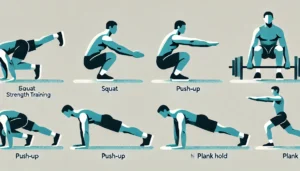
Start with simple, compound movements.
- Squats
- Push-ups (or modified push-ups)
- Rows or band pulls
- Glute bridges
- Planks
Focus on good form rather than heavy resistance. New to training entirely? Start with the beginner fat loss guide.
Short workouts still work:
Cardio vs Strength Training: Which Is Better?
Both have benefits, but strength training offers unique advantages for fat loss.
- Cardio burns calories during exercise
- Strength training preserves muscle and shape
- Combining both works best
A practical split for a beginner: two or three strength sessions, plus walking on most days, plus one or two short cardio sessions if you enjoy them. Cardio is the easier lever for adding energy expenditure; strength is the lever that protects what you are trying to keep. Neither replaces the calorie deficit. If the cardio side is the part you are unsure about — how much, what type, and how it interacts with lifting — the practical breakdown is in cardio during body recomposition.
Common Strength Training Mistakes
- Lifting too heavy too soon
- Ignoring recovery
- Skipping warm-ups
- Expecting instant results
- Changing the whole program every two weeks instead of progressing one variable
Progress comes from patience and consistency.
How to Track Strength Progress
The scale is the least useful measure here, because muscle gain can mask fat loss for weeks. Track these instead:
- Reps or load on two or three key exercises — the clearest sign the training is working
- Waist circumference every two weeks, same spot, morning
- Sessions completed per week — consistency predicts results better than program perfection
If strength is rising while the scale is flat, the plan is working: you are likely gaining or holding muscle while losing fat. Give it four to six weeks before judging.
How Strength Training Fits Long-Term Fat Loss
Strength training helps maintain fat loss by preserving muscle and keeping metabolism healthy.
Combined with nutrition, hydration, and rest, it becomes a powerful long-term tool.
Supporting habits matter:
How Much Work? What the Volume and Frequency Data Show
The 2022 meta-analysis above found something that surprises most beginners: within resistance training, the amount of work was not associated with how much fat was lost. Volume does not buy fat loss. It buys muscle — and muscle is the part you are trying to keep.
On that question the evidence is now quite detailed. A 2026 multi-level meta-regression in Sports Medicine pooled 67 studies and 2,058 participants (79% male, average age 25) and modelled weekly set volume and training frequency separately for hypertrophy and strength. Two findings are worth carrying into your programme:
- Volume has a positive but curved relationship with growth. The probability that the slope exceeded zero was 100% for both muscle size and strength, but gains flatten as sets pile up — and they flatten faster for strength than for size. The 15th set of the week is worth less than the 5th.
- Frequency mostly redistributes volume. For hypertrophy, the model could not rule out a negligible effect of training more often; for strength, more frequent training did help, again with diminishing returns. In plain terms: if the weekly sets are the same, spreading them over more days is a scheduling choice rather than a growth secret.
An earlier meta-analysis reached the same practical conclusion from a different angle. Pooling 34 treatment groups from 15 studies, each additional weekly set was associated with an effect-size increase of 0.023 — about 0.37% more muscle gain — and comparing higher with lower volume within a study produced a 3.9% difference in gains. Grouping studies by weekly sets per muscle (under 5, 5–9, and 10+) showed the same direction of effect, though that particular comparison only reached a trend (p = 0.074), so treat "10+ sets" as a sensible target rather than a law.
The frequency question was tested directly in a 2019 meta-analysis of 25 studies. When volume was equated, training a muscle once a week and training it three times a week produced statistically indistinguishable growth — including in trained lifters and when only direct measures of muscle size were used. The authors' conclusion was refreshingly unromantic: for a given volume, choose your weekly frequency by preference.
What that means for a beginner doing two or three sessions a week: total sets per muscle per week is the dial that matters, and it should move slowly. A workable starting point is 2–3 sets per exercise, 5–6 exercises per session, which usually lands somewhere between 6 and 12 hard sets per muscle per week. Add one set to one or two exercises every week or two while sleep, joints and performance hold up, and stop adding when they do not.
Protein Is the Other Half of the Equation
Lifting supplies the signal to keep muscle. Protein supplies the material. The largest synthesis of that evidence is a 2018 systematic review, meta-analysis and meta-regression in the British Journal of Sports Medicine: 49 randomised trials with 1,863 participants, all lasting at least six weeks.
- Protein supplementation increased one-repetition-maximum strength by 2.49 kg, fat-free mass by 0.30 kg, and muscle fibre cross-sectional area by 310 µm²
- A two-phase break-point analysis found no further fat-free mass gain beyond about 1.62 g of protein per kilogram of body weight per day
- The effect was larger in people with resistance-training experience (0.75 kg) and smaller in older adults
For a 70 kg beginner, 1.6 g/kg is roughly 112 g of protein a day — three or four meals built around eggs, dairy, fish, poultry, legumes or tofu, rather than one heroic shake. What this does not mean is that protein is a fat-loss drug. It protects muscle in a deficit and blunts hunger for some people; it does not cancel a calorie surplus.
What Lifting Actually Preserves During a Calorie Deficit
The strongest recent answer comes from a 2026 systematic review with pairwise and network meta-analysis in Diabetes, Obesity and Metabolism: 34 randomised controlled trials, 1,455 participants with overweight or obesity, comparing calorie restriction alone with calorie restriction plus exercise.
- Adding exercise to calorie restriction preserved +0.87 kg of fat-free mass (95% CI +0.59 to +1.16 kg)
- On average, exercise prevented 45.7% of the fat-free mass that restriction alone would have cost
- In the network comparison, mixed training had the largest effect (+1.20 kg), followed by strength training (+0.83 kg); endurance training alone fell just short of statistical significance (+0.51 kg, p = 0.067)
Two honest qualifications. First, exercise removed about half of the lean-mass loss, not all of it — a deficit still costs some lean tissue. Second, only two of the 34 trials measured skeletal muscle mass directly rather than estimating it from fat-free mass, so the muscle-specific numbers are thinner than the headline.
Read together with the volume data, the message is consistent: in a deficit, the training that keeps muscle is ordinary, repeated, progressive lifting — not a heroic programme. What changes the outcome more is how aggressive the deficit is and whether protein is adequate.
Does Lifting Burn Extra Calories Afterwards?
This is the most oversold part of strength training. Excess post-exercise oxygen consumption (EPOC) — the "afterburn" — is measurable, but the measured amounts are small. A 2021 systematic review in Obesity Reviews collected 22 studies comparing it after high-intensity interval exercise, sprint interval exercise and moderate continuous exercise:
- Short-duration measurements: about 136 kJ after interval exercise versus 101 kJ after moderate continuous exercise; sprint intervals reached about 241 kJ versus 151 kJ
- Longer measurements (over three hours): about 289 kJ after interval exercise versus 159 kJ after moderate continuous work
- Converted, that is roughly 30–70 kcal of extra energy above the session itself — about a small apple, not a meal
Those numbers come from aerobic interval work, and there is no reason to expect barbell sets to look better. The practical consequence is simple: do not choose strength training for its afterburn. Choose it because it keeps muscle, keeps strength, and makes the physique outcome different at the same body weight. If you want more energy expenditure, walking is far easier to add and far easier to sustain.
Visceral Fat: Where Lifting Sits Among the Options
Visceral fat — the fat around the organs — responds to exercise differently depending on modality. A 2026 dose-response network meta-analysis in Obesity Reviews pooled 78 reports and 4,930 participants with overweight or obesity (mean age 43, mean BMI 30.7). Against controls, the standardised effects on visceral fat were:
- Vigorous aerobic exercise: −0.73
- High-intensity interval training: −0.73
- Combined training: −0.61
- Moderate-to-vigorous aerobic exercise: −0.53
- Resistance training: −0.50
Two details matter more than the ranking. First, total exercise dose followed a U-shaped curve rather than "more is always better", with the largest model-predicted reduction around 750 MET-minutes per week — roughly 150 minutes of brisk walking, or about 100 minutes of jogging. Second, the estimated dose needed for a substantial clinical benefit was only about 440 MET-minutes per week, which is a realistic target for someone who currently walks little.
So resistance training does reduce visceral fat, just less per unit of effort than vigorous aerobic work. The practical combination — two or three lifting sessions to hold muscle, plus a walking or interval habit for the fat-loss and visceral-fat dose — is supported by both literatures rather than by enthusiasm for one camp.
Frequently Asked Questions
Can strength training alone make me lose fat?
Only modestly. The pooled effect in healthy adults is about 0.55 kg of fat mass, without a deliberate calorie deficit. Strength training is best understood as the thing that protects muscle while your diet does the fat-loss work.
Will lifting make me bulky?
Not quickly, and not by accident. Building noticeable muscle takes consistent training, progressive load and a calorie surplus for months. In a deficit, beginners typically gain little or no muscle while keeping what they have.
How long until I see results?
Strength usually improves within two to four weeks. Visible changes in shape typically take six to twelve weeks, which is why waist measurements and rep records are more useful early on than the scale.
Do I need to train to failure?
No. Leaving one or two repetitions in reserve keeps form intact and recovery manageable. The evidence above did not show that more volume produced more fat loss, so there is no reason to chase failure every session.
Can I do strength training at home with no equipment?
Yes. Bodyweight progressions, a chair, a wall and a resistance band cover most beginner needs. Add load gradually through harder variations before buying anything.
Can I build muscle while eating less?
Yes, but modestly, and mostly if you are new to lifting. In the 2026 meta-analysis of 34 trials, people in a calorie deficit who trained kept about 0.87 kg more fat-free mass than those who only restricted food; whether that showed up as new muscle or simply less loss depended on the trial. Beginners and people with higher body fat have the most room for genuine gain; experienced lifters in a deficit should expect to defend what they have rather than add much.
How many sets should a complete beginner do?
Start with 2 sets per exercise, 5–6 exercises, two or three times a week — roughly 6–12 hard sets per muscle per week. That sits inside the range where the volume data show clear benefit without the recovery cost that makes week three collapse. Add a set only when the previous weeks felt manageable.
Should I lift before or after cardio?
For fat loss, the order matters far less than whether both happen. For performance, do the session whose quality you care about first: lifting first keeps loads and technique sharper, cardio first leaves you fresher for intervals. If you can only fit one, lift — it is the modality that protects muscle.
Is walking better than lifting for fat loss?
Walking burns more calories per session and is easier to add daily; lifting decides what the lost weight consists of. That is why the sensible answer is both, in proportions set by your time: 150 minutes of walking a week plus two lifting sessions covers the fat-loss dose and the muscle-retention dose without competing for the same hours.
Start Safe
These are general guidelines for healthy adults, not medical advice. Begin with light resistance and add load gradually, warm up before working muscles hard, and stop if you feel sharp pain, chest discomfort, dizziness or unusual breathlessness. Speak to a health professional before starting a strength program if you have a health condition, an injury or ongoing symptoms, have had a recent health event, or are pregnant or have recently given birth.
Sources
- Wewege MA, Desai I, Honey C, et al. The effect of resistance training in healthy adults on body fat percentage, fat mass and visceral fat: a systematic review and meta-analysis. Sports Medicine, 2022 (58 studies; body fat −1.46 percentage points, fat mass −0.55 kg; volume not associated with effect size)
- Lopez P, Taaffe DR, Galvão DA, et al. Resistance training effectiveness on body composition and body weight outcomes in individuals with overweight and obesity across the lifespan: a systematic review and meta-analysis. Obesity Reviews, 2022 (lean mass maintained with resistance training plus caloric restriction; risk of bias assessed per outcome)
- Pelland JC, Remmert JF, Robinson ZP, Hinson SR, Zourdos MC. The resistance training dose response: meta-regressions exploring the effects of weekly volume and frequency on muscle hypertrophy and strength gains. Sports Medicine, 2026 (67 studies, 2,058 participants; volume positively related to size and strength with diminishing returns; frequency compatible with negligible hypertrophy effect but positive for strength)
- Schoenfeld BJ, Ogborn D, Krieger JW. Dose-response relationship between weekly resistance training volume and increases in muscle mass: a systematic review and meta-analysis. Journal of Sports Sciences, 2017 (34 treatment groups from 15 studies; +0.37% muscle gain per weekly set; 3.9% difference between higher and lower volume)
- Schoenfeld BJ, Grgic J, Krieger J. How many times per week should a muscle be trained to maximize muscle hypertrophy? Journal of Sports Sciences, 2019 (25 studies; no significant difference between frequencies when volume is equated)
- Morton RW, Murphy KT, McKellar SR, et al. A systematic review, meta-analysis and meta-regression of the effect of protein supplementation on resistance training-induced gains in muscle mass and strength in healthy adults. British Journal of Sports Medicine, 2018 (49 trials, 1,863 participants; fat-free mass +0.30 kg; no further gain above 1.62 g/kg/day)
- Deller M, Weiershaus J, Held S, Brinkmann C. Effects of calorie restriction with and without strength, endurance or mixed training on fat-free and skeletal muscle mass in overweight or obese individuals. Diabetes, Obesity and Metabolism, 2026 (34 randomised trials, 1,455 participants; fat-free mass +0.87 kg with exercise; 45.7% of loss prevented; only two trials measured skeletal muscle directly)
- Deng Y, Wang X, Li D, Zhao Z, Tang W. Optimal dose and modality of exercise for reducing visceral adipose tissue in individuals with overweight or obesity. Obesity Reviews, 2026 (78 reports, 4,930 participants; resistance training SMD −0.50; vigorous aerobic and interval training −0.73; peak predicted effect near 750 MET-minutes per week)
- Panissa VLG, Fukuda DH, Staibano V, Marques M, Franchini E. Magnitude and duration of excess post-exercise oxygen consumption between high-intensity interval and moderate-intensity continuous exercise: a systematic review. Obesity Reviews, 2021 (22 studies; EPOC roughly 101–289 kJ depending on protocol and measurement window)
- NHS — How to improve your strength and flexibility (muscle-strengthening on at least 2 days a week, all major muscle groups; 8–12 repetitions per set, 2–3 sets; start gradually)
- NHS — Physical activity guidelines for adults aged 19 to 64 (strengthening on at least 2 days a week alongside 150 minutes of moderate activity)
- WHO — Physical activity fact sheet (weekly activity recommendations; muscle strengthening benefits everyone)
This article is general information for healthy adults, not medical advice.