Beginner’s Home Workout Routine (No Equipment Needed)
You do not need a gym, machines, or an expensive plan to start training. A short bodyweight routine done three times a week is enough to build the habit, keep your muscles working, and support fat loss while you eat in a sensible calorie deficit. This guide gives you a complete beginner routine you can do in your living room, plus clear rules for how to progress it in the first month.
On this page16 sections
Key Takeaways
- Start with 10–15 minutes, 3 times a week — not with an hour you cannot repeat.
- Warm up for 1–2 minutes, then work through 4–5 bodyweight exercises in a circuit.
- Strength work for all major muscle groups on at least 2 days a week is part of the official adult activity guidelines (NHS, physical activity guidelines for adults aged 19 to 64).
- Fat loss is driven mainly by your food intake; training protects muscle and makes the deficit easier to keep.
- Progress by adding reps, slowing the lowering phase, or adding a round — not by adding hours.
Why bodyweight training works when you are starting out
Bodyweight training asks your muscles to move your own body against gravity. For a beginner, that is enough stimulus to improve strength and muscle endurance, especially when you are new to training and every movement is a new challenge. It also removes the two biggest practical barriers to starting: cost and travel time.
The official advice for adults is not extreme. Adults should aim for at least 150 minutes of moderate-intensity activity a week (or 75 minutes of vigorous activity), spread across 4 to 5 days, and should do activities that work all the major muscle groups on at least 2 days a week. Three short home sessions a week plus daily walking puts you comfortably on that path.
Before you start: a two-minute check
- Clear a space about the size of a yoga mat and put a towel or mat down.
- Keep water nearby and wear shoes or go barefoot on a non-slip surface.
- If you have a health condition, are pregnant, are recovering from injury, or have not exercised for a long time, speak to your GP before starting — the NHS gives the same advice for adults who have been inactive.
- Stop any movement that causes sharp pain, dizziness, or chest discomfort.
Your first two weeks: the 10-minute routine
Do this three times a week with at least one rest day in between, for example Monday, Wednesday, and Friday.
Warm-up — 1 to 2 minutes
- March in place — 30 seconds
- Arm circles — 30 seconds
- Gentle bodyweight squats, no load, just to feel the movement — 30 seconds
Circuit — 2 rounds
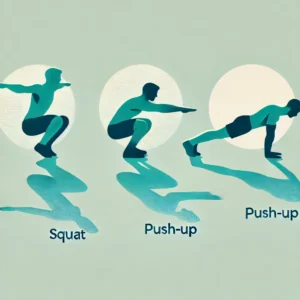
- Squats — 40 seconds (sit back, knees tracking over toes, chest up)
- Push-ups — 30 seconds (on your knees, or hands on a chair, if full push-ups are too hard)
- Mountain climbers — 30 seconds (slow and controlled; speed is not the goal)
- Glute bridge — 40 seconds (push through your heels, squeeze at the top)
- Dead bug — 30 seconds per side (keep your lower back flat on the floor)
- Rest — 20–30 seconds between exercises, 60 seconds between rounds
Cool-down — 2 minutes
Finish with gentle stretching for your hamstrings, quads, shoulders, and lower back. Breathe slowly and hold each stretch for about 20–30 seconds without bouncing.
Weeks 3 and 4: how to progress without equipment
Once the first two weeks feel manageable, pick one of these each week rather than all of them at once:
- Add a round. Go from 2 rounds to 3 rounds of the same circuit.
- Slow the lowering phase. Take 3 seconds to lower into each squat or glute bridge.
- Make an exercise harder. Push-ups with feet on a low step, squats to a slow 5-second lower, or mountain climbers with a longer reach.
- Add one exercise. Reverse lunges, step-ups onto a sturdy step, or a plank hold for 20–30 seconds.
Repeat the same session for 2 weeks before changing it. Muscle responds to a repeated stimulus, and repeating a routine makes it easier to see progress — which is what keeps beginners going.
How often should you train at home?
Three sessions a week is a solid beginner target. If you feel good and want more, add a fourth session or extend daily walking before you extend the workouts themselves. More is not automatically better: if sessions leave you so sore that you skip the next one, the plan is too big.
Walking counts. A 20–30 minute walk on rest days adds activity without adding recovery cost, and it is one of the easiest ways for a beginner to reach the weekly activity target.
How this fits into fat loss
Training is not the main driver of fat loss — your overall calorie intake is. What home training does is protect the muscle you have while you lose fat, improve how you feel day to day, and give your week a structure that supports eating habits. Think of the routine as the frame around your nutrition, not a replacement for it.
For the eating side, the NHS suggests aiming to lose around 0.5–1 kg (1–2 lb) a week, getting active for 150 minutes a week, and swapping sugary drinks for water. Those two changes together do more for fat loss than any single workout.
Common beginner mistakes
- Starting with too much. Five sessions in week one usually means zero sessions in week three.
- Chasing sweat instead of consistency. A boring routine done for a month beats a brutal one done twice.
- Skipping the warm-up. Two minutes of easy movement makes the main work feel better.
- Ignoring form to add reps. Half squats done fast build less than full squats done slowly.
- Relying on the workout to out-train the diet. You cannot out-train a consistently large surplus.
What to do when you miss a day
Do the next session. Missing one day does not matter; quitting for two weeks because you missed one day does. Keep the routine small enough that restarting is never a decision — just do 10 minutes and stop if you need to.
What bodyweight training does for fat loss, and what it does not
The honest version first: strength training at home will not out-burn a careless diet, and the fat-loss effect of exercise alone is smaller than most fitness content suggests. A 2026 network meta-analysis in BMJ Open pooled 43 randomised trials involving 2,315 women with overweight or obesity and compared exercise modalities against control. Structured exercise did produce meaningful improvements in body fat percentage, fat mass, BMI and waist circumference, with vigorous aerobic exercise showing the highest probability of being best. But no intervention produced a statistically significant improvement in lean body mass compared with control - resistance training simply ranked most favourably.
Two conclusions worth holding onto:
- Training changes body composition slowly, and the fat-loss contribution comes mainly through energy expenditure plus muscle preservation, not through any special fat-burning property of bodyweight work.
- What home strength training protects is the muscle you already have while your diet creates the deficit. That is a big deal for how you look at the end, even though it barely shows on the scale.
How much strength work you actually need
A 2026 meta-regression in Sports Medicine examined how weekly training volume and frequency relate to muscle growth and strength across the resistance-training literature. Two findings are directly useful for a beginner training at home:
- More volume means more size and strength, with 100% posterior probability that the effect is above zero - but with clear diminishing returns, and the flattening is much steeper for strength than for muscle size.
- Frequency matters for strength, not for muscle size. The evidence that training a muscle more often increases hypertrophy was compatible with a negligible effect; for strength, the effect was above zero, again with diminishing returns.
For someone starting at home with no equipment, the practical reading is: two to three full-body sessions per week, and add one set per exercise as the current sets stop being hard. Do not jump from two sets to six because a video said so. The curve rewards the first few extra sets and punishes the rest with fatigue.
Because frequency helps strength specifically, three shorter sessions beat one long weekly session for the same total sets. That is why this site's training split guide puts full-body work three times a week before it ever suggests a body-part split.
Protecting muscle while you lose fat
This is where home strength training earns its place. A 2018 meta-analysis in Nutrients pooled six randomised trials in which adults with obesity and older age followed a calorie-restricted diet with or without resistance training three times per week for 12 to 24 weeks. Resistance training offset 93.5% of the lean body mass that calorie restriction alone would have cost - 0.819 kg of lean mass preserved (95% CI 0.364 to 1.273), with similar fat mass reduction.
A 2022 meta-analysis in the Scandinavian Journal of Medicine & Science in Sports added the missing piece: how big a deficit is too big. When training in an energy deficit was compared with training without one, lean mass gains were impaired (effect size -0.57) while strength gains were comparable (effect size -0.31, not statistically significant). Meta-regression showed that an energy deficit of roughly 500 kcal per day prevented gains in lean mass altogether.
Put together, the rule is simple and it applies whether you train at home or in a gym: keep the deficit around 500 kcal or less, keep protein high, and keep the strength sessions. Aggressive crash diets plus no training is the combination that costs muscle. Body recomposition goes deeper on this trade-off.
Home training and belly fat: what the concurrent-training data shows
A 2026 systematic review and meta-analysis in BMC Public Health looked at 18 studies of concurrent training - aerobic work combined with resistance work - in adults with overweight or obesity. Combined training significantly reduced visceral fat (SMD -0.36, 95% CI -0.59 to -0.13) and subcutaneous fat (SMD -0.26, 95% CI -0.40 to -0.12), and the percentage reduction was roughly twice as large for visceral fat as for subcutaneous fat.
The conditions where effects were largest are worth noting because they are achievable at home with a pair of shoes and a wall:
- at least 3 sessions per week
- more than 180 minutes of activity per week
- interventions longer than 15 weeks
- vigorous-intensity aerobic exercise combined with moderate-to-low-intensity resistance training
That is a description of a brisk walking or cycling habit plus bodyweight circuits, done for four months. It is not a description of a 20-minute ab routine. If you want the cardio side without equipment, cardio for fat loss and walking for fat loss cover how to build it up.
Weeks 5 to 8: how to keep progressing with no equipment
Weeks one to four were about turning up. Weeks five to eight are about making the same movements harder without buying anything. Use one progression method at a time, and only when the last set of the current version still feels manageable with two repetitions left in reserve.
- Add reps first. Take each exercise from 8 to 12 reps before changing anything else. This is the cheapest form of progression and the safest for joints.
- Slow the lowering phase. Three seconds down on a squat or push-up increases time under tension without adding a single repetition.
- Make it unilateral. Split squats instead of two-legged squats, single-leg glute bridges instead of double. Half the base of support roughly doubles the challenge to balance and hip stability.
- Reduce the rest. Cutting rest from 90 to 60 seconds between sets raises the cardiovascular demand of the same workout - useful when time, not load, is your limit.
- Change leverage, not equipment. Feet elevated for push-ups, hands elevated for an easier regression, a towel under the knees for sliding hamstring curls.
A workable weeks 5 to 8 session, three times per week: warm-up 2 minutes, then three rounds of squats (12-15), push-ups (8-12, incline if needed), split squats (8 per leg), glute bridges (12-15), a 30-45 second plank and a 30-45 second wall sit, resting 60-90 seconds between rounds. Finish with 2 minutes of easy movement. If a round takes longer than 10 minutes, cut one exercise rather than the number of rounds.
The full progression logic, including how to swap exercises when something hurts, is in our home workout for fat loss guide, and the 10-minute workout is the version for days when 25 minutes is not available.
The honest limitation: adherence, not programming
A 2026 randomised trial in BMC Women's Health tested a six-week at-home programme with a strength-training focus. Of 36 participants randomised, 24 were retained at the post-intervention timepoint, attendance at the counselling sessions was 48%, and the study's own feasibility thresholds were not met - although satisfaction was high and the intervention group improved self-efficacy for physical activity and family social support.
Read that as the real obstacle. The exercises in a home programme are not the hard part; the hard part is being in the room three times a week in week six. Everything that makes adherence easier - a fixed time slot, a session that takes 12 minutes instead of 40, a plan written down before the week starts - matters more than the perfect exercise selection. Rest and recovery explains why more sessions is not automatically the fix.
Frequently asked questions
How many days a week should a beginner train at home?
Three full-body sessions, 20 to 30 minutes each, with a rest day between them where possible. Two is enough to make progress if three does not fit; one is enough to maintain the habit. Frequency helps strength specifically, which is why three short sessions beat one long one for the same total work.
Can bodyweight training build muscle, or do I need weights?
It can, especially as a beginner, because the first year of training is mostly about learning to produce force and the bodyweight movements are hard enough at first. What it cannot do forever is keep adding load. When you can do 20 clean push-ups and 25 squats, progression has to come from leverage, tempo, unilateral variations or added resistance - in that order.
Do I have to train to failure?
No. The dose-response data rewards more sets with diminishing returns, not maximal effort. Stopping each set with about two good repetitions left in reserve gets most of the benefit with far less soreness and far better adherence - which, per the trial above, is the actual bottleneck.
Should I do cardio before or after the strength session?
Either, as long as the cardio is easy or moderate. If you care about strength, put the strength work first while you are fresh. The concurrent-training evidence shows the combination works; it does not show that the order is critical for fat loss.
How many calories does a home workout burn?
Fewer than most apps claim - typically 120 to 250 kcal for a 25-minute bodyweight circuit depending on body size and effort, which is roughly one snack. That is why the workout supports the deficit rather than creating it, and why daily movement outside the session (steps, stairs, standing) is where the bigger numbers come from. Fat loss without exercise explains what the food side alone can do.
What if my knees or back hurt during the workout?
Stop that movement, not the session. Swap squats for a box squat to a chair, or split squats for step-ups; swap planks for a dead bug. Pain that is sharp, one-sided, or lasts more than a few days after training needs a clinician's opinion rather than a programme tweak. This article is not a substitute for individual assessment.
Sources
- Pelland JC, et al. The resistance training dose response: meta-regressions exploring the effects of weekly volume and frequency on muscle hypertrophy and strength gains. Sports Medicine, 2026. doi:10.1007/s40279-025-02344-w - volume increases both hypertrophy and strength with diminishing returns; frequency affects strength but not hypertrophy.
- Song S, et al. Effects of different exercise interventions on body composition in women with overweight and obesity: systematic review and network meta-analysis. BMJ Open, 2026. PMC13288685 - 43 trials, 2,315 women; exercise improved adiposity measures; no significant lean mass improvement versus control.
- Lin X, et al. Effects of concurrent training on fat mass and its distribution in individuals with overweight or obesity: systematic review, meta-analysis and exploratory regression analysis. BMC Public Health, 2026. PMC13126813 - 18 studies; visceral fat SMD -0.36, subcutaneous fat SMD -0.26; largest effects at 3+ sessions/week and over 15 weeks.
- Sardeli AV, et al. Resistance training prevents muscle loss induced by caloric restriction in obese elderly individuals: a systematic review and meta-analysis. Nutrients, 2018. PMC5946208 - 6 trials; resistance training 3x/week offset 93.5% of calorie-restriction lean mass loss (0.819 kg preserved).
- Murphy C, Koehler K. Energy deficiency impairs resistance training gains in lean mass but not strength: a meta-analysis and meta-regression. Scandinavian Journal of Medicine & Science in Sports, 2022. doi:10.1111/sms.14075 - lean mass gains impaired in a deficit (ES -0.57), strength gains comparable; a deficit of ~500 kcal/day prevented lean mass gains.
- Swinney KB, et al. Examining the feasibility and acceptability of a six-week at-home physical activity intervention with a focus on strength training: a randomized controlled trial. BMC Women's Health, 2026. PMC13628857 - 36 randomised, 24 retained; feasibility thresholds not met; higher self-efficacy in the intervention group.
- NHS - Physical activity guidelines for adults aged 19 to 64
- NHS - Strength and flexibility exercises
- WHO - Physical activity fact sheet
This article is general information for healthy adults, not medical advice. Stop and seek medical advice if you get chest pain, dizziness, or joint pain that persists beyond a few days. If you are pregnant, recovering from surgery or injury, or newly starting exercise with a heart condition, get individual guidance before beginning.
Next steps on this site: