Smart Eating Habits for Fat Loss
Losing fat becomes much easier when your eating habits work in the background, without willpower. You do not need an extreme diet, a cleanse, or a list of forbidden foods. You need a small number of habits you can repeat most days — and a plan for the days you do not.
On this page17 sections
Key Takeaways
- Build meals around the balanced plate: plenty of vegetables, a source of protein, and a sensible portion of whole-grain carbs.
- Aim for at least 5 portions of fruit and vegetables a day (80g counts as one portion) — it fills you up for very few calories.
- Protein at every meal is one of the most useful habits for appetite control while in a calorie deficit.
- Drinks are the easiest place to lose track of calories; swapping sugary drinks for water is a single change with a large effect.
- Aim to lose about 0.5–1 kg (1–2 lb) a week, not more.
1. Follow the balanced plate method
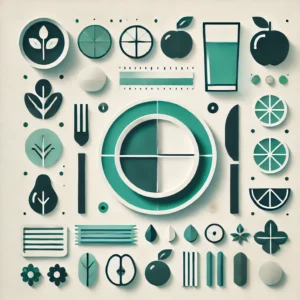
The plate model is the simplest way to make a meal work for fat loss without counting anything:
- Half the plate: vegetables or salad — volume and fibre for very few calories
- A quarter: lean protein — chicken, fish, eggs, beans, lentils, tofu, Greek yogurt
- A quarter: whole grains or starchy carbs — potatoes, rice, oats, whole-grain bread, pasta
The NHS Eatwell guidance uses the same idea: base meals on higher-fibre starchy carbohydrates, eat at least 5 portions of fruit and vegetables a day, choose some lean protein, and keep fatty and sugary foods as occasional rather than everyday items. When the plate already looks right, you do not have to measure anything.
2. Put protein in every meal
Protein is the habit that does most of the heavy lifting. It tends to be more filling per calorie than carbohydrate or fat, and it helps protect muscle while you lose fat. Practical ways to add it without cooking twice:
- Breakfast: eggs, Greek yogurt, cottage cheese, or a protein-rich smoothie
- Lunch: chicken, tuna, tofu, or beans added to a salad or wrap
- Dinner: a palm-sized portion of fish, chicken, lean meat, or lentils
- Snacks: boiled eggs, Greek yogurt, or a handful of nuts
3. Drink more water, and watch what you drink
Thirst is often mistaken for hunger, and drinking water with meals helps you slow down. More importantly, drinks are where calories hide: soft drinks, sweetened coffee, juice, and alcohol can add several hundred calories a day without making you feel full. The NHS suggests swapping sugary drinks for water as one of the most practical weight-loss changes you can make.
A simple rule: water or unsweetened tea and coffee as your default, everything else as an occasional choice rather than an automatic one.
4. Build meals around fibre
Fibre-rich foods — vegetables, fruit, beans, lentils, oats, whole grains — take longer to eat and keep you satisfied for longer. The practical version: add one extra vegetable to every meal you already cook, and keep fruit visible on the counter instead of biscuits.
5. Keep healthy snacks ready
Fat loss is usually broken by unplanned hunger, not by planned meals. Have something you actually enjoy ready to go:
- Greek yogurt with berries
- Fruit — apples, bananas, oranges
- A small handful of unsalted nuts
- Boiled eggs
- Hummus with carrot or cucumber sticks
Keep the portion inside a bowl or on a plate. Eating from the packet is where a handful becomes three.
6. Eat slowly enough to notice you are full
It takes time for fullness signals to catch up with what you have eaten. Simple habits that work: put your fork down between bites, drink water with meals, and aim to finish a meal in around 20 minutes rather than 5. You do not need to be perfect at this — doing it at your main meal is enough to start.
7. Plan for the situations that usually break the plan
- Eating out: check the menu first, choose the option with protein and vegetables, and treat sides and desserts as a deliberate choice.
- Weekends: keep the same breakfast and lunch as weekdays, and let dinner be the flexible meal.
- Stress or boredom: decide in advance what you will do instead for 10 minutes — walk, call someone, shower, or read.
- Takeaways: pick one main plus a side of vegetables rather than three sharing dishes.
What healthy eating habits are not
They are not cutting out carbohydrates, skipping meals to “bank” calories, or replacing meals with shakes. Very restrictive approaches are hard to repeat, and the habits you cannot repeat are the habits that stop working. Aim for a pace the NHS describes as reasonable: roughly 0.5–1 kg (1–2 lb) a week, which is a moderate deficit rather than a starvation diet.
Putting it together: a habit order that works
- Week 1: water instead of sugary drinks, and protein at breakfast.
- Week 2: half the plate vegetables at dinner, and one planned snack in the house.
- Week 3: plan dinners for the week and shop from that list.
- Week 4: slow down at your main meal and keep the other habits running.
One habit at a time, repeated until it stops needing effort. That is what makes fat loss stick.
What the evidence says about eating habits (and what it does not)
Eating habits get sold as personality traits - disciplined or undisciplined - when they are mostly a property of the environment around you. The most reliable finding in this area is the portion size effect: when adults are given larger portions of energy-dense food, they eat more, and they do not notice. A review in the Proceedings of the Nutrition Society describes the effect as robust, reliable and enduring, driven by a mix of estimation error, plate-cleaning habits and social norms about how much is a normal amount to eat.
That matters because it means the leverage is not in your character. It is in the size of the bowl, the glass you pour from, the snacks within reach, and whether the food is on the table or in a cupboard. The rest of this guide works through the specific habits with measurable evidence behind them, in order of how much they tend to change intake.
Portion control: which tools actually work
A 2021 systematic review and meta-analysis in Nutrients examined 36 publications on portion control tools - bowls, spoons, glasses, calibrated plates, educational aids and apps - and found a consistently modest but real effect on how much people serve and eat. The overall effect on food intake across 28 articles was d = -0.22, which is small; most of it came from one specific approach.
- Smaller bowls and smaller spoons: d = -0.48 for serving size and d = -0.22 for the amount eaten. This was the strongest single lever in the review.
- Reduced-size plates: d = -0.03, essentially no effect. The "use a smaller dinner plate" trick is the most repeated tip on the internet and the weakest one in the data.
- Calibrated or portion-marked tableware: drove the small weight-loss effect seen in nine comparisons (d = -0.20).
- Awareness: no measurable improvement - people used the tools without necessarily learning what a portion is.
The practical translation is unglamorous. Serve from a smaller bowl, use a smaller spoon, and put the serving dish away from the table instead of next to your hand. Portion-marked containers help mainly because they remove the guesswork on the things you eat every day. If you want the longer version of that system, see controlling portions without counting calories.
Protein: modest, real, and often oversold
Protein has become the most marketed nutrient in fat loss, so it is worth separating the effect size from the marketing. Two meta-analyses are the useful reference points.
A 2021 systematic review in Nutrients identified 375 randomised trials and pooled 43 unique trials on protein-rich diets in adults with excess body weight. Across 37 trials that compared weight outcomes, participants with higher protein intake (anywhere from 18% to 59% of energy) lost 1.6 kg more (95% CI 1.2 to 2.0) than controls, with some of the control conditions also energy-restricted.
A 2012 meta-analysis in the American Journal of Clinical Nutrition compared energy-restricted high-protein, low-fat diets with standard-protein, low-fat diets across trials averaging 12 weeks. High protein produced better changes in body weight (-0.79 kg), fat mass (-0.87 kg) and triglycerides (-0.23 mmol/L), and it blunted the loss of fat-free mass (+0.43 kg spared) and resting energy expenditure. Blood pressure, fasting glucose, insulin and cholesterol were similar between groups, and increased satiety was reported in only three of five studies that measured it.
So protein helps, by roughly a kilo over three months, and it protects lean mass while you are in a deficit. It is not a switch that turns off hunger. Practical target: put a palm-sized protein source in every meal, which for most adults lands in the range of 1.2 to 1.6 g per kg of body weight per day - the range most commonly studied. Protein intake for body recomposition has the per-meal breakdown.
Drinks: the highest-leverage single swap
If you change one habit this month, make it this one. It requires no cooking, no planning and no hunger.
A 2023 systematic review and meta-analysis in the American Journal of Clinical Nutrition pooled 85 articles covering children and adults. In adult cohort studies, each additional serving per day of sugar-sweetened beverages was associated with 0.42 kg higher body weight (95% CI 0.26 to 0.58), and the dose-response relationship was linear. In adult randomised trials, adding sugar-sweetened beverages to the diet produced 0.83 kg more weight gain (95% CI 0.47 to 1.19) than control, and removing them produced 0.49 kg more weight loss (95% CI -0.66 to -0.32).
A 2024 meta-analysis in Obesity Reviews looked specifically at substitution: six trials, 1,729 participants, follow-up of at least six months. Replacing an existing sugar-sweetened beverage intake with a non-caloric drink produced a BMI reduction of 0.31 kg/m² compared with continuing - roughly 0.5 to 1 kg depending on body size. One trial with a one-year intervention and two years of follow-up found BMI drifting back towards baseline after the intervention stopped, which is the honest caveat: the swap works while you keep doing it.
Two things follow. First, "diet" drinks are a reasonable bridge in that evidence base, not a health food. Second, the same logic applies to juice, sweetened coffee and alcohol - liquid calories are the ones that fail to register as food. Details for each in liquid calories and drinking water for fat loss.
Fibre: real satiety, smaller effect on how much you eat next
Fibre is usually described as a hunger killer. The data is more nuanced than that. A 2026 systematic review in Nutrition Reviews examined 48 randomised crossover studies on cereal fibre and appetite. Higher cereal fibre intake did improve satiety and other appetite ratings compared with a low-fibre control. But the effect on ad libitum energy intake - how much people actually ate at the next meal - was limited.
Fibre type mattered: rye and oat sources showed the strongest effects on appetite, while wheat, barley, resistant starch and soluble corn fibre showed weak effects. Note also that two of the four authors were employed by a breakfast cereal manufacturer (declared, with no financial sponsorship), so read the favourable framing with that in mind.
The practical version: keep the fibre habit because it improves fullness, digestion and diet quality, and because it is a reliable marker of a diet built on whole foods - not because it will automatically cut 300 kcal from your day. Fibre for fat loss covers sources and amounts.
Which habit to change first: ranked by expected effect
- Remove sugar-sweetened drinks. Largest measured effect from a single change, requires no hunger and no cooking.
- Shrink the serving vessel for dense foods - smaller bowl, smaller spoon, serving dish off the table. Small effect per meal, but it happens at every meal without willpower.
- Protein at every meal. About 0.8 to 1.6 kg extra loss over three months, plus lean mass protection while dieting.
- Fibre at two meals. Improves satiety ratings; do not expect it to police your intake for you.
- Slow down at the main meal. Keep this one because it supports the others and costs nothing, not because there is a large trial proving it moves body weight.
That order also happens to match the four-week habit sequence at the end of this article. If you are deciding where to start, start at number one and do not add number two until number one is boring. Habit stacking explains how to chain them so you are not relying on reminders.
Frequently asked questions
Do I need to count calories to eat smart?
No. Counting is one way to create a deficit, and it is accurate, but the habits above change intake without any arithmetic. Most people who track for a few weeks learn portion sizes and then stop; the tracking itself is a temporary tool. If you want the trade-offs, see calorie deficit for beginners.
How much protein is enough?
Most studies that show a benefit use 1.2 to 1.6 g per kg of body weight per day, spread over three or four meals. For a 70 kg adult that is roughly 85 to 110 g per day. Higher intakes are not automatically better, and anyone with kidney disease should get individual advice from a clinician rather than follow a general target.
Is fruit juice as bad as soft drinks?
Not identical, but it is still liquid sugar without the fibre of whole fruit. Whole fruit is more filling for the same energy. If you drink juice daily, treat it as a portion-controlled item rather than a health drink, and prefer whole fruit where you can. Best foods for fat loss has the swap list.
Does eating slowly actually help?
It is plausible and low-risk, but the trial evidence is far thinner than for drinks or portions - most studies are small and measure intake within a single meal. Keep it as a supporting habit: put the fork down between bites, aim for 20 minutes at your main meal, and do not build a plan around it.
Do I need a supplement to make these habits work?
No. None of the effects described above depend on supplements, and this site does not recommend them. Protein powder is convenient food, not a requirement - it is easier and cheaper to get the same protein from eggs, dairy, beans, fish or chicken.
What should a plate look like at a restaurant?
Order the protein first, add a vegetable or salad side, and decide about the drink before you sit down. Restaurant portions are the portion size effect at full strength, so the practical move is a smaller starter plus a main rather than two large courses. Eating out while losing fat has a scenario-by-scenario version.
Sources
- Vargas-Alvarez MA, et al. Impact of portion control tools on portion size awareness, choice and intake: systematic review and meta-analysis. Nutrients, 2021. PMC8229078 - 36 publications; overall intake effect d = -0.22; smaller bowls and spoons d = -0.48; reduced-size plates d = -0.03.
- Hetherington MM, et al. Understanding the science of portion control and the art of downsizing. Proceedings of the Nutrition Society, 2018. PMC6088523 - review of the portion size effect.
- Hansen TT, et al. Are dietary proteins the key to successful body weight management? A systematic review and meta-analysis. Nutrients, 2021. PMC8468854 - 43 unique trials; higher protein intake associated with 1.6 kg (1.2-2.0) greater weight reduction.
- Wycherley TP, et al. Effects of energy-restricted high-protein, low-fat compared with standard-protein, low-fat diets: a meta-analysis of randomized controlled trials. American Journal of Clinical Nutrition, 2012. doi:10.3945/ajcn.112.044321 - -0.79 kg weight, -0.87 kg fat mass, +0.43 kg fat-free mass spared; mean diet duration 12.1 weeks.
- Nguyen M, et al. Sugar-sweetened beverage consumption and weight gain in children and adults: a systematic review and meta-analysis of prospective cohort studies and randomized controlled trials. American Journal of Clinical Nutrition, 2023. doi:10.1016/j.ajcnut.2022.11.008 - 85 articles; adults: +0.42 kg per serving/day, adding SSBs +0.83 kg, removing -0.49 kg.
- Tobiassen PA, Koster-Rasmussen R. Substitution of sugar-sweetened beverages with non-caloric alternatives and weight change: systematic review of randomized trials and meta-analysis. Obesity Reviews, 2024. doi:10.1111/obr.13652 - 6 trials, 1,729 participants; BMI -0.31 kg/m²; regression after intervention ended.
- Machalias A, et al. Cereal fibers and satiety: a systematic review. Nutrition Reviews, 2026. PMC12696374 - 48 crossover studies; favourable satiety, limited effect on ad libitum intake; rye and oat stronger than wheat and barley.
- NHS - Eating a balanced diet (Eatwell Guide)
- NHS - Tips to help you lose weight
- WHO - Healthy diet fact sheet
This article is general information for healthy adults, not medical advice. It does not cover supplements, and it is not suitable as a plan for anyone with an eating disorder, kidney disease, diabetes on medication, or during pregnancy - those situations need individual advice from a clinician or dietitian.
Next steps on this site: