Drinking Water for Weight Loss: How Much Helps
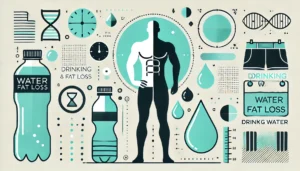
Water does not burn fat, and no amount of it will cancel what you eat. What it does is support the habits that do the work: it makes training feel easier, it can take the edge off appetite before a meal, and if it replaces soft drinks it removes calories you would otherwise drink.
On this page13 sections
That is the honest version of the claim, and it is more useful than the usual rule of thumb. Many beginners ask how much water you actually need to support fat loss — the answer is smaller than most articles suggest, and it depends more on replacing the right drinks than on forcing extra litres down.
This article walks through the evidence in order: what the trials found, what the 2024 systematic review found, what water cannot do, how much you actually need, and a hydration routine that supports fat loss without turning it into a project.
Key Takeaways
- Water supports fat loss indirectly — through hydration, training quality, a small appetite effect and, most of all, replacing sugary drinks.
- There is no fat-loss-specific water target. NHS guidance is 6–8 cups or glasses of fluid a day for most adults (roughly 1.5–2 litres of total fluid), more when you are active, hot, pregnant, breastfeeding or unwell.
- Two 12-week trials found about 1.2–2 kg extra weight loss when 500 ml of water was drunk before main meals alongside a diet. Both were small, and one difference lost statistical significance after adjustment.
- The 2024 systematic review of water trials found 18 eligible randomised trials, with 10 positive and 8 negative results — cheap and safe, but not powerful.
- The "water boosts your metabolism" claim has not survived controlled re-testing; any effect is a few tens of kilocalories at most.
- Pale-yellow urine and 6–8 glasses a day are better practical guides than counting litres.
Does Drinking Water Help Fat Loss?
Not directly. Water contains no calories and does not dissolve body fat. It helps fat loss indirectly, in four modest ways:
- It keeps you hydrated enough to train and move well. Dehydration makes exercise feel harder, and harder sessions are the ones people skip.
- It can soften appetite before a meal — a real but small and inconsistent effect, covered in detail further down.
- It can prevent thirst being mistaken for hunger, which matters mostly if you already eat on a schedule and are unsure whether you are hungry or just dry.
- It displaces sugary drinks, which is the only place water produces a calorie difference large enough to show up on a scale over months.
So the useful question is not "how much water burns fat" but "where can water replace something else in my day". Everything below serves that question.
For the nutrition fundamentals that actually drive fat loss, start here:
What the Controlled Trials Show
Two randomised trials have tested the "drink water before meals" idea directly, and both found a real but modest effect.
In the first trial, 48 overweight and obese adults aged 55–75 (BMI 25–40) followed a calorie-reduced diet for 12 weeks. Half of them also drank 500 ml of water before each main meal. The water group lost about 2 kg more than the diet-only group, and their rate of weight loss was roughly 44% faster over the study period. Interestingly, the acute effect on how much they ate at a meal was clear at the start (498 kcal with a water preload versus 541 kcal without) but had faded by week 12 (480 versus 506 kcal, p = 0.069). In other words, the benefit looked more like a useful daily habit than a trick that keeps working forever (Dennis et al., Obesity, 2010).
The second trial recruited 84 adults with obesity from general practices in Birmingham, England. Everyone received a short weight-management consultation; half were asked to drink 500 ml of water 30 minutes before each main meal, the other half were asked to imagine their stomach was full before meals. After 12 weeks the water group had lost 1.3 kg more (95% CI −2.4 to −0.1 kg). After adjusting for age, sex, ethnicity and deprivation the difference was 1.2 kg and was no longer statistically significant (95% CI −2.4 to 0.07 kg, p = 0.063) — the authors called the evidence "preliminary" (Parretti et al., Obesity, 2015).
- What the studies support: a cheap, harmless habit that may add a small edge when you are already in a calorie deficit.
- What they do not support: water as a standalone fat loss method, or a specific number of litres that guarantees results.
- Limits to keep in mind: both trials were small (48 and 84 people) and short (12 weeks), and neither could be blinded — people know whether they are drinking water.
What the 2024 Systematic Review Found
The best summary of this question to date is a 2024 systematic review in JAMA Network Open, which screened 1,464 records and found only 18 eligible randomised trials of changing daily water intake — a surprisingly small evidence base for such a widely repeated recommendation. Trial durations ran from 4 days to 5 years, and the interventions were simply a recommendation to drink a specified extra (or smaller) amount each day.
What it found on weight: consuming additional water was associated with greater weight loss, ranging from 44% to 100% more than control conditions. That sounds impressive until you read the second half of the result — 10 of the 18 trials (55%) reported at least one positive result and 8 (44%) reported negative results. The review's own conclusion is that the quality and quantity of evidence is limited. The one other benefit with reasonable support was fewer kidney stone events (15 fewer per 100 participants over 5 years).
- What this supports: drinking more water is cheap, safe, and in some trials nudges weight loss — worth doing because it costs nothing, not because it is powerful.
- What it does not support: a specific litre target, a percentage figure you can plan around, or water as a treatment for excess fat.
- Why the range is so wide: the trials measured different populations, different starting intakes, different extra volumes, and most could not be blinded.
Does Water Really "Speed Up" Your Metabolism?
This claim comes from a widely shared 2003 study. Fourteen healthy young adults drank 500 ml of water while inside a whole-room calorimeter. Their metabolic rate rose by about 30% for 30–40 minutes, worth roughly 100 kJ in total — and about 40% of that came simply from warming the cold water up to body temperature. The authors estimated that two litres a day could add around 400 kJ (about 95 kcal) to energy expenditure, and suggested this should be counted in weight loss programmes (Boschmann et al., JCEM, 2003).
Later studies could not reproduce it. A randomized crossover study found that drinking distilled water at room temperature did not increase energy expenditure (p = 0.34); neither did salty water, while a sugary drink did. Only water cooled to 3 °C produced a small rise of 4.5% over 60 minutes — less than the theoretical energy cost of warming it to body temperature. The authors concluded the results "cast doubt on water as a thermogenic agent for the management of obesity" (Brown et al., JCEM, 2006).
A third study compared drinking 500 ml of distilled water with sham drinking (going through the motion of drinking without swallowing the water) in 27 young adults whose BMI ranged from 18.5 to 34. Energy expenditure rose by less than 3% above baseline and was not significantly different from sham drinking. Fat oxidation did not increase either: the small fall in respiratory quotient appeared after sham drinking too. The response was not related to body fatness or abdominal fat (Charrière et al., Nutrition & Diabetes, 2015).
Honest summary: if water adds anything to daily energy expenditure, it is a few tens of kilocalories at most, and the effect is not reliably detectable. It is nowhere near enough to outrun what you eat. Treat "metabolism-boosting water" as a myth, not a strategy.
What Water Will Not Do for Fat Loss
Four claims are worth retiring explicitly, because each one hides a lever that does work.
- It will not burn body fat. The metabolism effect reported in 2003 has not held up in controlled re-tests at normal drinking temperatures.
- It will not replace a calorie deficit. Fat loss still comes down to eating slightly less than you burn — see Calorie Deficit Explained for Beginners.
- It will not cancel out liquid calories. Sugary coffee, juice and soft drinks can quietly add hundreds of calories a day — see Liquid Calories and Fat Loss.
- It will not fix water retention. Day-to-day scale swings are mostly fluid and food in your gut, not fat — see Why You Are Not Losing Fat.
How Much Water Do You Actually Need?
You do not need to force down a fixed number of litres. UK guidance is refreshingly simple: aim to drink enough during the day so that your pee is a clear pale yellow colour. In the Eatwell Guide, the recommendation is 6 to 8 cups or glasses of fluid a day — roughly 1.5 to 2 litres of total fluid — and more if you are pregnant or breastfeeding, in a hot environment, physically active for long periods, or ill and recovering (NHS, Water, drinks and hydration).
One population study shows how ordinary that intake really is. Among 5,817 adults aged 40–70 in Salzburg who met objective hydration criteria, the median was 1.3–1.5 litres of plain water a day; their total water intake, including food and other drinks, was about 2.9–3.0 litres a day. The plain-water figure is well below the "2–3 litres of water" rule that circulates online — that rule counts total fluid, not water you must drink from a bottle.
A few useful details from the same NHS guidance:
- Water, lower-fat milk and lower-sugar drinks — including tea and coffee — all count towards daily fluid intake.
- Some fluid also comes from the food you eat.
- Fruit juice and smoothies should be limited to a maximum of one small glass (150 ml) a day, taken with a meal, because of their sugar content.
- Swap sugary drinks for water, diet or no-added-sugar options.
- Drink extra fluids after sweating from physical activity, and when you are unwell — water is the best replacement.
Two practical cautions. First, spread fluids through the day rather than drinking a very large volume at once — that is easier on your body and easier to keep up. Second, if you have been told to restrict fluid because of a heart, kidney, liver or other medical condition, follow your clinician's advice rather than any general guideline. Drinking very large volumes quickly can dangerously dilute the sodium in your blood; that risk matters most during long endurance events and for people whose kidneys do not handle fluid normally.
Can Water Help Control Appetite?
Appetite is where water has better evidence, at least in the short term — and also where the details contradict the usual advice.
In a laboratory study, 14 healthy young men ate an unlimited porridge breakfast twice, once after drinking 568 ml (one pint) of water immediately beforehand and once with no preload. They ate 1,967 kJ after the water versus 2,551 kJ without it — a difference of about 584 kJ (roughly 140 kcal) in a single meal. They also reported more fullness and less hunger (Corney et al., European Journal of Nutrition, 2016).
An MRI study in 19 healthy men tested why. After a 500 kcal liquid meal, a larger water load (350 ml) stretched the stomach more than a small one (50 ml) and reduced hunger (p = 0.023) and increased fullness (p = 0.030) more. But brain activity related to satiety did not differ between the two, and appetite ratings did not track the brain measurements. Stomach stretch contributes to fullness, but it is only one small signal among many (Camps et al., Appetite, 2018).
"Drink a glass before meals" also does not work the same way for everyone. A crossover study gave 29 young adults (21–35 years) and 21 older adults (60–80 years) an unlimited lunch on two occasions, with or without a water preload 30 minutes earlier (375 ml for women, 500 ml for men). In the younger group, the preload changed nothing: 913 kcal with water versus 892 kcal without (p = 0.65). In the older group it cut intake from 682 to 624 kcal (p = 0.02), and the effect came mostly from older men (Van Walleghen et al., Obesity, 2007). So the trials that show a benefit may be telling you more about the age of the participants than about water.
There is also a counter-intuitive finding worth knowing. In a study of adults eating meals that varied in portion size, researchers recorded how often people alternated between bites of food and sips of water. Across all meals, switching more frequently was related to eating more food — 5.7 g more for each additional switch (p = 0.004). Drinking a lot of water during the meal was also linked to eating more, though that effect disappeared once switching was accounted for. The authors' interpretation: alternating lets you keep eating past the point where the food stops tasting as good (Cunningham et al., Appetite, 2023).
- Before the meal (about 30 minutes earlier) is the timing the trials actually tested.
- During the meal, sipping between bites may make it easier to eat more, not less — if your problem is portion control, keep the water for between meals.
- If you are younger and the pre-meal glass does nothing, that is consistent with the data; keep it as a habit if you like it, but do not expect it to shrink meals.
- The acute appetite effect faded by week 12 in the 2010 trial, so do not expect the same benefit forever.
- It works best next to the habits that do move appetite over months: protein and fibre at each meal, and portion awareness.
Protein and fibre are the appetite levers that hold up over months:
Where the Effect Is Real: Replacing Sugary Drinks
The most defensible way water helps weight is not by adding water — it is by replacing something. That distinction is where the biggest numbers show up.
In a 12-month analysis within the A TO Z weight loss trial, 118 adults who had been drinking less than a litre of water a day were followed with repeated 24-hour dietary recalls. Replacing all sweetened caloric beverages with water was predicted to reduce total energy intake by about 200 kcal a day, sustained over the year — without any instruction to eat less food (Stookey et al., Obesity, 2007).
In the same trial, 173 premenopausal women aged 25–50 who reported drinking less than a litre of water a day were followed for 12 months with DXA body-composition scans. Increases in drinking water were associated with significant loss of body weight and fat over time, independent of diet group, other beverages, food intake and physical activity (Stookey et al., Obesity, 2008). That is an observational analysis inside a trial, not a randomized comparison — it shows an association, not proof of cause.
A nationally representative US sample of 18,311 adults points the same way, and shows how small the per-unit effect is. Each one percentage-point increase in the share of daily water that was plain water was associated with 8.58 kcal less total daily energy intake (95% CI 7.87–9.29), including 1.43 kcal less from sugary drinks. The association was stronger in men and in younger adults, and — importantly — overall diet quality (Healthy Eating Index-2010) did not improve. Drinking more water did not make people eat better food; it displaced a little drink energy (An & McCaffrey, Journal of Human Nutrition and Dietetics, 2016).
- If you drink soft drinks, juice or sweetened coffee daily, switching those to water is the version of "drink more water" with real calorie maths behind it.
- If you already drink mostly water, adding more of it changes very little — the per-point effect in the US data is under 10 kcal a day.
- Water substituting for sugary drinks is a swap, not a boost. See liquid calories and fat loss for the arithmetic.
Signs You May Not Be Drinking Enough Water
- Frequent headaches
- Low energy
- Constant hunger
- Dark-coloured urine
These signs are non-specific — poor sleep, a hard training block and a calorie deficit all produce the same feelings — so treat them as a prompt to check urine colour, not as a diagnosis. Mild dehydration often improves quickly once you drink regularly through the day.
Common Hydration Myths
- "You must drink exactly 8 glasses." Six to eight cups or glasses of fluid a day is the NHS range for most adults, and tea, coffee and lower-fat milk count towards it. The exact number matters less than the pattern: fluid spread across the day, and pale-yellow urine as the check.
- "More water means faster fat loss." Beyond your needs, the extra fluid is simply excreted. The 2024 review found weight differences in some trials, but 8 of 18 trials were negative.
- "Coffee and tea don't count." They do, according to NHS guidance. What adds calories is what you put in them — sugar, syrups and full-fat milk.
- "Cold water burns calories." The 4.5% rise measured in one study over 60 minutes was smaller than the theoretical cost of warming the water, and room-temperature water showed no effect at all.
- "Water flushes fat out." Fat is broken down through normal metabolism, and drinking more fluid does not change the rate at which that happens — the calorie deficit does.
A Simple Hydration Plan That Supports Fat Loss
None of this requires tracking litres. A workable routine borrows the parts of the evidence with the best support and ignores the rest:
- Start the day with a glass of water, before coffee or breakfast.
- Drink a glass about 30 minutes before each main meal — this is the pattern the trials actually tested.
- Keep a bottle where you work; refill it at set times rather than waiting for thirst.
- Count unsweetened tea and coffee towards your total, and keep added sugar out of them.
- Add extra fluid on training days and hot days, and check urine colour as your guide.
- Attach drinking water to habits you already have, so it does not depend on willpower.
- Keep the water for between meals if portion control is your weak point, rather than sipping between bites.
Pairing water with existing routines is easier than creating a new routine from scratch:
Hydration also supports the days you train and walk:
Frequently Asked Questions
Does drinking water burn fat?
No meaningful amount. The much-quoted 30% rise in metabolic rate after drinking 500 ml of water (roughly 100 kJ) was measured once in 14 people and did not reappear when re-tested against room-temperature water or against sham drinking. Water supports fat loss indirectly — through better hydration, training quality and a small appetite effect — but it does not burn fat.
How much water should I drink to lose fat?
There is no fat-loss-specific amount. NHS guidance is 6 to 8 cups or glasses of fluid a day for most people, more when you are active or hot, using pale-yellow urine as a practical check. Drinking more than that does not speed up fat loss.
Does drinking water before meals help you eat less?
In one small study, 568 ml of water immediately before a meal cut intake by roughly 140 kcal at that meal. Over 12 weeks, two trials found about 1.2–2 kg extra weight loss when water was combined with a diet, though one of those differences lost statistical significance after adjustment for other factors. It is a cheap habit worth testing on yourself for a few weeks.
Do tea and coffee count towards my daily fluid?
Yes. NHS guidance includes water, lower-fat milk and lower-sugar drinks such as tea and coffee in daily fluid intake. What adds calories is what you put in them — sugar, syrups and full-fat milk. Keep caffeine sensible, and remember that being pregnant changes the recommended caffeine limit.
Can drinking more water reduce bloating or "water weight"?
Bloating and daily scale swings are usually fluid shifts, salt, carbohydrate and gut contents — not fat. Drinking water will not remove them, and severe restriction of fluid is not a fat loss strategy. If bloating is persistent or painful, or you have swelling in your legs, that is a reason to see a clinician.
Is it possible to drink too much water?
Yes, if very large volumes are drunk quickly — this can dangerously dilute the sodium in your blood. It matters most during long endurance events and for people whose kidneys do not handle fluid normally. In everyday life, spread your drinking across the day rather than gulping litres at once, and follow medical advice if you have been given a fluid restriction.
Does drinking water help you lose belly fat?
No. There is no mechanism by which water targets fat in one area, and no trial has shown spot reduction from drinking water. Where you lose fat from is determined by genetics, sex and hormones, not by what you drink. Water can help your overall deficit slightly — mostly by replacing sugary drinks — and that is the honest limit of the claim.
Is 2 litres of water a day enough?
For most healthy adults in a temperate climate, yes — 2 litres sits comfortably inside NHS guidance of 6 to 8 cups or glasses of fluid a day, and it is close to the total water intake (about 2.9–3.0 litres including food and other drinks, of which roughly 1.3–1.5 litres was plain water) seen in adults who met objective hydration criteria in a large Austrian study. It is not a target that produces fat loss, and going well above it does not add any. Needs rise with heat, exercise, pregnancy, breastfeeding and illness.
Keep Reading
- Smart eating habits
- Healthy snacks for fat loss
- 10-minute fat-burning workout
- Sleep for fat loss
- Beginner fat loss guide
Sources
- NHS. Water, drinks and hydration (6 to 8 cups or glasses of fluid a day; pale-yellow urine as a practical check; water, lower-fat milk and lower-sugar drinks including tea and coffee count; fruit juice and smoothies limited to 150 ml a day with a meal; extra fluid after sweating and during illness).
- WHO. Healthy diet — fact sheet (limits on free sugars, salt and fat quality; fibre at least 25 g a day for adults; water as the drink of choice).
- Dennis EA et al. Water consumption increases weight loss during a hypocaloric diet intervention in middle-aged and older adults. Obesity, 2010. (n = 48, 55–75 years, 12 weeks: ~2 kg greater weight loss with 500 ml pre-meal water; acute meal-energy effect did not persist to week 12.)
- Parretti HM et al. Efficacy of water preloading before main meals as a strategy for weight loss in primary care patients with obesity: RCT. Obesity, 2015. (n = 84, 12 weeks: 1.3 kg greater loss, 95% CI −2.4 to −0.1; not significant after adjustment, 1.2 kg, 95% CI −2.4 to 0.07.)
- Corney RA, Sunderland C, James LJ. Immediate pre-meal water ingestion decreases voluntary food intake in lean young males. European Journal of Nutrition, 2016. (n = 14; 1,967 kJ versus 2,551 kJ at an ad libitum breakfast; increased fullness and satisfaction.)
- Camps G et al. Just add water: effects of added gastric distention by water on gastric emptying and satiety related brain activity. Appetite, 2018. (n = 19; a 350 ml water load increased gastric volume and lowered hunger, p = 0.023, but brain activation did not differ.)
- Boschmann M et al. Water-induced thermogenesis. Journal of Clinical Endocrinology & Metabolism, 2003. (n = 14; 500 ml water raised metabolic rate ~30%, total ~100 kJ, about 40% from warming the water; effect reduced by beta-blockade.)
- Brown CM, Dulloo AG, Montani JP. Water-induced thermogenesis reconsidered: the effects of osmolality and water temperature on energy expenditure after drinking. JCEM, 2006. (Room-temperature water did not increase energy expenditure, p = 0.34; 3 °C water raised it only 4.5%.)
- Charrière N et al. Water-induced thermogenesis and fat oxidation: a reassessment. Nutrition & Diabetes, 2015. (n = 27, BMI 18.5–33.9; less than 3% rise in resting energy expenditure, not different from sham drinking; no effect on fat oxidation.)
- Hakam N et al. Evidence-based message of the health benefits of water intake: a systematic review. JAMA Network Open, 2024. (18 randomized trials, durations 4 days to 5 years: additional water associated with 44%–100% more weight loss than control, but 10/18 trials positive and 8/18 negative; overall quality and quantity of evidence limited; 15 fewer kidney stone events per 100 participants over 5 years.)
- Stookey JD et al. Replacing sweetened caloric beverages with drinking water is associated with lower energy intake. Obesity, 2007. (n = 118, 12 months: replacing all sweetened caloric beverages with water predicted about 200 kcal/day lower energy intake.)
- Stookey JD et al. Drinking water is associated with weight loss in overweight dieting women independent of diet and activity. Obesity, 2008. (n = 173 premenopausal women, 25–50 years, repeated DXA over 12 months; increases in water associated with weight and fat loss independent of diet group and covariates — observational analysis within a trial.)
- An R, McCaffrey J. Plain water consumption in relation to energy intake and diet quality among US adults, 2005–2012. Journal of Human Nutrition and Dietetics, 2016. (n = 18,311: each 1 percentage-point increase in plain water share associated with 8.58 kcal/day lower total energy intake, 95% CI 7.87–9.29; no improvement in Healthy Eating Index-2010.)
- Van Walleghen EL et al. Pre-meal water consumption reduces meal energy intake in older but not younger subjects. Obesity, 2007. (n = 29 young, 21–35 years: 892 vs 913 kcal, p = 0.65; n = 21 older, 60–80 years: 682 vs 624 kcal, p = 0.02.)
- Cunningham PM et al. Switching between bites of food and sips of water is related to food intake across meals varying in portion size. Appetite, 2023. (Each additional switch between bites and sips was related to 5.7 g more food eaten, p = 0.004; the water effect itself was not significant after accounting for switching.)
- Stookey JD et al. Hydration and health at ages 40–70 years in Salzburg, Austria is associated with a median total water intake over 40 mL/kg including at least 1 L/d plain drinking water. Frontiers in Public Health, 2025. (n = 5,817; healthy adults meeting hydration criteria: median plain water 1.3–1.5 L/day and total water 2.9–3.0 L/day.)
This article is general information for healthy adults, not medical advice. If you have kidney, liver or heart disease, are pregnant or breastfeeding, or you take medication that affects fluid balance, ask a qualified clinician how much you should drink before changing your habits. Persistent thirst, unexplained weight change, swelling in the legs, or a sudden change in urine colour or output should be assessed by a doctor.