The Complete Beginner’s Guide to Fat Loss
Losing fat does not have to be confusing, extreme, or complicated. This guide explains exactly how fat loss works, what genuinely matters, and how to start with clear steps that fit a busy life.
On this page12 sections
If you have tried diets, workouts or routines before and nothing stuck, the problem is usually not your willpower. It is that the plan asked for too much, too fast, and gave you no way to tell whether it was working.
Updated 10 November 2026: this article adds what measured data say predicts success in the first eight weeks, plus the protein and step targets with the trials behind them.
Key takeaways (if you read nothing else)
- Fat loss = a calorie deficit. Everything else is a tool for making that deficit easier to hold.
- Aim for 0.5–1 kg (roughly 1–2 lb) per week. Slower is more sustainable and protects muscle better than crash dieting.
- Protein and strength training protect your muscle while you lose fat — this is the difference between looking lean and looking smaller.
- 150–300 minutes of moderate activity per week is the public-health baseline; walking counts.
- Consistency beats intensity. A plan you follow at 80% for a year beats a perfect plan you quit in three weeks.
What is fat loss?
Fat loss happens when your body uses more energy than it takes in from food. That is the calorie deficit. It does not require starvation, cutting out entire food groups, or training until you cannot move — it requires eating slightly less and moving slightly more, consistently enough for your body to notice.
Fat loss is not the same as weight loss. The scale measures everything: fat, muscle, water, undigested food. You can lose weight and still look softer if the loss came from muscle, or stay a similar weight and look visibly leaner if you lost fat and kept muscle. That is why progress is best judged with a tape measure, photos, how clothes fit, and strength in the gym — not the scale alone.
How much should you eat?
You do not need to count every calorie forever, but you do need a rough idea of your intake. Two practical methods:
- Small deficit: eat roughly 300–500 calories below what you burn per day. For most adults that means slow, steady fat loss without constant hunger.
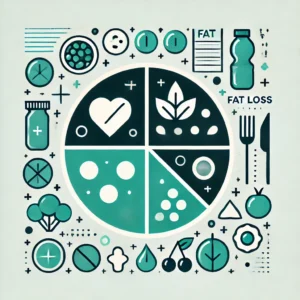
- Plate method: half the plate vegetables, a quarter protein, a quarter starch, plus a little fat. This controls calories without any app.
Protein deserves special attention. A 2022 systematic review and meta-analysis in the Journal of Cachexia, Sarcopenia and Muscle found that increasing daily protein intake supports lean body mass and muscle strength in healthy adults. In a deficit, protein also keeps you full — which, in practice, is what makes the deficit survivable.
The NHS 12 tips to help you lose weight are a good sanity check on the basics: do not skip breakfast, eat regular meals, eat plenty of fruit and vegetables, stay active, drink water, and do not ban all treats. Bans create the binge-and-quit cycle.

What Predicts Success in the First Eight Weeks
Beginners usually want to know whether they are on track. The data give a surprisingly specific answer: the first two months predict the rest, and they predict it better than any monitoring habit.
In a primary-care lifestyle trial, 452 participants in the intervention arm (88% women, 74% Black, mean BMI 37.3) were weighed at home daily and in clinic. Percentage weight change at 2, 4 and 8 weeks explained 15%, 28% and 50% of the variance in weight change at six months. The 8-week figure still explained 32% of the change at 12 months and 16% at 24 months. How often people weighed themselves, and whether those weigh-ins followed the expected trajectory, predicted outcomes on their own — but added little once the early weight change was known (Höchsmann et al., 2023).
Self-weighing by itself is a small lever. A randomised trial in 107 adults with obesity in rural Thailand compared twice-daily self-weighing plus weekly counselling visits against usual care for 20 weeks. The intervention group lost 1.2 kg while controls gained 0.3 kg (p = 0.007), a difference of about 1.0 kg, with small improvements in BMI and blood pressure (Liampeng et al., 2023). Real, cheap, and nowhere near sufficient on its own.
What to do with that: judge your first eight weeks by direction, not by any single weigh-in, and treat an off-track 8-week trend as a reason to change one variable now rather than after six months. If the trend is flat, fat loss plateau explained is the diagnostic checklist; if you have already fallen off once, restart fat loss after falling off track and consistency over perfection cover the restart without the guilt spiral.
Limitation worth stating: this was prediction inside a trial, not a guarantee. Early weight change includes water and glycogen, so a fast first week is not proof that the plan is ideal — it is a signal that the deficit exists.
The 4 pillars of effective fat loss
- 1. Nutrition (the biggest lever). You cannot out-train a diet that is consistently above your needs. Focus on a small deficit, adequate protein, and meals you actually enjoy.
- 2. Training (the muscle-protecting lever). Resistance training 2–4 times per week tells your body to keep the muscle you have. It also changes how you look at the same body weight.
- 3. Movement (the easy-volume lever). Everyday activity — steps, walking, stairs, standing — burns more over a week than one heroic workout. A meta-analysis of 15 international cohorts published in The Lancet Public Health (2022) found that higher daily step counts were associated with lower all-cause mortality in adults.
- 4. Recovery (the multiplier). Poor sleep raises appetite and reduces training quality. Under-sleeping makes every other pillar harder to hold.
Protein and Steps: Two Numbers Worth Setting First
Most beginner plans fail on the boring variables rather than the exciting ones. Two of them are worth fixing before anything else.
Protein
A review of the clinical evidence concluded that higher-protein energy-restricted diets produce greater weight and fat-mass loss and better preservation of lean mass than lower-protein diets, with the useful range around 1.2–1.6 g per kg of body weight per day and roughly 25–30 g per meal. Short-term controlled feeding studies were consistent; longer-term studies were mixed, and the authors attributed the inconsistency mainly to compliance rather than to biology (Leidy et al., 2015).
A meta-regression of 49 trials in 1,863 participants found that protein supplementation added 0.30 kg of fat-free mass on average during resistance training, with the benefit plateauing at about 1.62 g per kg per day — beyond that, more protein bought nothing measurable (Morton et al., 2018).
The size of the stakes: in a review of 52 studies in middle-aged and older adults, 81% of groups using calorie restriction alone lost 15% or more of their total weight as fat-free mass, against 39% of groups where exercise was added (Weinheimer et al., 2010). Protein and strength work are the two things that change which side of that split you land on — see protein intake for body recomposition for the numbers per meal.
Steps
An umbrella review pooling 11 systematic reviews and 14 cohort studies found a non-linear relationship between daily steps and all-cause mortality, with a protective threshold at about 3,143 steps per day, a pooled hazard ratio of 0.91 per additional 1,000 steps per day, and the lowest risk in the group above 12,500 steps (0.35, 95% CI 0.29–0.42). The authors also noted that the exact threshold moved between reviews because exposure was quantified differently (Rodríguez-Gutiérrez et al., 2024).
Read that as: the direction is robust, the cut-off is not gospel. For a beginner, a floor of 7,000–8,000 steps most days is a defensible target that sits above the mortality threshold without requiring a gym. These are observational data, so they show association, not proof that hitting a step count causes the outcome. If you prefer training in short blocks at home, home workout for fat loss covers that route.
How much exercise do you actually need?
Less than most people think, and more consistently than most people do:
- Strength training: 2–3 sessions per week as a beginner, 30–45 minutes, covering squats, hinges, pushes, pulls and carries.
- Cardio: 120–150 minutes per week of moderate work (brisk walking, cycling, incline treadmill) spread over 3–5 sessions.
- Steps: aim for 7,000–10,000 per day. This is the underrated part — it adds up to more energy expenditure than any single workout.
The World Health Organization recommends 150–300 minutes of moderate-intensity aerobic activity per week for adults, plus muscle-strengthening activities on two or more days. A 2024 dose-response meta-analysis in JAMA Network Open found that while even 30 minutes of aerobic exercise per week was associated with modest reductions in weight and waist circumference, more than 150 minutes per week may be needed for clinically important reductions.
Translation: walking alone is not a fat-loss strategy, but walking plus a modest deficit plus strength training is a very effective one.
How to start: your first four weeks
Week 1 — observe, do not overhaul. Eat normally but write down what you eat and count your daily steps. Most people find one or two obvious problem areas immediately.
Week 2 — one change. Add protein to breakfast and take a 20–30 minute walk daily. Nothing else changes. This builds the habit without the shock.
Week 3 — add training. Two full-body strength sessions per week, 30 minutes each. Use movements you can control rather than the heaviest weights you can move.
Week 4 — create the deficit. Now trim portions slightly or swap high-calorie drinks for water. Target 300–500 calories below maintenance and hold it.
Then repeat weeks 2–4 for as long as progress continues, adjusting only when the scale and measurements stall for 3–4 weeks.
Common mistakes that slow fat loss
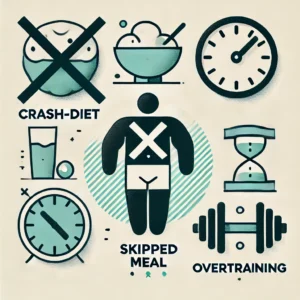
- Cutting calories too hard. Fast at first, then hunger, poor training and rebound. Slow losses stick.
- Doing only cardio. You lose weight, but often muscle too — the result is a smaller version of the same shape.
- Ignoring liquid calories. Sweetened coffee, juice and alcohol can quietly erase a 400-calorie deficit.
- Weighing yourself daily and reacting to every number. Water weight moves 1–2 kg in a day. Use weekly averages.
- Starting with an all-or-nothing plan. Five gym days and a strict diet in week one is the fastest route to quitting in week three.
- Not sleeping. Sleep loss raises appetite and lowers training quality — it sabotages the deficit from the inside.
How long until you see results?
Realistically: 2–3 weeks before clothes feel different, 6–8 weeks before other people notice, and 3–6 months before the change is unmistakable. Fat loss at 0.5–1 kg per week sounds slow, but it is roughly 2–4 kg per month — 12–24 kg in six months, with your muscle intact.
The first two weeks often show a fast drop from water and less food in your system. Do not treat that as your real rate; the third and fourth weeks show the truth.

Frequently asked questions
How do I start losing fat as a complete beginner?
Pick one change for week one — usually adding protein to breakfast and walking 20–30 minutes a day. Add two short strength sessions in week two, then create a modest calorie deficit of 300–500 calories in week three. Small steps in that order outperform a complete overhaul.
Do I need to count calories?
No, but you need some way to keep intake roughly stable. Counting works for some people; the plate method (half vegetables, a quarter protein, a quarter starch) and portion awareness work for others. What matters is that the deficit is real and sustainable.
How much weight can I lose in a month safely?
About 2–4 kg per month, which is 0.5–1 kg per week. Losing faster usually means losing muscle and water, and it is much more likely to rebound.
Is cardio or weights better for losing fat?
Both, with different jobs. Strength training protects muscle so you look leaner at the same weight. Cardio increases energy expenditure and heart health. Nutrition creates the deficit that actually causes the fat loss.
What if I have a bad day and eat more than planned?
One day does not undo a week. Return to your normal pattern at the next meal rather than compensating with extra training or starving yourself — that compensation is what turns one bad day into a bad month.
How much protein should a beginner eat?
Aim for 1.2–1.6 g per kg of body weight per day, spread across three or four meals of roughly 25–30 g. Above about 1.6 g per kg there is no measurable extra benefit for muscle retention. Food sources are covered in best foods for fat loss.
How many steps a day should I aim for?
Start from where you are and add 2,000–3,000. A floor of 7,000–8,000 most days is above the mortality threshold in the pooled cohort data and is enough to keep non-exercise activity from collapsing during a diet. Do not use step counts to justify extra eating.
How fast should I lose weight?
About 0.5–1 kg per week, or roughly 0.5–1% of body weight per week. Slower is fine and easier to keep muscle on; much faster usually means more of the loss is lean tissue and water.
Should I weigh myself every day?
Daily weighing gives you a usable weekly average, and in trial data the early trend is what predicts the rest. Judge the average, not the morning. If daily numbers make you anxious, weigh twice a week and track waist monthly instead — see signs you are losing fat.
What if I do not want to count calories?
You still need a deficit; you just do not need arithmetic to get there. Fixed portion templates, protein at every meal, and fewer liquid calories do the same job. Control portions without counting calories and meal prep for fat loss are the practical routes, and how long does fat loss take sets the timeline.
Final tips for beginners
- Track weekly averages, not daily fluctuations.
- Protect protein and sleep before adding more cardio.
- Judge progress with measurements, photos and strength — not the scale alone.
- Plan for holidays, weekends and birthdays instead of pretending they will not happen.
Fat loss is not a test of suffering. It is a set of small, repeatable behaviours held long enough to change your body.
Cardio is optional at the start, but it helps once your deficit stalls. If you are asking is cardio good for body recomposition, the short answer is yes at moderate doses — roughly 120–200 minutes a week, which still leaves room for strength work and recovery.
Keep reading
- Fat loss vs weight loss: what’s the difference?
- Calorie deficit explained for beginners
- 7-day fat loss meal plan for beginners
- Strength training for fat loss: a beginner’s guide
- Try the 10-minute fat-burning workout
- Walking for fat loss
- Why you’re not losing fat
Sources
- World Health Organization. Physical activity — fact sheet (150–300 minutes of moderate aerobic activity per week plus muscle-strengthening on 2+ days).
- NHS. 12 tips to help you lose weight (practical UK healthy-weight guidance).
- NHS. Exercise — Live Well (adult activity guidance).
- Jayedi A et al. Aerobic exercise and weight loss in adults: a systematic review and dose-response meta-analysis. JAMA Network Open, 2024.
- Nunes EA et al. Systematic review and meta-analysis of protein intake to support muscle mass and function in healthy adults. Journal of Cachexia, Sarcopenia and Muscle, 2022.
- Paluch AE et al. Daily steps and all-cause mortality: a meta-analysis of 15 international cohorts. The Lancet Public Health, 2022.
- Keating SE et al. A systematic review and meta-analysis of interval training versus moderate-intensity continuous training on body adiposity. Obesity Reviews, 2017.
- Höchsmann C, Martin CK, Apolzan JW, et al. Initial weight loss and early intervention adherence predict long-term weight loss during the Promoting Successful Weight Loss in Primary Care in Louisiana lifestyle intervention. Obesity. 2023;31(9):2272–2282. PMID 37551762 — 452 participants; 8-week weight change explained 50% of the variance at 6 months and 32% at 12 months.
- Liampeng S, Wongkliawrian N, Junlawakkananon S, et al. Effect of the weight-loss program using daily self-weighing combined with personalized counseling led by village health volunteers in adults with obesity in a rural community, Thailand: a randomized controlled trial. BMC Prim Care. 2023;24(1):226. PMID 37898753 — 107 adults, 20 weeks; −1.2 kg versus +0.3 kg.
- Leidy HJ, Clifton PM, Astrup A, et al. The role of protein in weight loss and maintenance. Am J Clin Nutr. 2015;101(6):1320S–1329S. PMID 25926512 — 1.2–1.6 g/kg/day and 25–30 g per meal; long-term results limited by compliance.
- Morton RW, Murphy KT, McKellar SR, et al. A systematic review, meta-analysis and meta-regression of the effect of protein supplementation on resistance training-induced gains in muscle mass and strength in healthy adults. Br J Sports Med. 2018;52(6):376–384. PMID 28698222 — 49 trials, 1,863 participants; fat-free mass benefit plateaued at 1.62 g/kg/day.
- Weinheimer EM, Sands LP, Campbell WW. A systematic review of the separate and combined effects of energy restriction and exercise on fat-free mass in middle-aged and older adults: implications for sarcopenic obesity. Nutr Rev. 2010;68(7):375–388. PMID 20591106 — 52 studies; 81% of restriction-only groups lost 15% or more of weight as fat-free mass versus 39% with exercise added.
- Rodríguez-Gutiérrez E, Torres-Costoso A, Del Pozo Cruz B, et al. Daily steps and all-cause mortality: an umbrella review and meta-analysis. Prev Med. 2024;185:108047. PMID 38901742 — protective threshold about 3,143 steps/day; HR 0.91 per 1,000 steps/day.
This article is general information for healthy adults, not medical advice. If you are pregnant, have a medical condition, or take medication that affects weight, speak to a qualified clinician before making significant changes.