Home Workout for Fat Loss: No Equipment Needed
Not everyone has access to a gym—or the time to go to one. The good news is that you don’t need equipment or a gym membership to lose fat.
On this page20 sections
Home workouts can be highly effective when done consistently and paired with proper nutrition.
This guide shows how beginners can use simple home workouts to support fat loss.
Updated 21 November 2026: this guide now includes the aerobic dose-response data from 116 trials, MET-minute targets for home circuits, exercise-snack trials, concurrent-training evidence, and a direct look at where home training has not yet been shown to match supervised training.
Key Takeaways
- Home workouts can support fat loss
- No equipment is required
- Consistency matters more than intensity
- Combine training with daily movement and nutrition
- In an 18-month trial, exercising more than 200 minutes a week produced far more weight loss (13.1 kg) than less than 150 minutes (3.5 kg)
- Home-based training matched supervised gym training for fat loss in a 12-week comparison, but only the gym group improved physical function
- Bodyweight and band training helped older men avoid losing muscle mass and grip strength over 12 weeks
- Intervals are time-efficient but not superior to steady work for fat loss — 31 studies found no difference
When workouts fit your lifestyle, fat loss becomes sustainable.
Can Home Workouts Really Burn Fat?
Yes. Fat loss depends on overall energy balance, not workout location.
Home workouts contribute by increasing daily calorie burn and preserving muscle.
For a complete training overview, start here:
Why Home Workouts Are Ideal for Beginners
- No equipment needed
- No travel time
- Low cost
- Easy to stay consistent
Consistency is often easier when workouts fit into daily life.
Best Bodyweight Exercises for Fat Loss
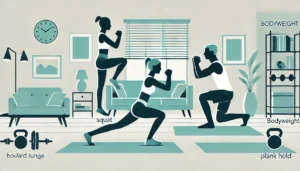
Focus on compound movements that use multiple muscle groups.
- Squats
- Push-ups (or knee push-ups)
- Lunges
- Glute bridges
- Planks
These exercises build strength and increase calorie burn.
Short sessions still work:
How Often Should You Do Home Workouts?
You don’t need to work out every day.
- 2–4 sessions per week
- Focus on full-body routines
- Rest or light activity between sessions
Recovery supports progress.
Learn more about recovery here:
Combine Home Workouts With Daily Movement
Home workouts work best when combined with daily movement.
- Walking more
- Staying active between workouts
- Avoiding long sedentary periods
Walking is a great addition:
What Randomized Trials Show About Training at Home
Home exercise is not a compromise that has been tested only in theory. One of the most useful trials on this question ran for 18 months in 148 sedentary women with overweight or obesity (average BMI 32.8, average age 37) enrolled in a university weight-control programme. They were assigned to long continuous exercise bouts, to multiple short bouts spread through the day, or to short bouts plus a treadmill at home. Overall weight loss was −7.4 kg in the home-equipment group versus −3.7 kg in the short-bout-only group, and the home group kept exercising more than the others between months 13 and 18 (Jakicic et al., JAMA, 1999).
The same study found the clearest pattern of all — a dose response. Women who exercised more than 200 minutes a week lost 13.1 kg on average over 18 months, compared with 8.5 kg for 150–200 minutes and 3.5 kg for less than 150 minutes a week. Home was not the magic ingredient; total weekly minutes were.
- What this supports: training at home can work, and having easy access to your equipment or space helps you keep doing it
- What it does not prove: that home training beats a gym — the trial compared ways of doing the same exercise, not locations in a head-to-head test
- Limits: conducted in 1996–1998, in women only, inside a structured behavioural programme, so the adherence support was better than most people have at home
How Much Weekly Exercise Actually Moves Body Fat
The largest dose-response answer on this question pooled 116 randomised trials with 6,880 adults who had overweight or obesity. Every additional 30 minutes of aerobic exercise per week was associated with body weight lower by 0.52 kg (95% CI −0.61 to −0.44), waist circumference lower by 0.56 cm (−0.67 to −0.45), and body fat percentage lower by 0.37 points (−0.43 to −0.31). Visceral fat area fell by 1.60 cm² per 30 minutes and subcutaneous fat area by 1.37 cm² (Jayedi et al., JAMA Network Open, 2024).
The shape of that relationship matters more than any single number. Body weight, waist circumference, and body fat all fell in a straight line up to 300 minutes per week — in other words, at the doses most people are choosing between, more was still better. The authors put the clinically important threshold at 150 minutes per week of moderate-to-vigorous aerobic exercise, and graded the waist-circumference and visceral-fat findings as high certainty.
Two honest limits. First, these were supervised aerobic programmes; the pooled effect is what a prescribed, counted dose produced, not what an unstructured home session delivers. Second, an extra 0.52 kg per 30 minutes per week is real but small — which is why exercise is the half of the plan that protects muscle and health, while the calorie deficit is what moves weight. If you are choosing between adding a fourth session and tightening the diet, the diet is usually the bigger lever: the calorie deficit does the rest (see the guide to calorie deficits for beginners).
Home-Based Versus Gym-Based Training: What Actually Changes
A 2025 mixed-methods analysis compared 13 older adults with obesity who had to switch from supervised gym-based high-intensity resistance and impact training to unsupervised home-based bodyweight resistance and aerobic training during COVID-19 lockdowns, against 17 who continued in the gym. Everyone stayed on the same dietary weight-loss programme for 12 weeks.
Body mass fell in both groups (gym −4.4 kg, home −6.2 kg), and the home group actually lost more fat mass — a mean difference of −3.1 kg (95% CI −6.0 to −0.3), a large effect size (d = 0.8). But physical function improved only in the gym group. Interviews with eight home participants described both sides of the trade-off: easier access and accountability helped them stay engaged, while limited equipment, less supervision and patchy digital support got in the way (Glavas et al., BMC Geriatrics, 2025).
- Home training held its own for fat loss during a diet
- Supervised gym training did better for function and skill development — the part that is hardest to replace at home
- Limits: only 30 older adults, opportunistic (not a planned randomisation to home), and short at 12 weeks
If you want the function and strength side to keep progressing at home, plan for progression on purpose:
How Many MET-Minutes You Need at Home
Guidelines talk in minutes, physiology talks in METs, and home circuits sit somewhere between. A network meta-analysis of 43 randomised trials with 3,154 participants compared aerobic training, combined training, HIIT, mind-body exercise, calisthenics, and resistance training on body composition. All of the active formats reduced BMI compared with control, and no format was significantly better than another. Ranked by probability, calisthenics — bodyweight training — came out highest for BMI reduction, and resistance training alone lowest (Li et al., Frontiers in Physiology, 2025).
That analysis also produced a dose threshold worth knowing: 310 MET-minutes per week was where the effect on BMI began, and 1,300 MET-minutes per week was where the predicted response levelled off. A bodyweight circuit sits at roughly 5–6 METs, so 310 MET-minutes works out at about 55–60 minutes of circuit work per week to reach the threshold, and about 220–260 minutes per week at the point where returns flatten. That is a wider range than most home programmes assume, and it lines up with the 150-minute threshold from the aerobic trials.
Read the ranking with care: the participants were university students, the outcome was BMI rather than measured fat mass, and a probability ranking is not proof that calisthenics beats everything else. What the data does support is unglamorous — once the weekly dose is sufficient, the format you will actually repeat is the one that works. For the equipment-free starting point, see the beginner home workout guide.
Can Bodyweight Training Keep Muscle While You Lose Fat?
Losing fat without losing muscle is the goal of body recomposition, and resistance work is what protects muscle. A 12-week randomized trial in 36 older men (average age 67, BMI 27.1) tested three options: suspension training, traditional training with elastic bands plus bodyweight, or no exercise. Bodyweight and band training helped prevent the decline in muscle mass and handgrip strength seen in the non-exercise group. Suspension training was the most effective for handgrip strength (effect size 1.50), while in the control group handgrip fell (effect size −0.86) (Campa et al., Nutrients, 2021).
The honest read: a small study in older men over 12 weeks cannot promise that a bodyweight circuit build muscle the way heavy gym loading does. What it does show is that some form of resistance at home — bodyweight, bands, a suspension trainer, or water bottles and a loaded backpack if that is what you have — is enough to defend muscle while you are in a calorie deficit.
Pair resistance work with enough protein to give muscle retention the best chance:
Intervals at Home: Worth It or Hype?
Home interval circuits are popular because they are short. The systematic evidence is more sober. A meta-analysis of 31 studies comparing interval training (including HIIT and sprint intervals) with steady moderate-intensity cardio found no difference between them for total body fat percentage or fat mass. Within-group changes were modest (HIIT/SIT −1.26% body fat, steady cardio −1.48%), and the authors concluded that neither produced clinically meaningful fat loss over the short term — and intervals were not reliably more time-efficient than steady work (Keating et al., Obesity Reviews, 2017).
A 2025 meta-regression of 23 randomized trials found no overall difference between sprint intervals and steady cardio for fat mass (SMD −0.11, 95% CI −0.30 to 0.08) or body fat percentage. It did find that how much sprint work you do matters: more weekly sprint time was linked to greater absolute fat loss, though the pooled difference between formats stayed null (Liang et al., BMC Public Health, 2025).
- Intervals are fine, and useful when time is short
- They are not a shortcut around diet, and they are not better than steady work for fat loss
- At home, intervals are easiest as bodyweight circuits — squat, push-up, lunge, hinge and a brisk march or stair climb
Exercise Snacks: The Smallest Version That Still Counts
If a 40-minute block is the barrier, the evidence for much smaller doses is worth knowing. A scoping review of 32 studies on exercise snacks — brief bouts of activity spread across the day, also called VILPA — found the approach feasible and apparently safe in predominantly inactive but healthy adults and older adults. The epidemiological studies showed steep, near-linear associations between VILPA and lower all-cause, cardiovascular, and cancer mortality. The trial evidence was thinner: modest improvements in cardiorespiratory fitness, with physical function, mood, and quality of life equivocal, and most trials small (Jones et al., Sports Medicine, 2024).
One randomised trial has tested snacks specifically for body composition. Thirty overweight or obese female university students were assigned to 8 weeks of either exercise snacks or HIIT, with both groups doing 75 minutes of bodyweight exercise per week. Body weight, BMI, and body fat percentage improved over time in both groups, VO₂max rose in both, and the snack group reported a consistently lower perceived effort. Diastolic blood pressure fell only in the HIIT group (Jin et al., Frontiers in Public Health, 2026).
The practical translation: snacks are a reasonable way to reach a weekly dose when your day is fragmented, and they are easier to tolerate than structured HIIT. They are not a replacement for resistance work if muscle retention is the goal — 75 minutes of bodyweight work did not change body composition differently from 75 minutes of intervals.
Why Both Strength and Movement Matter (Not Just Workouts)
The strongest evidence for combining resistance training with aerobic activity comes from a cohort of 500,705 US adults followed for a median of 10 years. Compared with people doing no moderate or vigorous aerobic activity and fewer than the recommended muscle-strengthening sessions, the combination linked to the lowest all-cause mortality risk was more than 0 to 75 minutes of moderate aerobic activity, more than 150 minutes of vigorous activity, and two or more muscle-strengthening sessions per week (hazard ratio 0.50, 95% CI 0.42–0.59) — roughly half the mortality rate (López-Bueno et al., JAMA Internal Medicine, 2023).
This is observational data, so it shows an association, not proof that one combination causes longer life. But the pattern is consistent with WHO guidance that all activity counts and that muscle strengthening benefits everyone — and WHO notes that around 31% of adults worldwide do not meet the recommendation of at least 150 minutes of moderate activity a week. A home programme that mixes strength work with walking is a practical way to cover both.
Strength Plus Cardio: What Happens When You Do Both at Home
Most home programmes end up as a mix — some resistance work, some walking or intervals — so the relevant question is what combining them does. A systematic review and meta-analysis pooled 53 randomised trials with 2,873 middle-aged and older adults and compared concurrent training against aerobic training alone and against resistance training alone. Concurrent training was as effective as aerobic training for lowering body fat percentage, fat mass, waist circumference, and visceral fat, and as effective as resistance training for increasing muscle mass. It also increased lean body mass and body weight more than aerobic training alone (Khalafi et al., Healthcare, 2025).
There is no interference penalty worth planning around at this level of training. The practical implication for a home programme is simple: you do not have to choose one mode, and you should not drop resistance work because you added walking. Two resistance sessions plus daily walking covers both signals. The mortality data points the same way — the lowest risk in a 500,705-adult cohort appeared in people who did both aerobic activity and two or more muscle-strengthening sessions per week.
If you want the strength side planned properly rather than improvised, the sequence and progression matter more than the equipment.
How to Progress a Home Workout (Four-Week Example)
Progressive overload is what stops a home routine going stale. You do not need heavier weights to achieve it — you need to make the same movements harder over time.
- Week 1: 2 sessions. Squat, incline or knee push-up, lunge, glute bridge, plank. 2 sets of 8–12 reps, stopping 2 reps short of failure
- Week 2: 3 sessions. Add a set to the two hardest exercises. Keep the same rest (about 60–90 seconds)
- Week 3: 3 sessions. Slow the lowering phase to 3 seconds, or step the push-up down from an incline to the floor
- Week 4: 3–4 sessions. Add a harder variation where you are strongest (feet-elevated push-up, split squat, single-leg glute bridge) and a short circuit finisher
Three levers do all the work: more reps, slower tempo, harder variation. Write the numbers down each session so you can beat them next time.
If you are starting from zero, this is the place to begin:
And when you are ready to plan the whole week around fat loss:
Common Home Workout Mistakes
- Trying to do too much too soon
- Skipping warm-ups
- Expecting fast results
- Ignoring nutrition
Home workouts support fat loss best when paired with good eating habits.
Nutrition fundamentals:
Troubleshooting: When Home Training Stalls
- The scale has not moved for three weeks. Check the diet and daily movement before adding more sessions — the calorie deficit moves body weight, not the workout. See Calorie Deficit Explained for Beginners and Why You Are Not Losing Fat
- The sessions feel easy. That is the signal to progress, not to add a fourth session. Add reps, slow the tempo, or use a harder variation
- Joints hurt. Regress the movement (incline push-up, box squat, shorter range) rather than pushing through. Pain that persists after rest, or that interferes with daily life, is a reason to see a clinician
- Motivation has gone. Attach the session to a fixed daily cue and make the minimum version very short, so missing a day is harder than doing it. See Habit Stacking for Fat Loss
- Strength feels flat and sleep is poor. Recovery and sleep are part of the programme, not an optional extra. See Sleep for Fat Loss
Where Home Training Has Not Been Proven Yet
It is worth being precise about the limits, because home-training content tends to overstate them. A six-month randomised trial during the Italian COVID-19 lockdown assigned older adults to a prescribed home resistance programme or to a control group, with body composition measured by DXA and MRI. Nine participants completed the study — five in the exercise group, four controls. The exercise group improved chair-stand performance by 19.8% and finished with greater thigh cross-sectional area, but total fat mass rose 5.0% within that group, and no body-composition difference between groups reached significance (Vitale et al., IJERPH, 2020).
What that trial does not show is that home resistance training fails. With nine completers it cannot detect a real effect either way, and lockdown conditions changed diet and daily movement for everyone. What it does show is the pattern visible across the home-training literature: strength and function respond reliably, while fat mass responds mainly to the energy balance around the programme. Expect the workouts to build the capacity and the deficit to move the scale.
A home-based resistance programme in older adults with sarcopenia shows the same split. In a systematic review of 12 randomised trials with 928 participants, home programmes lasting about 12 weeks improved muscle strength, balance, and quality of life, while findings on muscle mass and body composition were inconsistent across studies (Sharma et al., BMC Geriatrics, 2026).
Frequently Asked Questions
Can I really lose fat with only bodyweight exercises?
Yes, if the calorie deficit is there. Bodyweight work helps you keep muscle while you lose fat, and it adds to your weekly activity. In the 18-month trial in overweight women, the group with home exercise equipment lost about twice as much weight as the group doing short bouts alone — but the biggest predictor was total weekly minutes, not the setting.
Is a home workout as good as going to the gym?
For fat loss specifically, home-based training has held up in a 12-week comparison with supervised gym training. For physical function and skill progress, the supervised gym group did better. The realistic answer is that home training is good enough for fat loss and health, and you should consider some supervised or progressive resistance work if strength and function are your priority.
How many days a week should I train at home?
Two to four full-body sessions a week is a sensible starting range, with the rest of your week filled by walking and general activity. The 18-month trial found progressively better weight loss at 150–200 minutes and above 200 minutes of exercise a week, so aim to build weekly minutes rather than adding intensity all at once.
Do I need equipment?
No. Squats, push-ups, lunges, glute bridges, planks and their harder variations cover the main movement patterns. If you want to add resistance cheaply, elastic bands or a suspension trainer are the options with the most research behind them — a 12-week trial in older men found bands plus bodyweight helped prevent loss of muscle mass and grip strength.
Are short home workouts enough?
Short sessions are much better than none and they help you build the habit. But the weight-loss data point to total weekly volume: more than 200 minutes a week clearly outperformed less than 150 minutes in the long trial. Use short sessions on busy days and longer ones when you can, and let the weekly total be your scoreboard.
Keep Reading
- Cardio for fat loss: how much is enough?
- Cardio during body recomposition
- Training split for body recomposition
- Body recomposition explained
- How to build a realistic fat loss routine
- Fat loss mistakes beginners should avoid
- When to stop cutting: 7 signs it's time for a break
- Advanced fat loss strategies when progress slows
Sources
- WHO. Physical activity — fact sheet (at least 150 minutes of moderate-intensity activity a week for adults; all activity counts; muscle-strengthening benefits everyone; around 31% of adults do not meet the recommendation).
- NHS. Exercise (guidance and how-to videos for strength, resistance and flexibility work you can do at home).
- Jakicic JM et al. Effects of intermittent exercise and use of home exercise equipment on adherence, weight loss, and fitness in overweight women: a randomized trial. JAMA, 1999. (n = 148, 18 months: −7.4 kg with home equipment versus −3.7 kg with short bouts alone; 13.1 kg at >200 min/week versus 3.5 kg at <150 min/week.)
- Glavas C et al. Experiences and outcomes of older adults with obesity transitioning from gym- to home-based resistance training due to COVID-19 lockdowns: a mixed-methods analysis of a RCT. BMC Geriatrics, 2025. (n = 30 older adults, 12 weeks: home lost 3.1 kg more fat mass, 95% CI −6.0 to −0.3; physical function improved only in the gym group.)
- Campa F et al. Effects of a 12-week suspension versus traditional resistance training program on body composition, bioimpedance vector patterns, and handgrip strength in older men: a randomized controlled trial. Nutrients, 2021. (n = 36 older men; bodyweight and band training prevented declines in muscle mass and grip strength; suspension training most effective for grip, ES 1.50.)
- Keating SE et al. A systematic review and meta-analysis of interval training versus moderate-intensity continuous training on body adiposity. Obesity Reviews, 2017. (31 studies; no difference between interval and steady training; neither produced clinically meaningful fat loss short term.)
- Liang W et al. Moderators of body composition change in response to sprint interval training versus moderate-intensity continuous training: a systematic review and meta-regression analysis. BMC Public Health, 2025. (23 RCTs; pooled difference null, SMD −0.11, 95% CI −0.30 to 0.08; weekly sprint volume mattered.)
- López-Bueno R et al. Prospective associations of different combinations of aerobic and muscle-strengthening activity with all-cause, cardiovascular, and cancer mortality. JAMA Internal Medicine, 2023. (500,705 adults, median 10 years; lowest all-cause mortality for 0–75 min moderate + >150 min vigorous aerobic + 2 or more strengthening sessions weekly, HR 0.50, 95% CI 0.42–0.59.)
- Jayedi A, Soltani S, Emadi A, Zargar MS, Najafi A. Aerobic exercise and weight loss in adults: a systematic review and dose-response meta-analysis. JAMA Network Open, 2024 (116 RCTs, 6,880 adults; each +30 min/week: −0.52 kg weight, −0.56 cm waist, −0.37 body-fat points, −1.60 cm² visceral fat; linear to 300 min/week, clinically important threshold 150 min/week).
- Jones MD, Clifford BK, Stamatakis E, Gibbs MT. Exercise snacks and other forms of intermittent physical activity for improving health in adults and older adults: a scoping review. Sports Medicine, 2024 (32 studies; feasible and apparently safe; near-linear mortality associations; trial effects on fitness modest, other outcomes equivocal).
- Jin N, Zheng X, Zhao Z, Zhao F, Shang Z, Zhou K. Effects of 75 min of weekly exercise snacks on body composition, cardiometabolic health, cardiorespiratory fitness, and lower-body explosive power in overweight and obese female university students. Frontiers in Public Health, 2026 (n = 30, 8 weeks; body weight, BMI, body fat percentage and VO₂max improved in both groups; diastolic blood pressure improved only with HIIT; lower perceived effort with snacks).
- Li J, Zang L, Hao S, Wang H. Comparative efficacy of different exercise types on body composition in university students: a systematic review and meta-analysis of randomized controlled trials. Frontiers in Physiology, 2025 (43 RCTs, 3,154 participants; all active types reduced BMI, no significant difference between types; calisthenics ranked highest for BMI reduction, resistance training alone lowest; dose threshold 310 MET-min/week, plateau at 1,300 MET-min/week).
- Khalafi M, Kheradmand S, Habibi Maleki A, Symonds ME, Rosenkranz SK, Batrakoulis A. The effects of concurrent training versus aerobic or resistance training alone on body composition in middle-aged and older adults: a systematic review and meta-analysis. Healthcare, 2025 (53 studies, 2,873 participants; concurrent training as effective as aerobic training for fat measures and as effective as resistance training for muscle mass).
- Vitale JA, Bonato M, Borghi S, et al. Home-based resistance training for older subjects during the COVID-19 outbreak in Italy: preliminary results of a six-months RCT. International Journal of Environmental Research and Public Health, 2020 (9 completers; chair-stand +19.8% in the exercise group; total fat mass +5.0% within that group; no significant between-group body-composition difference).
- Sharma I, Mishra A, Singal U, et al. Effectiveness of home-based exercise interventions in the management of sarcopenia in older adults: a systematic review of randomized controlled trials. BMC Geriatrics, 2026 (12 RCTs, 928 participants; strength, balance and quality of life improved; body-composition findings inconsistent).
This article is general information for healthy adults, not medical advice. If you have a heart, lung, joint or metabolic condition, are pregnant, or have been inactive for a long time, speak to a qualified clinician before starting a new training programme. Stop and seek medical help if you develop chest pain, severe breathlessness, dizziness or pain that does not settle with rest.