How to Build a Realistic Fat Loss Routine

Building a fat loss routine does not need to be complicated. What matters most is whether you can still follow it in week six, on a busy Tuesday, when motivation is average. A realistic routine blends simple nutrition habits, manageable activity, and enough sleep — and it is designed around the life you actually have.
On this page16 sections
Key Takeaways
- Design the routine for your worst week, not your best one.
- Three things need a plan: what you eat, how you move, and how you sleep.
- Adults should aim for at least 150 minutes of moderate activity a week and strength work on 2 days a week.
- Most adults need 7 to 9 hours of sleep; short sleep makes appetite and cravings harder to manage.
- Track a few habits, not your mood. Consistency is measured in weeks, not days.
1. Start with simple nutrition rules you can actually keep
Rules work when they are countable on one hand and do not require an app. A good starting set:
- Protein with every meal — eggs, yogurt, chicken, fish, beans, lentils, tofu
- Vegetables or salad twice a day, not once
- Water as your default drink; sugary drinks become occasional
- One planned snack in the house, portioned on a plate
- Sweets and takeaways planned into the week rather than cut out entirely
That structure is essentially the balanced plate: half vegetables, a quarter lean protein, a quarter whole-grain or starchy carbs. The NHS suggests a sensible target of around 0.5–1 kg (1–2 lb) of weight loss a week, which is what a moderate deficit produces.
2. Choose a workout routine you can maintain
You do not need long workouts. For most beginners, three short sessions a week with a bodyweight circuit is enough to start, with walking on the other days. The activity guidelines for adults are 150 minutes of moderate activity (or 75 minutes vigorous) spread over 4 to 5 days, plus muscle-strengthening work on at least 2 days a week.
Two practical formats:
- Minimum week: 3 × 15-minute home circuit + 3 × 20-minute walks.
- Standard week: 3 × 25-minute circuit + daily 8,000–10,000 steps where possible.
Pick the minimum week first. You can always add sessions; you cannot easily un-quit.
3. Add daily movement instead of more workouts
Small movement between workouts is free and easy to keep: take the stairs, park further away, walk during phone calls, stand up every hour. If you like numbers, a step target between 8,000 and 10,000 is a reasonable personal goal for most people — but a step target you never hit is worse than a smaller one you do.
4. Protect your sleep
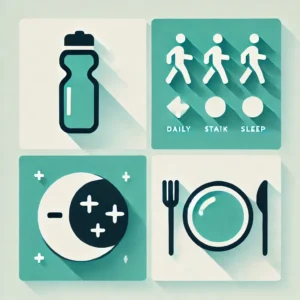
Sleep is the part of a fat loss routine people skip. On average, adults need 7 to 9 hours a night, and short sleep is linked with feeling hungrier and finding it harder to stick to a plan. Keep it simple: a fixed bedtime window, screens down before bed, and no caffeine after early afternoon.
5. Build your week around anchors, not willpower
Anchors are fixed points that the rest of the week organises itself around:
- Sunday: plan dinners for the week and shop for them.
- Weekdays: same breakfast, planned lunch, home-cooked dinner.
- Training days: fixed days and times, treated like appointments.
- Friday or Saturday: one flexible meal, planned in advance.
When the anchors hold, the details take care of themselves.
6. Track habits, not just the scale
Body weight moves up and down daily with water, salt, and food in the gut, so weigh yourself under the same conditions a few times a week and read the weekly trend instead of a single number. Track a few habits alongside it — sessions completed, water instead of soft drinks, vegetables at dinner. Those are things you control, and they keep the routine running on weeks when the scale stalls.
7. Plan for the days that go wrong
- Missed a workout? Do the next one. Do not double up.
- Overate? Return to your normal meals at the next meal — skipping meals to compensate usually backfires.
- Away for work? Keep breakfast and protein habits, and walk.
- Progress stalled for 3–4 weeks? Check your portions and daily movement before cutting food further.
Start small and stay consistent
A realistic fat loss routine is not about perfection. It is about building habits that survive a busy month. Begin with the minimum week, keep the nutrition rules to five, protect your sleep, and adjust only when the current plan has become easy. Then repeat until the routine stops feeling like a plan and starts feeling like your normal week.
What the research says about keeping a routine going
The part of fat loss that fails is rarely the first two weeks. It is month four, when the plan stops being interesting. A 2026 meta-analysis in Obesity Reviews pooled 65 randomised trials (about 10,000 adults with overweight or obesity, follow-up of at least six months) and found that behavioural programmes produced an average additional weight loss of roughly 3.25 kg compared with controls. The same analysis found something less convenient: during the maintenance phase, after the initial loss, the difference between programme and control was no longer statistically significant.
That single finding explains why so many routines collapse. Structure helps you lose the first few kilos. What keeps them off is not more structure, it is a routine small enough to survive a bad month.
The techniques that were associated with better long-term outcomes in that review are unglamorous, and none of them require an app subscription:
- goal setting (a specific target, not "eat better")
- feedback on your behaviour and on the result of that behaviour
- self-monitoring of both the behaviour and the outcome
- instructions and demonstration of exactly how to do the thing
- conserving mental resources, which is the research term for "do not make 30 decisions a day"
- incentives
Notice what is missing from that list: willpower, motivation, and the perfect meal plan. If your current routine depends on feeling enthusiastic every morning, it is not a routine yet.
How much weekly activity actually moves the scale
Most people overestimate what exercise does to body weight, then quit when the scale does not cooperate. A 2024 dose-response meta-analysis in JAMA Network Open (116 randomised trials, 6,880 adults with overweight or obesity, supervised aerobic training, at least eight weeks) gives the numbers per 30 minutes of weekly aerobic exercise:
- body weight: -0.52 kg (95% CI -0.61 to -0.44)
- waist circumference: -0.56 cm (95% CI -0.67 to -0.45)
- body fat percentage: -0.37 percentage points (95% CI -0.43 to -0.31)
- visceral fat area: -1.60 cm²; subcutaneous fat area: -1.37 cm²
Read that per-30-minute figure carefully, because it cuts both ways. Doubling from 150 to 300 minutes per week does add to the effect, but the curve flattens. Around 150 minutes per week of moderate-to-vigorous activity is where the changes become clinically meaningful, which matches the weekly target in the NHS physical activity guidelines. Someone training 150 minutes a week should expect the scale to move about 2.5 kg in the direction they want over a programme, assuming the food side is handled. That is a real result and it is not a dramatic one, which is exactly why the routine has to be repeatable rather than heroic.
The certainty of this evidence was rated moderate to high for weight, waist and visceral fat, so this is about as solid as nutrition-adjacent research gets.
Why "it takes 21 days to form a habit" is the wrong target
A 2024 systematic review in Healthcare pooled 20 studies (2,601 participants) that measured habit strength or automaticity for health behaviours including physical activity, healthy eating and water intake. Where time to automaticity was reported, the medians were 59 to 66 days, the means were 106 to 154 days, and individual values spanned 4 to 335 days. Eleven of the 20 studies were rated high risk of bias, so treat these as the best available estimate rather than a law of nature.
Two practical consequences follow. First, any plan built on a 21-day challenge is measuring the wrong thing. Second, because the spread is enormous, the useful question is not "how long until this is automatic" but "is this version small enough that I will still do it on day 40 when I am tired". A routine that is 60% as effective and survives is worth more than one that is perfect and abandoned in week three.
The three ingredients that predict who stays consistent
A review of self-regulation mediators in adult obesity interventions (35 studies, 42 candidate mediators) found that the factors linked to medium- and long-term weight control were: autonomous motivation (doing it for reasons you actually endorse), self-efficacy and confidence in handling barriers, self-regulation skills such as self-monitoring, flexible eating restraint rather than all-or-nothing rules, and a more positive body image.
Translated into a weekly routine, that means three design rules:
- Pick a reason you would defend to a friend - health, energy, blood pressure, how clothes fit - rather than a number on a scale you are angry at.
- Track one thing well. One weekly weigh-in average, one habit ticked off, one walk logged. Not four apps.
- Build in flexibility on purpose. A routine with two planned flexible meals per week is easier to keep than one that treats a restaurant dinner as failure. More on this in consistency over perfection.
Measuring progress without letting the scale run your week
A 2024 single-arm study in Obesity Science & Practice tested a deliberately low-effort version: 39 adults with obesity who were not enrolled in a structured programme were given a self-weighing routine with text support. Participants weighed themselves on average 4.6 days per week. At 12 months, 30.8% had lost at least 3% of body weight, 28.2% were stable within 3%, 15.4% had gained at least 3%, and 25.6% had no follow-up weight data. Satisfaction was high (4.1 out of 5).
Be careful with that result: there was no control group, and a quarter of the sample had no weight data at all, so it shows that a light-touch routine is acceptable and can work, not that weighing causes weight loss. The useful part is the format: frequent weighing, interpreted as a trend.
- Weigh at the same time of day, ideally after waking and using the bathroom, three to five days a week.
- Judge the weekly average, never a single morning. Daily weight swings of 1 kg from salt, carbohydrate and hydration are normal.
- If the four-week average has not moved and your waist has not moved, adjust portions or daily steps before adding more exercise. See what a real plateau looks like.
A weekly template: minimum week versus standard week
The template below is the part you can copy. The "minimum week" is what you do in a week where work explodes or a child is ill. It is not a failure state; it is the floor that keeps the habit alive.
- Monday - standard: 25-minute home strength session, protein at breakfast, 8,000+ steps. Minimum: 10-minute bodyweight circuit, protein at breakfast.
- Tuesday - standard: 30-minute brisk walk, normal meals. Minimum: 15-minute walk after dinner.
- Wednesday - standard: 25-minute strength session, plan Thursday's dinner. Minimum: 10-minute circuit.
- Thursday - standard: 30-40 minute walk or easy cardio, 2 portions of vegetables at dinner. Minimum: one vegetable portion, walk to the shop.
- Friday - standard: 25-minute strength session. Minimum: bodyweight squats and push-ups while the kettle boils.
- Saturday - standard: longer walk or bike ride with the family, flexible meal. Minimum: family walk, no tracking.
- Sunday - standard: 20-minute reset - weigh-in average, shop for the week, prep two protein sources. Minimum: weigh-in and one prep task.
That is three strength sessions and roughly 150 minutes of movement in a standard week, and it still keeps two contacts per week in the minimum week. The full reasoning behind spacing training this way is in how to build a fat loss routine and rest and recovery.
If you already train more than this, do not cut back - just make sure the extra sessions are the ones you would keep if you had to choose. Training for fat loss covers how to add volume without breaking the routine.
Frequently asked questions
How long before this routine feels automatic?
Median estimates sit at 59 to 66 days, with averages over 100 days and a range from 4 days to nearly a year. Plan for two to three months of deliberate effort, not three weeks. Keeping the same time slot and the same trigger (after breakfast, after work, before showering) is what the habit research associates with faster automaticity.
Is three workouts a week enough?
For a beginner, yes - three strength sessions plus daily walking is a realistic week that covers the NHS activity target and leaves room to recover. More is not automatically better; adherence is the limiting factor, not the number of sessions on paper.
Should I weigh myself every day?
Weighing most days is fine if you only act on the weekly average. If daily fluctuations make you anxious or trigger restriction, weigh once or twice a week under the same conditions and use waist measurement plus how clothes fit as secondary signals. The routine has to serve you, not the other way round.
What do I do when a whole week falls apart?
Run the minimum week, not a punishment week. Do not cut calories to compensate, do not add double sessions. Just re-establish the floor - one circuit, one walk - and let the normal week resume. The restart protocol is in restarting after falling off track.
What is the one habit I should keep if I can only keep one?
Protein at breakfast and a daily walk. Those two carry most of the practical benefit: they protect satiety and keep daily movement from collapsing, which is the variable that quietly disappears when work gets busy. Our guide to habit stacking shows how to attach them to things you already do.
How fast should the scale move on this routine?
Roughly 0.5 to 1 kg per week is the pace the NHS describes as reasonable, which works out to about 2 to 4 kg per month. Losing faster usually means the deficit is too large to hold, and in a larger deficit you also risk losing more lean mass. Healthy fat loss per week has the full breakdown, and how long fat loss takes covers realistic timelines for different starting points.
A routine that works is not the strictest one you can survive for a fortnight. It is the one whose minimum version you will still be doing in March. Start with the minimum week, run it for two weeks, then add the standard week on top - not the other way around.
Sources
- Preuhs K, et al. Effective behavior change techniques for successful weight loss and weight loss maintenance among adults with overweight and obesity: a systematic review and meta-analysis. Obesity Reviews, 2026. PMC13460769 - 65 trials, ~10,000 participants; behavioural programmes produced ~3.25 kg additional loss, no significant maintenance-phase difference; lists the effective techniques.
- Jayedi A, et al. Aerobic exercise and weight loss in adults: a systematic review and dose-response meta-analysis. JAMA Network Open, 2024. PMC11672165 - 116 trials, 6,880 participants; per 30 min/week: -0.52 kg weight, -0.56 cm waist, -0.37 percentage points body fat.
- Singh B, et al. Time to form a habit: a systematic review and meta-analysis of health behaviour habit formation and its determinants. Healthcare (Basel), 2024. PMC11641623 - 20 studies, 2,601 participants; median 59-66 days, mean 106-154 days, range 4-335 days; 11 of 20 studies high risk of bias.
- McVay MA, et al. A low-burden, self-weighing intervention to prevent weight gain in adults with obesity who do not enroll in comprehensive treatment. Obesity Science & Practice, 2024. PMC10951869 - single-arm, n=39; weighing 4.6 days/week; 30.8% lost at least 3% at 12 months; 25.6% without weight data.
- Teixeira PJ, et al. Successful behavior change in obesity interventions in adults: a systematic review of self-regulation mediators. BMC Medicine, 2015. PMC4408562 - 35 studies, 42 mediators; autonomous motivation, self-efficacy, self-monitoring and flexible restraint predicted better weight control.
- NHS - Physical activity guidelines for adults aged 19 to 64
- NHS - Tips to help you lose weight (0.5-1 kg per week pace)
- NHS - Insomnia: how much sleep you need
- WHO - Physical activity fact sheet
This article is general information for healthy adults, not medical advice. If you have a heart condition, uncontrolled blood pressure, diabetes, are pregnant, or take medication that affects weight or appetite, speak to a clinician before changing your diet or training load.
Next steps on this site:
- Complete beginner's guide to fat loss
- Habit stacking: attach the new routine to what you already do
- Why sleep belongs in the routine
- Keeping the routine alive at the weekend
- Smart eating habits that make the food side easier
- How a calorie deficit actually works
- The 10-minute home workout for beginners
- Walking as the base of daily movement